

When to Replace Water Pumps and Thermostats on European Cars
There’s no universal 80,000-mile replacement schedule for water pumps or thermostat housings on Audi and VW EA888 engines. For das motor haus cooling, water pumps and thermostats, the deciding factors are the part’s condition, signs of a cooling-system fault, and the vehicle’s specific requirements.
It’s reasonable to want a clear mileage rule: cooling-system failures can interrupt a drive and put an engine at risk of overheating. But replacing parts based on mileage alone can mean changing components that still work, while overlooking leaks or temperature problems can allow damage to develop. The key distinction is between preventive replacement and replacement prompted by evidence of a fault.
This article explains how the water pump and thermostat work together, which warning signs matter, and why one mileage target doesn’t suit every European car. It also covers how to assess replacement timing and choose the right parts, so you can make an informed decision focused on dependable cooling and engine protection.
Key Takeaways
- There’s no universal 80,000-mile replacement schedule for Audi and Volkswagen EA888 water pumps or thermostat housings; condition and signs of a fault matter.
- Learn which cooling-system changes can point to a leak or circulation problem, and why they deserve attention before overheating develops.
- Understand how overheating can threaten engine components and why responding to temperature warnings promptly matters.
- Compare preventive replacement with replacing a part after a fault appears, and see why part quality can affect the long-term value of the repair.
- Explore how the water pump and thermostat work together to regulate engine temperature and support consistent cooling.
How often should the water pump and thermostat be replaced on a European car?
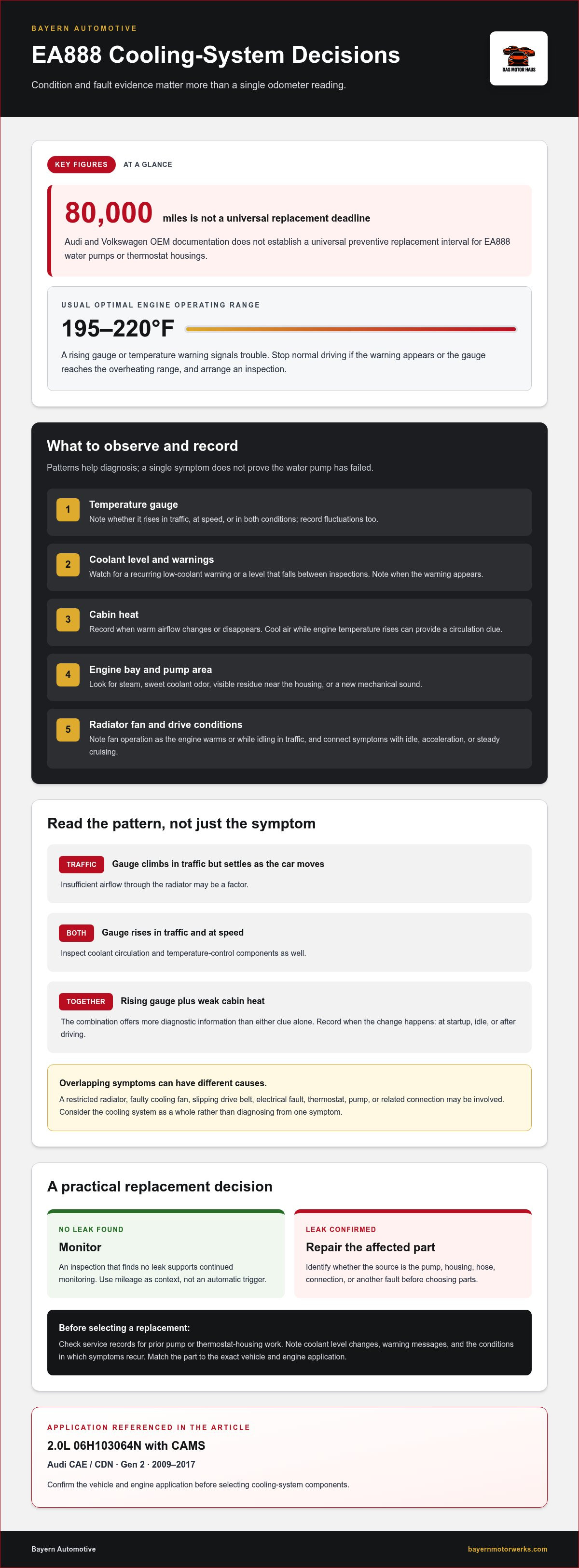
Audi and Volkswagen OEM documentation does not establish a universal 80,000-mile preventive replacement interval for EA888 water pumps or thermostat housings. Treat mileage as context, not an automatic replacement trigger. A pump with no leak and stable cooling presents a different decision from one showing coolant loss. The vehicle’s engine version, service history, and current symptoms matter more than one odometer reading.
EA888 owners should pay particular attention to the water pump and thermostat housing as potential coolant leak areas. A leak may leave visible residue near the housing, a recurring low-coolant warning, or a coolant level that falls between inspections. One sign alone doesn’t prove the pump has failed. Coolant can escape from other connections, so identify the source before selecting replacement parts.
Start with the car’s service records to see what has already been replaced. An invoice that names the water pump or thermostat housing is useful; a general cooling-system entry may not identify the component. If the records are incomplete, note the coolant level and any warning messages, including when they appear. For instance, a warning after a drive offers different clues from one that appears soon after a refill.
Replacement becomes more compelling when inspection identifies a leak at the pump or housing, or cooling performance changes alongside coolant loss. A technician can examine the suspected area and distinguish a housing leak from a hose, connection, or another fault. This avoids treating every EA888 coolant warning as proof of pump failure. Match replacement parts to the exact vehicle and engine application.
- Use mileage as background, not a fixed EA888 replacement deadline.
- Record coolant warnings, level changes, and prior pump or housing work.
- Identify the leak source before selecting a replacement component.
Preventive replacement depends on evidence and risk, not a universal mileage rule. An inspection that finds no leak supports continued monitoring; confirmed leakage supports repairing the affected part. Consider how the car is used and whether symptoms recur under particular driving conditions. These observations help assess the system, while the leak location and vehicle application guide the repair.
When should you care about your cooling system?
A rising temperature gauge, steam from the engine bay, or a sudden change in cabin heat deserves attention. These signs can have different causes, so note what happens before concluding that the water pump has failed. Weak cabin heat during a drive, a climbing temperature gauge, and an unusual sound near the pump each provide different diagnostic clues.
Observe the temperature gauge during ordinary driving and in slow traffic. If it climbs in traffic but settles as the car moves, insufficient airflow through the radiator may be a factor. If it rises in both conditions, inspect coolant circulation and temperature-control components as well. A gauge that fluctuates instead of settling can also help with diagnosis.
Changes in cabin heat can offer clues about coolant circulation. If the heater suddenly blows cool air while engine temperature rises, coolant may not be flowing through the heater core as expected. A thermostat that doesn’t open correctly can also disrupt flow through the radiator. Record whether the change happens at startup, at idle, or after driving.
- Temperature gauge: Note whether the reading rises in traffic, at speed, or in both conditions.
- Cabin heater: Record when warm airflow changes or disappears.
- Radiator fan: Observe whether the fan operates as the engine warms or while the car sits in traffic.
- Engine bay: Note steam, a sweet coolant odor, or a new mechanical sound.
- Drive conditions: Connect each symptom with idle, acceleration, or steady cruising.
Several faults can cause overlapping symptoms. A restricted radiator can reduce heat transfer, while a faulty cooling fan can limit airflow at low speed. A slipping drive belt may affect a belt-driven pump, and an electrical fault can interfere with fan operation. Consider the thermostat, pump, radiator, fan, and related connections as a system rather than diagnosing from a single symptom.
Take symptoms seriously when they recur or appear alongside another change. A rising gauge combined with weak cabin heat, for example, provides more diagnostic information than either clue alone. A new fan noise or steam adds context. If the temperature warning appears or the gauge reaches the overheating range, stop normal driving and arrange an inspection rather than testing the car under load.
Before choosing parts, write down the vehicle’s make, model, engine, and the exact conditions behind each symptom. That record helps narrow the diagnosis and part application. If a confirmed cooling-system fault points to replacement, review water pumps and thermostats alongside the specific findings, rather than treating every temperature change as the same failure.
Engine overheating and potential damage
An overheating engine can suffer damage beyond the cooling system itself. The usual optimal operating range is around 195-220°F, but a rising gauge or temperature warning signals trouble. For example, a pump that no longer circulates coolant effectively can leave heat concentrated in the engine. Continued driving under that condition can compound the original fault.
Excess heat can affect the cylinder head and head gasket. As temperatures rise, metal components expand, which can alter the engine’s carefully controlled clearances. A compromised head gasket may allow coolant and engine oil to mix or combustion gases to enter the cooling system. These symptoms need diagnosis: a coolant leak or warning alone doesn’t establish internal engine damage.
Engine oil also plays a demanding role at high temperatures. It lubricates moving components and carries heat away from working surfaces. If overheating degrades lubrication, friction can increase at components such as bearings and pistons. Continuing to drive after a temperature warning risks turning a cooling-system fault into a more extensive engine repair.
First, reduce the risk of further heat exposure. If a temperature warning appears while driving, find a safe place to stop and arrange an inspection instead of continuing the trip. A warning that disappears after a pause doesn’t prove the fault has cleared. A pump, thermostat, radiator, fan, or coolant leak can all cause an intermittent problem.
- Rising gauge: Record whether the temperature climbs during traffic, steady driving, or both.
- Coolant loss: Note repeated low-level warnings or visible residue, then report them during diagnosis.
- Cabin heat change: Describe sudden cold airflow alongside a rising engine temperature.
- Unusual engine behavior: Report rough running, persistent steam, or new noises after a temperature warning.
These observations help distinguish an active cooling fault from damage that may have followed overheating. A technician can assess the cooling circuit, inspect for leaks, and evaluate engine condition if symptoms warrant further testing. Coolant loss with stable engine operation, for example, calls for a different assessment from coolant loss combined with rough running or persistent exhaust steam.
After overheating, the repair should address the cause, not just the temperature warning. Replacing a thermostat won’t fix a leaking pump, and replacing a pump won’t clear a blocked radiator. Accurate diagnosis identifies the failed component and checks whether the engine has related damage. This helps prevent the repair from overlooking problems that developed before the vehicle stopped.
Preventive replacement and parts selection
Preventive replacement is a judgment about evidence, access, and the consequences of repeat work. A fixed interval alone cannot show whether an individual pump or thermostat is worn. For an Audi or Volkswagen EA888, a documented leak or recurring coolant loss gives a clearer reason to replace than mileage by itself. Inspection helps distinguish an actual fault from routine concern.
Part selection begins with the exact vehicle application. Record the make, model, model year, and engine code, then match the replacement to those details. Two cars from the same manufacturer may use different cooling-system parts. Even an engine family name such as EA888 doesn’t, by itself, establish the correct component. Compare the part’s stated application with the vehicle information and diagnosed fault.
Next, identify what the repair requires. The water pump and thermostat perform different functions, so diagnosis should pinpoint the failed component. Some vehicle designs combine cooling components; others use separate parts, which affects the repair. Don’t choose a thermostat just because the pump is leaking, or a pump just because the gauge has changed. A sound DAS MOTOR HAUS cooling, water pump, and thermostat parts decision starts with the fault and vehicle fitment.
Part quality matters because replacement involves more than the component itself. A budget aftermarket cooling part may fail after 20,000 miles, requiring the labor to be paid for again. That figure isn’t a prediction for every low-cost part. Compare application and construction details, then weigh the risk of repeating the repair against the initial saving. This is central to choosing DAS MOTOR HAUS cooling parts, water pumps, and thermostats with the vehicle’s needs in view.
- Confirm application: Match the part to the vehicle and engine code.
- Use the diagnosis: Select the failed pump, thermostat, or required assembly.
- Review repair scope: Include related seals or connections only when the repair specification calls for them.
- Keep records: Save the part description and repair details for future service history.
Preventive replacement can make sense when an inspection reveals deterioration or a confirmed repair requires access to related components. Base the decision on the car’s condition and repair scope, not a blanket instruction to replace everything. A verified pump leak supports replacing the pump; it doesn’t automatically show that a functioning thermostat has failed.
Before ordering, compare the diagnosis, engine code, and part application together. When these details align, the component choice is grounded in the actual repair. Careful matching reduces the risk of selecting an incompatible part or repeating work because the original fault was misidentified.
Water pump and thermostat functions
The water pump and thermostat manage different parts of the same cooling process. Understanding their roles helps explain why either fault can affect engine temperature.
Water Pump Function
The water pump circulates coolant through the engine and cooling system, carrying heat away from engine components. This flow brings heated coolant to the radiator, where heat can dissipate. If circulation weakens, the radiator can’t effectively cool coolant that doesn’t reach it. A pump fault can therefore appear as rising engine temperature or coolant loss.
In a typical liquid-cooled system, coolant passes through engine passages before returning toward the radiator. The pump maintains this flow while the engine runs. A leak at the pump can lower coolant volume, while an internal circulation problem can limit heat transfer without leaving an obvious puddle. That’s why a sound or temperature change needs context, rather than a diagnosis based on one clue.
Thermostat Function
The thermostat regulates coolant flow to the radiator in response to engine temperature. During warm-up, it restricts flow to the radiator; as the engine heats up, it opens to let more coolant through. This helps the engine reach and maintain its designed operating range. If the thermostat sticks closed, heat may remain trapped in the engine; if it stays open, warm-up and temperature regulation can be affected.
The thermostat’s response affects how quickly the engine reaches normal operating temperature. A stuck-open thermostat may cause slow warm-up, while a stuck-closed thermostat can contribute to overheating. Neither pattern alone proves the thermostat has failed, since coolant circulation, radiator condition, and other components also affect temperature. Diagnosis compares observed behavior with how the cooling system should operate.
The pump and thermostat must work together. The pump moves coolant, and the thermostat controls its route through the radiator. If the pump moves coolant but the thermostat restricts radiator flow, heat rejection can fall. If the thermostat opens but pump circulation is inadequate, coolant may still fail to move effectively through the system. A technician considers both functions when investigating a temperature concern.
Engine temperature provides useful context for understanding this balance. The usual optimal operating range is around 195-220°F. The thermostat helps regulate temperature around the engine’s designed range, and the pump supports heat transfer by maintaining circulation. A gauge that climbs beyond its normal position can signal that the system isn’t controlling heat as intended, though it doesn’t identify which component caused the change.
Choose replacement parts based on the diagnosed fault and the vehicle’s exact application. Explore water pumps and thermostats when you’re ready to match cooling components to the repair.
Bayern Automotive: 2.0L 06H103064N DAS MOTOR HAUS with CAMS AUDI CAE CDN GEN 2 2009-2017
Bayern Automotive is a relevant next step when overheating leads to a broader engine replacement decision, rather than a routine pump or thermostat repair. Its 2.0L 06H103064N DAS MOTOR HAUS engine assembly with cams is listed for Audi CAE and CDN Gen 2 applications from 2009-2017. Match the assembly details to the vehicle and repair diagnosis before proceeding.
A confirmed cooling-system fault doesn’t automatically mean the engine needs replacement. If diagnosis identifies serious engine damage, however, an engine assembly may be relevant to the repair plan. Bayern Automotive also offers drivetrain, brake, chassis, and transmission parts for related vehicle needs.
Contact Bayern Automotive to discuss the listed engine assembly and your repair requirements.
Make your next cooling-system decision with confidence
A well-planned repair starts with a clear record of the diagnosis and the vehicle’s exact application. Keep those details together as you move from identifying a fault to selecting a component. This helps ensure the parts decision reflects the repair need, rather than an assumption based on one symptom.
For DAS MOTOR HAUS cooling, water pumps, and thermostats, match the component to the diagnostic findings and vehicle information. If the diagnosis points beyond a cooling-system repair, keep that distinction clear in your next steps. A focused parts decision supports a more coherent repair plan and gives future service records useful context.
Explore the DAS MOTOR HAUS water pumps and thermostats collection as you consider the appropriate next step. Keep the diagnosis at the center of the decision, and move forward with care and confidence.
Frequently Asked Questions
What cooling system water pumps and thermostats does Das Motor Haus sell?
Bayern Automotive’s identified DAS MOTOR HAUS product is a 2.0L engine assembly with cams, not a water pump or thermostat. Its wider catalog includes genuine OEM components and premium aftermarket parts for European vehicles. For a cooling-system repair, use the vehicle’s diagnosis to identify the required component and application. The DAS MOTOR HAUS engine assembly is relevant when the repair calls for that complete engine assembly.
Which vehicle makes and models are supported by Das Motor Haus cooling parts?
Bayern Automotive’s parts focus on Audi, Volkswagen, Porsche, and BMW vehicles, but fitment depends on the specific part. The DAS MOTOR HAUS 2.0L assembly with cams is identified for Audi CAE and CDN Gen 2 engines from 2009-2017. That application doesn’t establish fitment for every Audi or other vehicle make. Match the component to the vehicle’s engine and the repair requirement.
Are Das Motor Haus water pumps and thermostats OEM, aftermarket, or refurbished?
Bayern Automotive supplies genuine OEM components and premium aftermarket parts. The specific DAS MOTOR HAUS item identified in its offerings is a 2.0L engine assembly with cams for the stated Audi application. These product details don’t classify an individual water pump or thermostat as OEM, aftermarket, or refurbished. Distinguish the part category from the brand name, and base the choice on the exact component needed for the repair.
What symptoms indicate a failing water pump or thermostat, and how urgent is repair?
Coolant loss, a rising temperature gauge, changing cabin heat, or steam can signal a cooling-system fault, but none identifies a failed part on its own. A new noise near the pump adds useful diagnostic information. If the temperature warning appears or the engine overheats, stop driving when it’s safe and arrange an inspection. If coolant loss recurs without a warning, record when it happens and have the leak source identified promptly.