

VW OEM Parts Online Store: A Buyer’s Guide to Genuine Fitment
An identical-looking listing can still be the wrong part for your Volkswagen. Model year, trim, engine, and production changes can affect fitment, so a product title alone isn’t enough to confirm a match. A dependable VW OEM parts online store should make it easier to check a part’s identity and application before you order.
This matters when you’re comparing genuine OEM components with premium aftermarket alternatives. OEM parts are made by or for Volkswagen to its specifications, while aftermarket components come from other manufacturers and can vary by manufacturer and part. The right option depends on the repair and the specific component, not just its label.
This guide explains how to use your VIN and part number to check fitment, what listing details can help you assess a part, and how to compare OEM and aftermarket options. It also covers Volkswagen parts categories available through Bayern Automotive, including drivetrain, brake, chassis, transmission, lighting, interior, and exterior components.
Key Takeaways
- Gather your Volkswagen’s vehicle details and identify the component required for the repair before comparing listings.
- Use the VIN through a verified catalog process, then compare the result’s part number and application notes with your vehicle.
- Assess OEM and premium aftermarket options by their stated identity, documented specifications, and the needs of the repair.
- Before ordering from a VW OEM parts online store, compare the listing’s part number, vehicle application, condition details, and description with your repair diagnosis.
- Explore Volkswagen replacement components across drivetrain, brake, chassis, transmission, lighting, interior, and exterior categories.
Why a VW OEM Parts Online Store Should Start With Fitment
A listing for a brake, lighting, or transmission component can sound right and still describe the wrong application. Volkswagen models may share a name across different years, trims, and configurations, while the component itself can vary. Choosing by a broad part name alone can lead to a component that doesn’t match your vehicle or repair. A dependable VW OEM parts online store should put vehicle application at the center of part selection.
Vehicle-specific fitment matters more than a generic category label. The correct match helps the component align with the vehicle’s design and the repair diagnosis. That’s important across mechanical systems, from drivetrain and transmission components to brakes, lighting, and body parts.
What makes an OEM Volkswagen part different?
OEM means original equipment manufacturer. An OEM component is made by or for the vehicle manufacturer to its original specifications. The term is different from generic replacement wording, which describes a part’s purpose but doesn’t establish who made it or which specifications it follows.
OEM status alone doesn’t prove that a component fits every Volkswagen or that a listing accurately represents the part. Volkswagen Group’s broader manufacturing background offers context about the company, but it doesn’t verify an individual component’s identity or vehicle application. Check those details against the specific part and vehicle.
Why year, model, trim, and configuration matter
A model name can cover different component applications. Model year and trim are useful starting details, but engine, transmission, body style, and installed options may also affect which part is suitable. Two vehicles with the same model name can therefore require different components for the same type of repair.
For example, imagine a Volkswagen model offered with more than one engine and transmission configuration. A drivetrain listing might apply to one configuration but not another, even if its title names the model and year. A lighting component could also vary with body style or equipment. Treat the listing details as an application to verify, not proof that every vehicle with that model name is compatible.
Fitment matters because a mismatched component may not install as intended, interrupting the repair and leaving the original fault unresolved. Before choosing between genuine OEM and premium aftermarket options, establish the exact application. Then compare the part’s stated identity and specifications with the repair requirement. This fitment-first approach helps you narrow the options to components that match the vehicle and the job.
How to Verify VW OEM Part Fitment Before Ordering
Use a repeatable verification process before adding a Volkswagen component to your order. A category name can narrow the search, but it can’t establish that a particular part number applies to your vehicle. Treat each listing as a candidate to cross-check against your vehicle details and repair information, not as a confirmed match based on its title.
Build an accurate vehicle and part reference
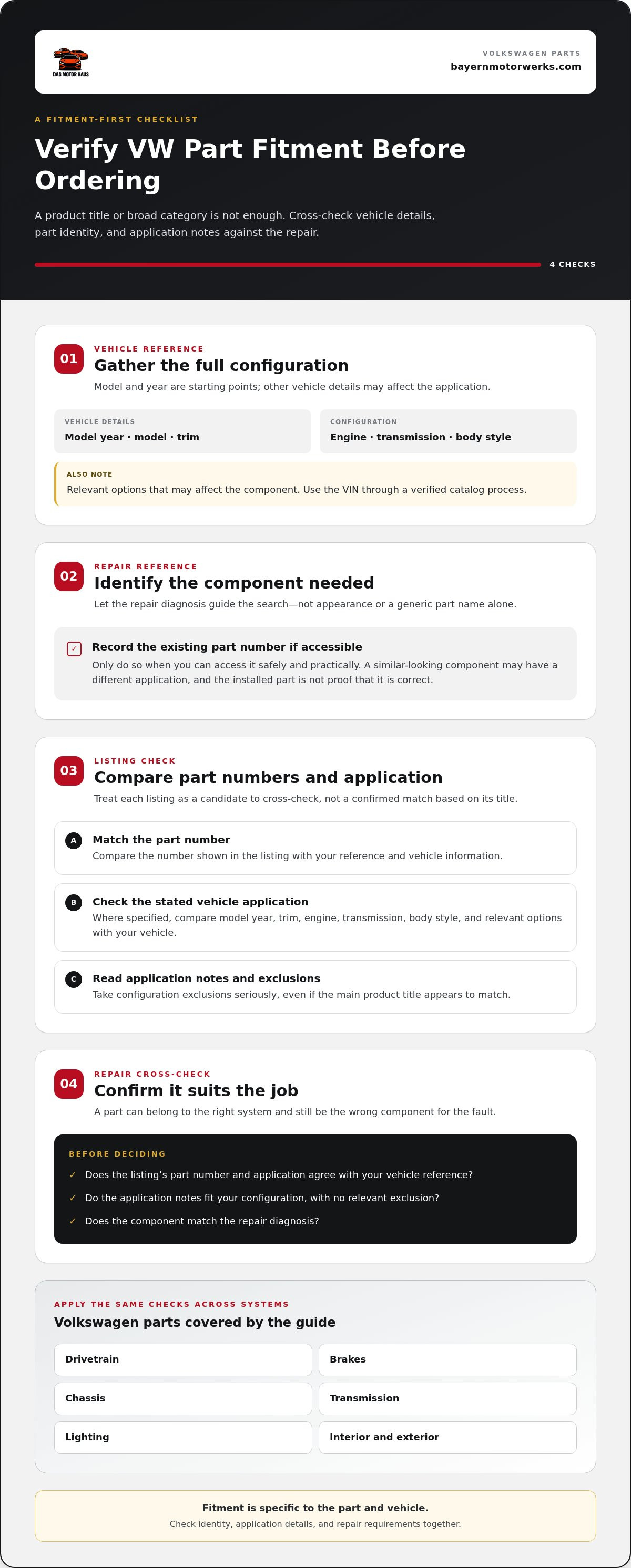
Before searching a catalog, gather the model year, model, trim, engine, transmission, body style, and relevant options. Use the vehicle identification number through a verified catalog process. If you can safely and practically access the existing component’s part number, record it as a reference. Don’t identify a replacement by appearance alone, because similar-looking components can have different applications.
- Collect vehicle details. Write down the complete vehicle configuration, including options that may affect the component. Model and year alone may not narrow the application sufficiently.
- Identify the component. Use the repair diagnosis to determine which part is needed and where it belongs. If you can safely read the existing part number, record it, but don’t assume the installed component is correct just because it came off the vehicle.
- Compare part numbers. Check the number shown in the listing against your part reference and vehicle information. A matching category name, such as “brake component” or “lighting,” isn’t enough if the part number or application details differ.
- Review application notes. Look for stated exclusions or configuration differences. Make sure they align with your vehicle information and repair diagnosis rather than relying on a broad model-family match.
Collect vehicle details, identify the component, compare part numbers, then review application notes before deciding whether a listing matches your repair. This order helps you assess fitment carefully without treating a catalog result as a guarantee.
Cross-check the listing before purchase
Compare the listing’s part number and stated application with your vehicle reference. Check that the model year, trim, engine, transmission, body style, and relevant options agree wherever the listing specifies them. Take any application note that excludes a configuration seriously, even when the main product title appears to match.
Keep the repair diagnosis in view. A part can belong to the right general system yet still be the wrong component for the fault. Apply the same checks to Volkswagen drivetrain, brake, chassis, transmission, lighting, interior, and exterior parts.
For a related make-specific reference, see OEM Audi Parts in the USA: A Practical Guide to Authenticity, Fitment, and Buying. You can also explore Volkswagen parts categories while comparing the application details relevant to your vehicle.
VW OEM vs. Premium Aftermarket Parts: Which Fits the Repair?
Choosing between genuine OEM and premium aftermarket components comes down to provenance, documented application, and the demands of the repair. Neither label alone establishes that a part is right for every job. Start by verifying the vehicle application, then compare the details provided for each component.
| Consideration | Genuine OEM | Premium aftermarket |
|---|---|---|
| Provenance | Made by or for the vehicle manufacturer to its specifications. | Made by another manufacturer; source and production standards vary. |
| Documented specifications | Review the stated part identity and vehicle application. | Review the manufacturer, stated specifications, and vehicle application. |
| Intended repair | May suit a repair where original-equipment sourcing is a priority. | May suit a repair when its documented details align with the component requirement. |
| Buyer priorities | Emphasizes original-equipment provenance and a matched application. | Calls for comparing manufacturer and component details, not relying on the category label. |
When OEM sourcing is the priority
OEM may be the preferred route if original-equipment provenance is important to you and you want the replacement decision anchored to the vehicle manufacturer’s specifications. The specific part still matters: verify its identity and stated application against your vehicle and repair objective. An OEM label doesn’t mean a component fits every Volkswagen or every configuration of one model.
This distinction is useful for repairs involving drivetrain, brake, chassis, transmission, or lighting components. You may be looking for an original-equipment replacement, but the part number and application details must still match the repair. Fitment evidence supports the decision; the label alone doesn’t settle it.
How to assess a premium aftermarket alternative
Aftermarket parts are produced by manufacturers other than the vehicle maker. Their quality and application vary by manufacturer and component, so assess the specific item rather than making a blanket judgment about the category. Compare its stated specifications and vehicle application with the repair requirements, giving weight to details the listing actually documents.
For broader sourcing considerations, the guide German Car Parts Supplier: How to Choose Quality Parts with Confidence offers a related perspective. The same comparison applies to both OEM and aftermarket options: provenance, application, and repair purpose should align.
A VW OEM parts online store can present both types of components, but your decision should remain tied to the job. If original-equipment sourcing is your priority, focus on part identity and application. If you’re considering an aftermarket alternative, assess the manufacturer information and stated suitability. Explore Volkswagen OEM and aftermarket parts with those criteria in mind.
A Practical Checklist for Buying Volkswagen Parts Online
A product listing should give you details to compare with your vehicle and repair, not just name a familiar category. Keep your vehicle information and repair diagnosis together, then review each listing against the same checks. This makes differences between similar Volkswagen parts easier to spot and helps prevent assumptions based on a title or image.
What to inspect on an individual product listing
Read the written details closely. Look for a part number, a clear component description, and vehicle application information that corresponds to your Volkswagen’s configuration. If the listing states the component’s condition or included items, assess those details as written. Don’t infer specifications, condition, or included hardware from a product image.
- Part number: Check whether the listing identifies a specific part number. Compare it with your reference, and don’t treat a broad category name as a substitute for a number or application match.
- Vehicle application: Compare the stated year, model, trim, engine, transmission, body style, and relevant options with your vehicle. Read the fitment notes for exclusions or configuration differences.
- Component condition: Review any condition information in the written description. If the listing doesn’t describe condition, an image alone can’t establish it.
- Listing description: Confirm that the component described is the one identified by your repair diagnosis. Note what the listing explicitly states and avoid filling gaps with assumptions.
How to avoid common online ordering mistakes
Visual resemblance can be misleading. Two parts may look similar while having different part numbers or vehicle applications. Don’t choose by appearance when the written application details point elsewhere. Keep your vehicle reference, part number, and repair notes together as you compare listings, so you assess each candidate against the same information.
Diagnosis and part selection are separate steps. First identify the failed component and repair requirement, then evaluate whether the listing describes a part for that application. A listing may name the right system but refer to a different component within it. For Volkswagen drivetrain, brake, chassis, transmission, lighting, interior, or exterior repairs, match the described part to the diagnosed need rather than relying on a broad label.
Use this checklist to assess a VW OEM parts online store listing based on its documented details. For broader criteria on assessing German-parts sources, consult German Car Parts Supplier: How to Choose Quality Parts with Confidence. Keep your focus on the part itself: its listed identity, application, condition details, and description.
Compare Volkswagen components by their stated details. Explore Volkswagen OEM and aftermarket parts for repair-related categories.
Find Volkswagen OEM and Replacement Parts at Bayern Automotive
Bayern Automotive supplies genuine OEM and premium aftermarket components for Volkswagen, with categories spanning mechanical repairs and vehicle upgrades. The selection includes drivetrain, brake, chassis, transmission, lighting, interior, and exterior parts. These categories cover a range of repair and upgrade needs, while the part choice should still match the specific job.
The company sources products from Europe and worldwide. For any individual component, base your decision on its stated identity, application, and documented details. A category label is a useful starting point, not a substitute for checking whether the part corresponds to your vehicle and repair.
Choose a part category that matches the repair
Start with the system identified in the repair diagnosis. A drivetrain or transmission repair calls for reviewing the relevant mechanical category; brake and chassis work points to those component groups. For a lighting, interior, or exterior project, begin with the corresponding vehicle category and compare the listing details with the intended repair.
Keep replacement needs separate from upgrades. A part selected to address a diagnosed fault has a different purpose from an upgrade chosen to change or enhance a vehicle system. In either case, confirm that the component’s described application and identity align with your Volkswagen before treating it as a candidate. For wider sourcing considerations, the guide German Car Parts Supplier: How to Choose Quality Parts with Confidence offers a broader framework for assessing parts and suppliers.
Continue with a fitment-first purchase
Before ordering, bring together the vehicle configuration, repair diagnosis, and candidate part details. Compare the part number and application information where provided, and read the listing description instead of relying on a broad category name or visual resemblance. If the details don’t align, resolve the mismatch rather than assuming a familiar model name establishes compatibility.
Then make a deliberate choice between genuine OEM and premium aftermarket components. OEM may suit a buyer who prioritizes original-equipment provenance. An aftermarket option may suit the repair when its manufacturer information and stated application support the requirement. Neither label replaces careful assessment of the specific part.
A VW OEM parts online store should help you assess components by their stated identity and application, not ask you to choose by label alone. Bayern Automotive’s Volkswagen selection brings genuine OEM and premium aftermarket options together across relevant repair and upgrade categories. Browse the Volkswagen parts selection and use your vehicle and repair details to guide your choice.
Make Your Next Volkswagen Repair Count
Keep the component details with your vehicle records so you have a clear reference for future repair decisions. Recording the part number and the vehicle configuration it was matched to can make it easier to compare replacement options later.
When comparing options, use a VW OEM parts online store to explore components with the repair objective in mind. Bayern Automotive supplies genuine OEM and premium aftermarket parts across mechanical systems, drivetrain, brakes, chassis, transmission, lighting, interior, and exterior categories. Assess each option by its stated application and suitability for the job, not its label alone.
Browse Volkswagen OEM and replacement parts at Bayern Automotive to find a starting point for your next repair or upgrade.
Frequently Asked Questions About Volkswagen Parts
How do I know if a VW OEM part fits my car?
Match the part’s stated application to your car’s configuration and check its part number. For example, if two listings name the same model but one excludes your engine or trim, the shared model name isn’t enough. Read the application notes and compare the candidate number with your repair reference. If the details conflict, don’t infer compatibility from the title.
Can I use my VIN to find the correct Volkswagen part?
A VIN can help identify vehicle details in a catalog that supports VIN lookup. Enter it through a verified process, then review the result’s component description, application notes, and part number. Treat the result as a starting point for validation, not an assurance that every listed part suits the repair.
What is the difference between VW OEM and aftermarket parts?
VW OEM parts are made by or for the vehicle manufacturer to its specifications, while aftermarket parts come from other manufacturers. Aftermarket doesn’t automatically mean unsuitable; documented specifications and vehicle applications vary by manufacturer and component. Compare the details with the specific repair instead of assuming one category is better. The right choice depends on whether original-equipment provenance or a well-documented alternative best fits the repair requirements.
Are Volkswagen OEM parts the same for every model year?
No. Volkswagen part applications can differ by model year, trim, engine, transmission, body style, and installed options. A component listed for one configuration may not apply to another vehicle with the same model name. This can matter even within one system, such as lighting or drivetrain components. Check the application details for your specific vehicle instead of extending a match from a nearby year or similar trim.
How can I check whether a Volkswagen part is genuine OEM?
Review the part identification and the seller’s stated sourcing information. A product title or OEM wording alone doesn’t establish provenance; compare the listed part number and description with reliable catalog or supplier information. Also distinguish an OEM part from an aftermarket replacement, since both may be listed for similar repairs. If the listing lacks enough identifying detail, don’t treat the label alone as proof.
Can an aftermarket VW part fit as well as an OEM part?
An aftermarket VW part can be a suitable match if the specific manufacturer’s application and documented specifications align with the vehicle and repair. Don’t judge fit by the word “premium” or appearance alone. Compare the details for that component, including its stated vehicle application, with the repair requirements. Because aftermarket parts vary by manufacturer and component, suitability depends on the individual part rather than a blanket rule.
What information should I have before ordering a VW replacement part online?
Have the vehicle’s model year, model, trim, engine, and relevant options ready. Include transmission and body-style details if they help distinguish the application, along with the repair system or diagnosed component. If accessible, record the existing part number as a reference, but don’t rely on appearance alone. Keeping the vehicle and repair details together makes listing comparisons clearer and can help reveal a mismatch before ordering.