

VW Performance Hose Kits: A Buyer’s Guide to the Right Fit
A hose kit that matches the VW badge can still be wrong for the engine. Model names span different generations and configurations, and a performance label alone doesn’t establish fitment. Before choosing among vw performance hose kits, identify your vehicle, engine, and the hose function you need. A coolant replacement, boost-system upgrade, intake connection, and breather repair each call for a different application.
Check whether a listing covers a complete kit or a single hose. This guide compares coolant, boost, intake, and breather hoses, then explains how to narrow your options by vehicle and engine. Bayern Automotive’s collection includes model-specific kits and individual hoses, including MQB 1.8 and 2.0 TSI coolant and boost applications. A Mk6 2.0T TSI breather kit listing names CCTA and CBFA engines, illustrating why engine details matter. Use the stated hose function and fitment, not broad performance claims, to make a more informed selection.
Key Takeaways
- Start with the exact vehicle and engine, then use the listing’s year and configuration details to narrow fitment.
- Choose by system function: coolant, boost, intake, and breather hoses serve different purposes.
- Read the product description for stated material and construction details instead of assuming all hoses share the same design.
- Check whether a listing covers the repair you’re planning or a broader set of hoses before comparing options.
- Use fitment and application, not color or broad performance language, to assess vw performance hose kits for your build.
What VW Performance Hose Kits Do, and Why Hose Type Matters
A performance hose kit is a vehicle-specific group of hoses, or an individual hose, intended for a stated system and fitment. The product description should identify what the hose serves and which vehicle or engine it is designed for. Check the listed contents before buying: “kit” doesn’t automatically mean every hose in the cooling system or engine bay is included.
Define a hose kit by its stated application and vehicle fitment, not its appearance. Silicone color or a broad performance description may catch your eye, but neither identifies the hose’s job or confirms that it matches a particular VW configuration. The collection includes coolant, boost, intake, and breather applications, so start with the system you’re repairing or modifying. A worn hose may call for a direct application match, while a build plan may lead you to compare another hose product. In either case, function and fitment are the first filters.
How coolant, boost, intake, and breather hoses differ
Coolant hoses connect parts of the engine cooling circuit. Boost and intake are distinct categories, and the product listing’s stated function is the clearest guide to the connection each hose serves. Breather hoses are a separate category as well. Don’t treat these labels as interchangeable: a hose intended for one system isn’t automatically suitable for another. For general background on different types of hoses, materials, and applications, see Wikipedia’s overview, then use the vehicle-specific listing to assess automotive fitment.
Read the application wording closely. A boost hose listing should be considered for that stated function, not assumed to cover all intake plumbing. A breather listing identifies its own product category; the category name alone doesn’t establish fitment for a particular vehicle. Comparing the stated function with the repair or upgrade helps you choose for the job rather than by appearance.
Complete kits versus individual VW hoses
The scope of a complete kit is defined by its product title or description. Check which hoses the listing says it contains before treating it as a system-wide replacement. The collection also includes individual hoses, such as separate MK1 upper and lower radiator hose listings. Each listing refers to a particular hose, not a full cooling-system set.
Use the product title and description to check scope before comparing options:
- For a single-hose repair, match the named hose position and its stated vehicle fitment.
- For a multi-hose replacement, confirm that the listing describes a complete kit and identifies its included scope.
- For an upgrade, compare products within the same hose function rather than treating unrelated categories as substitutes.
This distinction helps keep the selection precise. An individual hose can address a targeted replacement, while a complete kit may suit a broader job if its stated contents match the work planned. With vw performance hose kits, application and fitment provide a more dependable basis for selection than a visual match alone.
How to Compare VW Performance Hose Kits by Material and Construction
Material labels are useful when they describe the specific hose listing you’re considering. Compare each product by application, stated construction, and exact vehicle fitment. A shared product category or brand doesn’t establish that every hose uses the same material, reinforcement, or construction. Treat construction details as specific to the listing where they appear.
What reinforced silicone construction can tell you
The MQB coolant kit description identifies reinforced, multi-layer construction. This is a concrete detail to compare with another listing, but it doesn’t establish guaranteed service life, added power, or identical construction across other kits. Look for material and reinforcement details in the description for the exact product. Apply any resistance claims only to the listing that explicitly makes them.
Separate what the description states from what it doesn’t. A construction detail helps characterize a product, but it doesn’t replace fitment checks or support assumptions about performance. Keep claims about resistance or durability tied to the product description that names them.
Which listing details deserve a side-by-side check
Use a comparison table to keep application, fitment, scope, and construction distinct. These examples show how named engine fitment can narrow a choice, while construction details should remain specific to each listing.
| Hose function | Named vehicle fitment | Kit scope | Stated construction |
|---|---|---|---|
| Coolant | MQB 1.8 and 2.0 TSI | Coolant hose kit; use the listing description for included scope | Reinforced, multi-layer construction stated for the MQB coolant kit |
| Boost | MQB 1.8 and 2.0 TSI | Boost hose kit; compare the named scope in the listing | Use only construction details stated for the specific listing |
| Breather | Mk6 2.0T TSI, CCTA and CBFA engines | Breather kit | Compare the product description’s stated construction |
Read each row across, rather than comparing by color or general category. Vehicle generation, engine code, model year, and transmission are separate fitment details. Match each one when the listing provides it, and don’t assume that a shared model name covers every engine or configuration. Color variants, where offered, describe appearance, not mechanical compatibility.
For vw performance hose kits, this side-by-side method helps distinguish a specific construction detail from a broad description. Once the vehicle, hose function, and scope are clear, compare the VW performance cooling listings using the same criteria. Don’t fill gaps in a product description with assumptions.
VW Hose Kit Examples: Match the Product Type to the Job
Product examples are most useful when compared by intended job and stated fitment. A coolant kit and a boost hose kit aren’t competing versions of the same part; they serve different applications. The examples below show how vehicle and engine details narrow the options, while kit scope distinguishes a multi-hose replacement from a single-hose listing.
Examples for TSI and turbocharged Volkswagen applications
The MQB 1.8 and 2.0 TSI listings separate coolant hose kits from boost hose kits by function. A listing for one application shouldn’t be treated as coverage for the other. The Mk5 and Mk6 2.0 TSI boost hose kit is another distinct fitment example. Its generation-specific description doesn’t establish compatibility with MQB or other generations.
| Product example | Stated vehicle or engine fitment | Hose function | Listed variants |
|---|---|---|---|
| MQB coolant hose kit | MQB 1.8 and 2.0 TSI | Coolant | 1.8 TSI and 2.0 TSI |
| MQB boost hose kit | MQB 1.8 and 2.0 TSI | Boost | 1.8 TSI and 2.0 TSI |
| 2.0 TSI boost hose kit | Mk5 and Mk6 | Boost | Mk5 and Mk6 applications |
| Mk4 R32 3.2L 24v VR6 complete coolant hose kit | VW Mk4 R32, 3.2L 24v VR6 | Coolant | 3.2L 24v VR6 |
| Mk4 Golf and Jetta 2.0 complete coolant hose kit | Mk4 Golf and Jetta 2.0 | Coolant | Golf and Jetta applications |
| MK1 upper and lower radiator hoses | MK1 | Coolant, radiator hoses | Upper hose and lower hose listed individually |
| Mk6 2.0T TSI breather kit | Mk6 2.0T TSI, CCTA and CBFA | Breather | CCTA and CBFA engines |
Examples for VR6, classic VW, and breather applications
The Mk4 R32 example is a complete coolant hose kit tied to a specific engine and vehicle. The Mk4 Golf and Jetta 2.0 listing is a separate complete-kit application. The MK1 upper and lower radiator hoses illustrate individual-hose scope: each listing names one hose position, not a complete cooling-system replacement. The Mk6 breather kit is a different application, with CCTA and CBFA engines named in its fitment.
Use these examples to narrow vw performance hose kits by system, vehicle, engine, and the scope stated in the product description. Once those details align with the job, browse the VW performance cooling products for the relevant application.
How to Confirm the Right VW Performance Hose Kit Fitment
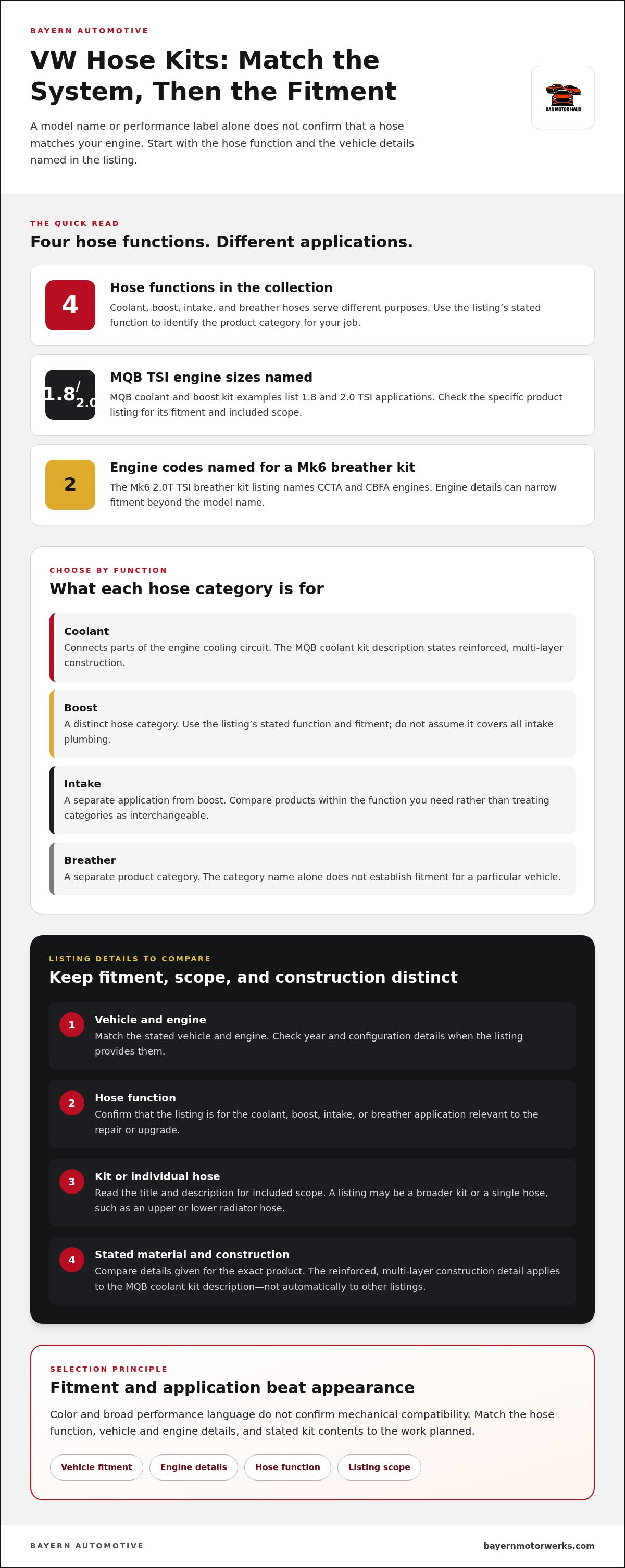
Fitment is a sequence, not a guess based on a badge or a hose’s appearance. Volkswagen model names can span generations, engines, and configurations, so a product title that seems close may still describe a different application. Match the product listing to the vehicle’s stated engine and configuration before selecting a hose. Follow the checklist in order, then compare the hose function and kit scope with the work you’re planning.
Start with the vehicle and engine details
Write down your vehicle’s model, model year, engine designation, and transmission when the listing provides that detail. Compare each item with the product fitment description. Engine codes can be especially useful because they identify an engine more precisely than a model name alone. For example, a Mk6 2.0T TSI breather kit listing names CCTA and CBFA engines. Match those codes rather than assuming compatibility with other engines.
- Identify the vehicle. Record the Volkswagen model and generation rather than relying on a general name that may cover multiple versions.
- Confirm the engine. Use the engine designation or code shown for your vehicle, and compare it with the listing’s named engine fitment.
- Check year and configuration. Match the model year and any listed variant or transmission details. Don’t extend a fitment to a different year, trim, or generation just because the model name is shared.
- Match the hose function. Select the application that corresponds to the job, such as coolant, boost, intake, or breather, then confirm the listing describes the hose or kit you need.
Match the hose application and kit scope
Once the vehicle details line up, make sure the product serves the right system. An engine match doesn’t make a coolant hose suitable for a boost application, or a breather hose suitable for another route. Read the product title and description for the stated function, then check whether it identifies a complete kit, an individual hose, or a particular variant. This prevents a correct fitment from being mistaken for broader coverage than the listing describes.
Keep mechanical fitment separate from appearance. Color and visual similarity don’t establish engine compatibility, hose routing, or included scope. If a detail such as engine code, year, or configuration isn’t stated, don’t infer it. Base the comparison on the available product details and treat the listing’s defined application as the boundary of what it describes.
This process makes it easier to narrow vw performance hose kits without relying on a broad model label. After matching your vehicle, engine, configuration, and hose function, compare the listed VW cooling applications against your fitment and repair plan.
Choose Your VW Performance Hose Kit and Browse the Collection
A sound choice follows a clear sequence: define the repair or upgrade, identify the hose function, verify vehicle fitment, then compare each listing’s scope and stated construction. This keeps the decision tied to the part’s intended job instead of broad performance language. Color and appearance can help distinguish variants, but neither replaces an engine and application match.
A short buying checklist before selecting
Before choosing among vw performance hose kits, use the product description as a final fitment check. The collection includes model-specific kits and individual hoses, so compare the details for the exact listing rather than relying on a general category label.
- Define the job. Identify the repair or planned upgrade and the system involved.
- Select the hose function. Match the need to the application stated in the listing, such as coolant, boost, intake, or breather.
- Verify the vehicle. Compare model, year, engine, and configuration with the listing. Use engine codes and transmission details when provided.
- Confirm the scope. Check whether the product is described as a complete kit or as one specific hose, then review only the construction and variants stated for that product.
Keep those checks separate. A listing can match the vehicle but address a different hose function, or describe the right function while covering a single hose rather than the full scope of your job. Read the title and description together. Don’t interpret a color option, “performance” wording, or visual similarity as evidence of compatibility. If the listing names a specific engine or configuration, include that detail in your fitment comparison.
Browse VW performance cooling and hose options
Once you know the vehicle and application, the collection gives you a practical way to compare relevant VW listings. Its examples span different hose functions, model-specific kits, and individual hose applications. Focus on the details that distinguish the products: the vehicle and engine named, the system served, the scope described, and any construction information stated for that particular item. Don’t extend one listing’s fitment or material details to another product.
This approach supports a deliberate selection, whether you’re replacing a specific hose or comparing options for a planned build. Match the product description to the job, and let stated fitment guide the decision rather than appearance or general claims. For the next step, Browse VW performance cooling products and compare the listed applications against your vehicle details.
Make Your Next Hose Choice With Confidence
Before browsing, write down the vehicle details and the specific job you want the hose to perform. This gives you a clear reference while comparing vw performance hose kits and keeps the selection tied to your build rather than visual preference. If the project involves ongoing maintenance or future upgrades, save the fitment information with your service records for easy reference.
Use the collection once you’ve identified your Volkswagen and hose application. Read each product description on its own terms, and choose according to the fitment and scope it states. A deliberate match is more useful than a rushed choice based on broad performance wording.
Browse VW performance cooling products and compare the listings for your application. With your vehicle details in hand, you’re ready to make a considered choice for the work ahead.
Frequently Asked Questions
How do I know which VW coolant hose kit fits my car?
Match the listing to your car’s documented model, model year, and engine rather than relying on the badge alone. If you’re unsure of the engine designation, consult your vehicle records or owner documentation before comparing products. Then confirm that the description identifies a coolant application and that the kit scope suits the work planned. These details help narrow vw performance hose kits to the relevant options.
Are silicone performance hoses better than factory rubber hoses?
Not automatically. The right choice depends on the vehicle, hose application, and details stated for the specific product. Some listings describe reinforced, multi-layer silicone construction, but that alone doesn’t establish longer service life or a particular performance result. Compare the product’s stated construction with the job you’re planning, and don’t treat a material label as proof that a hose suits every system or configuration.
Can I replace one VW coolant hose instead of buying a complete kit?
Yes. An individual hose can suit a targeted repair if its listing matches the hose position and your vehicle’s fitment. For example, a repair limited to an upper or lower radiator hose may call for that specific listing rather than a broader set. Consider the condition and scope of the other hoses separately. Replacing one part doesn’t mean the remaining cooling hoses have also been renewed.
What is the difference between a boost hose and a coolant hose?
A coolant hose serves the engine’s cooling circuit, while a boost hose is listed for a boost-system application. They have different functions, so don’t choose between them based on similar shape, material, or color. Start with the system involved in your repair or modification, then compare products within that application. When identifying a hose during maintenance, use its routing and the product’s stated function rather than appearance alone.
Do VW performance hose kits fit every engine in the same model?
No. A model name can cover different engines, generations, or configurations, and a listing may be limited to a particular fitment. Check the engine and other vehicle details named in the product description instead of assuming a kit for one version applies across the model range. If your vehicle’s engine designation differs from the listing, a shared badge isn’t evidence of compatibility.
Can I use a different hose color without changing fitment?
Color doesn’t establish fitment. A different color may be an appearance variant, but the product still needs to match the vehicle and intended hose application. Compare the listing’s fitment and product details first, then consider color only among options described for that same application. Don’t assume two hoses are interchangeable because they look alike, or choose a visually appealing option before checking its stated vehicle details.