

OEM Audi Parts in the USA: A Practical Guide to Authenticity, Fitment, and Buying
What makes an Audi part the right choice: its label or verified fitment to your vehicle? When comparing OEM Audi parts USA listings, the supplier matters, but a product description is only a starting point. Look for clear details about the component and its intended application before ordering.
This guide explains how to compare genuine OEM parts with premium aftermarket alternatives, assess product descriptions, and check fitment. The goal is to choose a component that suits the vehicle and repair, with a clear understanding of what the listing describes.
Bayern Automotive supplies genuine OEM and premium aftermarket parts for Audi vehicles, including engine, drivetrain, brake, chassis, transmission, and body components. The selection also includes upgrades and accessories. Use the checks below to compare the stated part type and application, then decide whether an OEM component or a premium aftermarket option better suits the repair.
Key Takeaways
- OEM describes a parts category, not proof that a component fits every Audi. Match the listing to the vehicle and repair.
- When comparing OEM Audi parts USA listings, look for clear category labels and specific vehicle application details.
- OEM and premium aftermarket components have different considerations. Choose based on the repair, the stated application, and your priorities.
- Check fitment methodically: identify the vehicle, define the repair, compare application details, and review the full part listing.
- Explore Bayern Automotive’s Audi engine, drivetrain, brake, chassis, transmission, and body component categories. Assess each listing’s part type and stated application.
What OEM Audi Parts Mean for Buyers in the USA
OEM stands for Original Equipment Manufacturer. In automotive parts listings, it describes a component made by or for a vehicle manufacturer, or a part associated with the original equipment specification. A genuine Audi part is presented under Audi’s genuine-parts identity. A premium aftermarket part is made outside that genuine-parts channel, and its quality and application depend on the manufacturer and the specific component. These terms are related, but they are not interchangeable.
The Original Equipment Manufacturer (OEM) in the automotive industry term can be used in different ways, so read the listing’s exact description instead of relying on the label alone. “OEM” identifies a category; it does not establish a part’s condition, suitability, or fitment for every Audi. Fit depends on the vehicle’s configuration and the component being replaced.
OEM, genuine, and aftermarket: what the terms communicate
“Genuine” generally signals that a part is offered as a vehicle maker’s branded replacement component. “OEM” refers to the original-equipment relationship or category described by the seller. “Aftermarket” covers parts made by third-party manufacturers, from standard replacements to premium components. Quality, construction, and application can vary among manufacturers and parts.
For a useful comparison, identify what the listing says about the part’s origin and intended application. Don’t assume an OEM label alone verifies authenticity or proves the component matches your vehicle. An aftermarket label also doesn’t automatically make a part unsuitable. Evaluate the specific component, its stated application, and the needs of the repair.
Which Audi parts are commonly replaced?
Audi replacement components span several systems, including the engine, drivetrain, brakes, chassis, transmission, and body. The right category depends on the repair: a transmission component serves a different function from a body panel, and their fitment details differ. Naming the system and the specific component helps narrow your search before you compare product descriptions.
A replacement engine assembly is one example of a major engine component, not a universal solution for an engine concern. The repair scope determines whether an assembly or a smaller component is appropriate. Bayern Automotive supplies genuine OEM and premium aftermarket parts for Audi and other European makes, with offerings across engine and other component categories. Its parts selection also includes VW, Porsche, and BMW components. For shoppers comparing listings across these marques, a German car parts supplier guide can provide broader context on evaluating parts sources.
How to Evaluate an OEM Audi Parts Source Before You Buy
A useful listing should identify the component, its category, and its intended vehicle application. Those details make it easier to compare parts sources without treating a broad label as proof of fit or suitability. For OEM Audi parts USA, specific product descriptions are more useful than general claims about a source.
What a useful Audi parts listing should tell you
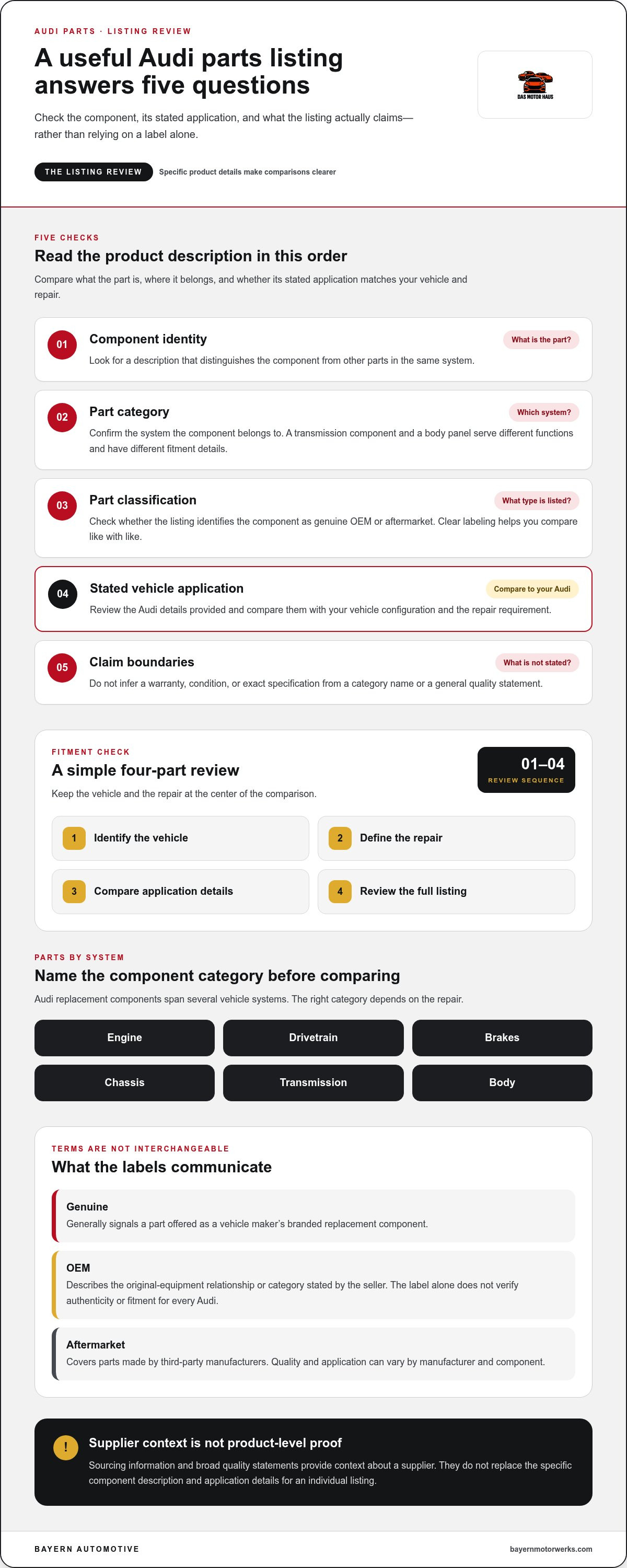
Read the product description as a set of specific claims. First, identify the component and the system it belongs to. Then compare the stated application with your Audi’s details and the repair you’re addressing. A listing that names a part type but gives little application information may not provide enough detail to select the right component.
- Component identity: Look for a description that distinguishes the part from other components in the same system.
- Category: Confirm whether it’s an engine, drivetrain, brake, chassis, transmission, or body component.
- Part classification: Check whether the listing identifies the part as genuine OEM or aftermarket. Clear labeling helps you compare like with like.
- Vehicle application: Review the Audi details provided and compare them with your vehicle and repair requirement.
- Claim boundaries: Don’t infer a warranty, condition, or exact specification from a category name or a general quality statement.
Ambiguous labels can make two listings appear equivalent even when they describe different types of parts. A clear OEM-versus-aftermarket distinction lets you compare the component category and application on their own terms. If the description doesn’t align with the repair, don’t rely on the brand or category alone to make the decision.
How to assess sourcing and quality statements
Sourcing information describes a supplier’s approach; it doesn’t automatically establish the origin or characteristics of each individual component. Bayern Automotive sources products directly from Europe and worldwide and states that its components meet strict quality standards. These business-wide sourcing and quality statements provide context, but they don’t replace the need to read a specific product’s description and application details.
As you compare sources, separate product-level details from broad statements. A specific component description tells you what kind of part is offered, while sourcing information gives context about the supplier. Neither should be taken as a claim about an individual part’s condition, warranty, or precise specification unless the listing states it.
Apply the same approach when exploring Bayern Automotive’s Audi component categories, including engine, drivetrain, brake, chassis, transmission, and body parts. Browse Bayern Automotive’s Audi parts and compare the product descriptions with your vehicle and repair needs. Keep the stated part type and application at the center of your decision.
OEM Audi Parts vs. Premium Aftermarket: How to Compare
Compare the specific components, not just their labels. OEM and premium aftermarket describe different categories, but neither category alone establishes that a part suits a particular repair. When considering OEM Audi parts USA, compare each component’s stated application with the vehicle’s requirements and weigh that against your priorities for the replacement.
A model name alone isn’t enough. The same Audi model may have different configurations, and components vary by vehicle details and function. Use the application information attached to each listing rather than assuming a model-name match proves fitment.
| Category | Selection considerations | Fitment checks |
|---|---|---|
| Genuine OEM | Consider it when the repair calls for a genuine replacement component. Read the exact part description and stated application. | Compare the listing’s vehicle details with the Audi and component being repaired. |
| Premium aftermarket | Consider the specific manufacturer’s component and its stated application. “Premium” doesn’t make every part identical. | Use the same vehicle and repair checks as for an OEM listing; don’t rely on the category name alone. |
The table is a starting point, not a verdict. A sound comparison asks what the repair requires, which application the listing identifies, and what matters most to you. Avoid assuming that OEM is necessary for every job or that an aftermarket component is automatically a compromise. The specific parts and their stated details determine what can be compared.
When an OEM component may suit the repair
A genuine OEM replacement may suit buyers who specifically want a component identified as genuine for a particular repair. The key question is whether the listing’s application matches the vehicle and the part being replaced. For example, Bayern Automotive lists a 2.0L 06H103064N DAS MOTOR HAUS assembly with cams for Audi CAE/CDN Gen 2 applications from 2009 to 2017. That application is specific and shouldn’t be generalized to other Audi engines or repairs.
When to consider a premium aftermarket alternative
Premium aftermarket is a distinct category, not another name for OEM. Evaluate an aftermarket option against its stated application and the repair’s requirements. Compare the actual component descriptions rather than inferring durability, performance, or longevity from the word “premium.” Without details about the specific parts being compared, there’s no sound basis for declaring one category the better choice.
Make the decision specific: identify the component, match its listed application to the vehicle, and weigh the repair’s priorities. This keeps the comparison grounded in part-level information instead of broad assumptions about a brand or category.
How to Confirm Audi Part Fitment Before Ordering
Fitment is a sequence of checks, not a guess based on a familiar model name or similar-looking part number. Before choosing OEM Audi parts USA, match the vehicle, the repair, and the listing’s stated application. The more precisely you identify the component needed, the less likely you are to confuse a broad repair goal with the part itself.
- Identify the vehicle. Record the Audi model and model year, along with the engine details available to you. These details can narrow the relevant application, but a model match alone doesn’t prove compatibility.
- Define the repair. Identify the specific component the repair requires. A symptom or general goal, such as addressing an engine concern, isn’t the same as a confirmed diagnosis of which part must be replaced.
- Compare application details. Match the vehicle information against the application stated for the component. Engine and component details can be especially important when a listing applies to a particular configuration.
- Review the full listing. Check the component description and scope. Don’t assume a part includes related pieces or accessories unless the listing says so.
Start with the vehicle and the repair
Gather vehicle details before browsing, then distinguish the repair diagnosis from the parts decision. A full engine assembly and an individual engine component are different purchases, even if both appear under an engine category. Establish which scope the repair calls for before comparing listings; a general concern alone doesn’t establish that an assembly is needed.
Compare the application and part description
Use part numbers as identifiers when comparing product information, but don’t treat similar numbers as proof of compatibility. Compare the complete number and the application details shown in the listing. A suffix or a small character difference can matter, so don’t choose based only on a partial match or model name.
For a specific example, Bayern Automotive lists the 2.0L 06H103064N DAS MOTOR HAUS with CAMS AUDI CAE CDN GEN 2 2009 to 2017. That stated application is specific to the listed engine configuration and years. It shouldn’t be generalized to other Audi vehicles or treated as evidence that every related component is included. Read the product description for its stated scope.
If your repair concerns this assembly, use the 06H103064N cylinder head fitment guide alongside the vehicle and listing details. For other parts, apply the same careful comparison to the relevant component description and application. Explore Bayern Automotive’s Audi parts with your vehicle details and repair requirement in mind.
Find OEM Audi Parts in the USA with Bayern Automotive
Choosing a part starts with matching its category to the repair, then checking that the individual listing fits the vehicle application. Bayern Automotive supplies genuine OEM and premium aftermarket Audi parts, with options for replacement components and upgrades. The distinction matters: an inventory category describes the kinds of parts offered, but doesn’t mean every component in that category is OEM.
Audi component categories available through Bayern Automotive
The range includes Audi engine, drivetrain, brake, chassis, transmission, and body components. These categories serve different systems and repair needs, so start with the system involved and narrow your search to the specific component. Read each listing’s classification and application rather than assuming that an entire category shares the same part type or fitment.
One specific engine example is the 2.0L 06H103064N DAS MOTOR HAUS with CAMS AUDI CAE CDN GEN 2 2009 to 2017. This is the stated application for that assembly, not a general fitment claim for other Audi models or engines. Compare the listing details with the vehicle and repair before treating it as a match.
Upgrades and accessories are separate from replacement components. Bayern Automotive also offers lighting, performance, interior, and body exterior upgrades, along with accessories. These serve different purposes from choosing a replacement OEM part, so keep the intended use clear as you browse.
Choose a part with fitment and repair scope in view
Before selecting a component, bring together three details: the vehicle information, the repair requirement, and the listing’s description. Model and model year can help narrow an application, while engine and component details may further distinguish the part needed. A similar model name or category isn’t enough by itself. Review what the listing describes, and don’t assume it includes related items unless the description says so.
Bayern Automotive sources products directly from Europe and worldwide and states that its components meet strict quality standards. Treat this as context about the business, while assessing each product through its own stated category, application, and scope. That keeps your decision grounded in the details relevant to the specific repair.
For a considered selection of OEM Audi parts USA, browse the Audi parts range and compare the relevant listing details with your vehicle and repair needs. Browse Audi parts at Bayern Automotive.
Make Your Next Parts Decision with Confidence
Put your vehicle details and repair requirement beside the product listing before choosing a component. This keeps your selection focused on the application, not just a familiar label. For OEM Audi parts USA, careful comparison supports a considered purchase, whether you’re evaluating a genuine OEM part or a premium aftermarket option.
Bayern Automotive brings more than 40 years of automotive industry expertise to its parts business. Explore the Audi selection and assess the listing details relevant to your repair.
Browse Audi parts at Bayern Automotive and compare the available components with your vehicle and repair needs. A clear, deliberate decision is a sound foundation for your Audi’s next repair.
Frequently Asked Questions
What does OEM mean when buying Audi parts?
OEM means Original Equipment Manufacturer, a term used for parts connected to a vehicle maker’s original equipment. In a listing, the label describes a category or claimed relationship; it doesn’t independently verify the component’s source or application. For example, an OEM-labeled brake component still needs to match the Audi’s particular brake system and the repair being performed. Read the full listing, not only its headline.
Are OEM Audi parts better than aftermarket parts?
Not automatically. The right choice depends on the repair, the vehicle application, and your priorities. A genuine OEM part may suit a buyer seeking a specific original-equipment replacement, while a premium aftermarket component may also be appropriate if its stated application meets the repair’s needs. Compare the exact parts and their descriptions. Broad category labels alone don’t establish that one component is more durable or suitable.
How can I make sure an Audi part fits my car?
Use the vehicle’s model, model year, engine information, and the exact component required to assess a listing. If you have a part number from the component being replaced, use it as a reference, but don’t assume a similar number confirms compatibility. Compare the listing’s stated application and included scope as well. If the repair involves multiple related components, check each part individually instead of relying on one matching description.
Can I buy genuine OEM Audi parts online in the USA?
Yes. Bayern Automotive supplies genuine OEM and premium aftermarket components for Audi and other European makes to customers in the United States. An online listing provides product information to compare, but the purchase decision still depends on the specific part’s stated type and vehicle application. Review those details carefully before selecting a component, especially if several listings appear relevant to the same repair.
What is the difference between an Audi OEM part and a genuine part?
“OEM” describes a parts category or relationship to original equipment, while “genuine” identifies a part presented as an Audi-branded genuine component. Sellers may use the terms differently, so don’t treat them as interchangeable without reading the listing. Look for an explicit statement of part type and origin, then assess the application separately. Neither term alone proves that a listing matches every Audi configuration.
Should I replace an Audi engine component or the complete assembly?
That depends on the diagnosed fault and repair scope, not simply on the fact that the concern involves the engine. An individual component and a complete assembly are different replacement decisions. A full assembly may be relevant when the required repair calls for that scope, but don’t assume it’s needed based on a symptom alone. Compare the diagnosis with the product description, including the parts the assembly specifically names.
What Audi parts does Bayern Automotive supply?
Bayern Automotive supplies Audi engine, drivetrain, brake, chassis, transmission, and body exterior components, along with upgrades and accessories. Its offering includes genuine OEM and premium aftermarket parts, so the classification depends on the individual listing rather than the category as a whole. One specific engine offering is the 2.0L 06H103064N DAS MOTOR HAUS with cams for Audi CAE/CDN Gen 2 applications from 2009 to 2017. Check the listing for its stated application.