

How to Choose Audi Lighting Upgrades: A Fitment-First Buying Guide
The right Audi lighting upgrade isn’t necessarily the most dramatic one. It’s the one suited to your exact vehicle. With audi lighting upgrades, model year, trim, connector, and factory lighting configuration all matter, especially when choosing between a complete assembly and a smaller component.
It’s easy to mistake a headlight assembly for a bulb or module, or to overlook how a signal adapter works with the car’s existing setup. Those differences affect what the part changes and may contribute to unexpected warning lights. A fitment-first approach helps narrow the options before you compare appearance and function.
This guide compares Audi lighting upgrade types, explains which vehicle details shape fitment, and shows how to identify products relevant to your configuration. Bayern Automotive offers lighting upgrades alongside genuine OEM components and premium aftermarket parts for Audi, VW, Porsche, and BMW vehicles. Its Audi lighting options include headlights and taillights, DRL boards, dynamic turn-signal adapters, and door puddle lamps. You’ll learn what each category does and which compatibility details to weigh before choosing.
Key Takeaways
- Start with the change you want, such as refreshed styling, clearer signaling, or a different lighting function.
- Compare audi lighting upgrades by format: complete assemblies and smaller components serve different purposes.
- Use your Audi’s year, model, generation, trim, and original lighting setup to narrow fitment before comparing appearance.
- Check the product’s specific application and variant rather than relying on a similar-looking part or model name alone.
- Explore vehicle-specific examples to see how factory configuration can shape the right upgrade for your Audi.
Why Audi Lighting Upgrades Start With Your Driving Goal
Begin with the change you want for your Audi: a different appearance, clearer signaling, or an update to a particular lighting function. Each goal points to a different part of the lighting system, so choosing by appearance alone can lead to the wrong product format. Headlights serve the front of the vehicle, while taillights and turn signals handle rear lighting and communication. Daytime running light (DRL) boards and door puddle lamps offer more focused changes.
An Audi lighting upgrade is a component or assembly selected to change a specific lighting function while complementing the vehicle’s existing system. Keeping that distinction in mind grounds the decision in purpose. Automotive lighting includes several systems with different roles; the overview of Automotive Lighting Systems provides useful context. For your Audi, the practical question is which location and function you intend to address.
Good selection also accounts for the factory setup and intended use. A component that changes a signal’s appearance is not a substitute for a headlight assembly, and a styling-focused update doesn’t necessarily address a visibility concern. Audi lighting upgrades include vehicle-specific assemblies and smaller components, so match the format to your goal before comparing finish or design.
Match the lighting upgrade to the change you want
For a front-end lighting change, compare headlight assemblies suited to the vehicle’s existing configuration. Taillight assemblies and turn-signal components address rear lighting, with signaling function distinct from appearance. DRL boards focus on the daytime running light area, while puddle lamps add illumination at the doors. Each option targets a different location, so identify the desired change before choosing a part.
This distinction helps prevent mismatched expectations. If your priority is the headlight system, focus on that system and its fitment rather than choosing a rear-lighting accessory for its visual effect. If you want a more distinctive signal or a styling change, consider the relevant rear, DRL, or door-lighting component. Let the intended function guide the category.
When a complete assembly makes more sense than a small component
A complete assembly replaces the larger lighting unit; a module or adapter changes or adds a smaller part of the setup. The Audi A6 C7 dynamic LED headlight is an example of an assembly-format upgrade. By contrast, a sequential turn-signal adapter is a smaller-format option that addresses the signal component rather than replacing the whole headlight or taillight assembly.
Choose between these formats by identifying what needs to change and how the part relates to the factory system. An assembly is relevant when the intended upgrade is the lighting unit itself. A smaller component makes more sense when the goal is narrower. Neither format is universal: vehicle generation and factory configuration shape which option is appropriate.
Audi Lighting Upgrade Types: Headlights, Taillights, DRLs, and Signals
Audi lighting products range from complete lamp assemblies to focused components. The format determines what changes and which fitment details matter. A headlight assembly is not the same purchase as a DRL board, and a sequential signal adapter doesn’t replace a rear lamp. Separate these categories first, then compare the applicable vehicle and factory lighting configuration.
| Product format | Lighting location | Intended change | Fitment variables |
|---|---|---|---|
| Headlight assembly | Front | Changes the complete headlamp unit | Model, year, generation, halogen or xenon setup, AFS configuration |
| Taillight assembly | Rear | Changes the complete rear lamp unit | Model, year, generation, and factory lamp variant |
| DRL board | Front daytime running light area | Targets the DRL component, not the full headlight | Headlight and vehicle configuration |
| Signal adapter | Turn-signal circuit | Changes signal presentation on listed applications | Vehicle application and existing signal setup |
| Door puddle lamp | Door area | Adds localized illumination near the doors | Vehicle and door-lighting arrangement |
Product format determines both the scope of the upgrade and the fitment checks required. Keep that distinction in view as you compare audi lighting upgrades: a full assembly calls for attention to the lamp’s original technology and vehicle variant, while a smaller component must match the specific system it modifies.
Headlight and taillight assemblies for a broader change
Headlights serve the front lighting system; taillights serve the rear and incorporate rear-lighting functions. Listings for the A4, A6, A7, Q5, Q7, and TT illustrate why a model name alone isn’t enough. Within a model family, product variants may distinguish halogen, xenon, bi-xenon, AFS, or model-year configurations. LED, xenon, and bi-xenon identify different lighting technologies or configurations, so treat those labels as fitment clues, not interchangeable descriptions.
A complete assembly is the broader-format choice because it replaces the lamp unit rather than modifying one element within it. Narrow the selection by matching the vehicle’s generation and original lighting configuration to the product variant. This helps prevent a similar-looking assembly from being mistaken for a match.
DRL, turn-signal, and puddle-lamp upgrades for targeted changes
DRL boards are separate components, not complete headlight assemblies. Sequential turn-signal adapters modify signal presentation on their listed applications, while door puddle lamps provide localized illumination at the vehicle’s doors. These focused formats address different areas and shouldn’t be compared as substitutes for a full front or rear lamp replacement.
For a practical comparison, start with the Audi lighting upgrade collection and distinguish assemblies from boards, adapters, and door lamps before assessing the design. The right category matches both the intended change and the Audi’s specific factory setup.
How to Compare Audi Lighting Upgrades Before You Buy
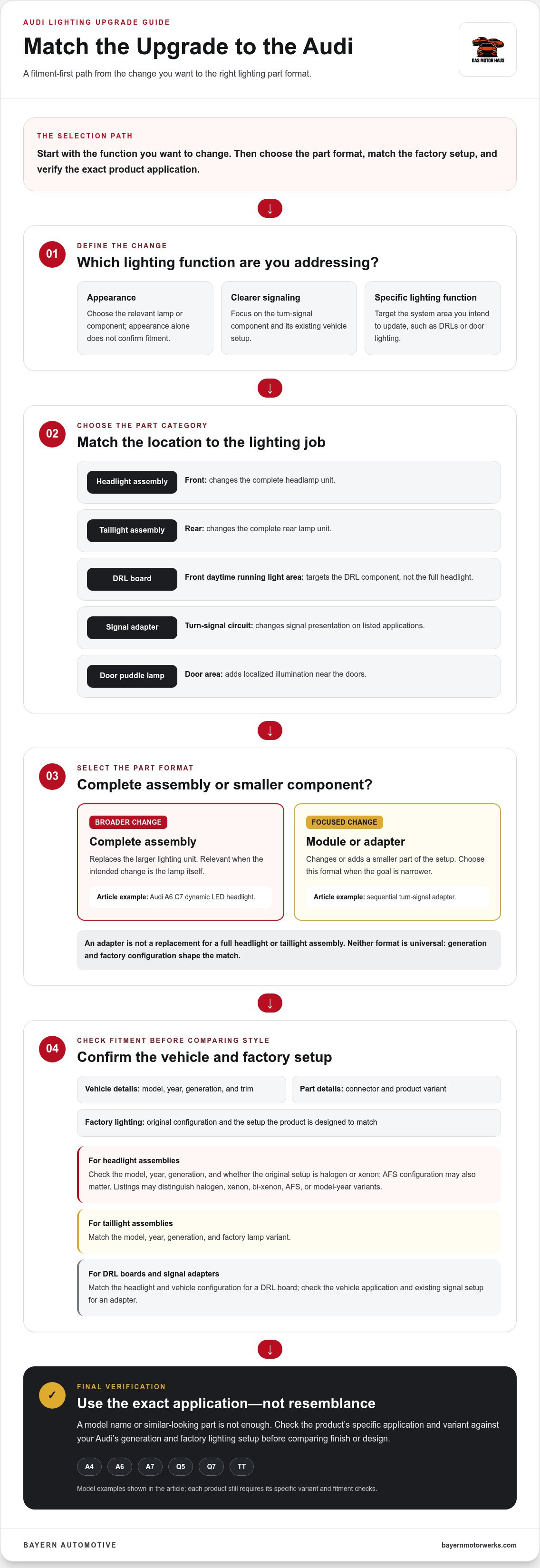
A disciplined comparison puts vehicle details ahead of styling preferences. For audi lighting upgrades, use this sequence: identify exactly which Audi you have, establish its factory lighting, choose the product format that matches your goal, and then compare design and integration features. This order helps separate products that look similar but serve different applications.
- Identify the vehicle. Record the model, model year, generation, and relevant trim. A model name can cover multiple generations and equipment configurations, so treat each detail as part of the fitment description.
- Confirm the factory setup. Determine whether the vehicle has halogen or xenon lighting and, where applicable, AFS. Check the existing lamp or component rather than assuming the configuration from the trim name alone.
- Select the product format. Decide whether you need an assembly, a DRL board, a signal adapter, or another smaller component. Compare listings within the same category. An assembly and an adapter aren’t alternatives for the same replacement task.
- Compare features and finish. Once the application aligns, weigh the specific lighting layout, signal presentation, colour, or lens variant against the change you want. Keep appearance as the final filter, not the first.
Which vehicle and factory-lighting details should you compare?
Start with the Audi’s exact model, year, generation, and trim, then match those details to the product’s stated application. Factory equipment matters too: halogen and xenon configurations can call for different variants, and AFS is another distinction where applicable. If a listing identifies a connector or pin-count option, compare it with the vehicle’s existing configuration rather than selecting by appearance or model family.
These checks are especially useful when two products have similar descriptions. A close match on model name doesn’t establish a match on year, generation, or original lighting type. Keep the vehicle and factory setup details together as you review each listing. That makes it easier to rule out mismatched variants before comparing styling.
How function, integration, and finish affect the decision
After fitment, return to the intended result. Compare dynamic signal presentation with other signal options, DRL appearance with other DRL components, and the lighting layout with the factory unit you’re replacing or modifying. Colour and lens choices are product-specific; evaluate them within the correct vehicle application rather than assuming a finish will transfer across variants.
CANBUS compatibility is an integration consideration, not a blanket guarantee that every product works with every Audi configuration. Assess compatibility descriptions at the product level. A claim associated with one listing shouldn’t be extended to another assembly, board, or adapter. The strongest comparison is specific: vehicle first, factory setup second, product format third, then finish and integration details.
Audi Lighting Fitment Checks That Prevent Common Buying Mistakes
Before selecting a lighting part, compare the product application with the Audi’s actual equipment. Model names and photographs can make different variants appear interchangeable, but year, generation, and factory configuration may change which assembly or component is appropriate. Fitment is separate from installation: a listing description helps define the product’s application, but it doesn’t establish every detail of an individual vehicle.
Check the exact Audi configuration, not just the badge
An A4, A6, A7, Q5, Q7, or TT name alone may cover different model years and lighting configurations. For example, A7 headlight options may distinguish pin-count variants, while Q7 choices may identify AFS equipment. Those details matter because the right part must correspond to the vehicle’s existing setup, not simply its badge or general appearance.
Use this pre-purchase checklist to narrow the match:
- Model and model year: Match the exact vehicle designation and year range stated for the product.
- Generation: Identify the Audi generation, since a shared model name doesn’t make parts interchangeable across generations.
- Factory lighting: Note the existing lighting type and relevant equipment, including AFS where applicable.
- Product variant: Compare any listed pin-count, connector, or equipment distinctions with the part currently fitted to the vehicle.
- Product scope: Confirm whether the listing describes an assembly, a smaller component, or an adapter.
Use the listed application details alongside the vehicle’s existing equipment. Don’t choose on appearance alone, and don’t assume that a product associated with one A7 or Q7 configuration fits every vehicle carrying that model badge. This deliberate comparison is especially useful for audi lighting upgrades with multiple variants.
Avoid confusing product scope and installation descriptions
A complete lamp set, a center trunk light strip, and an individual adapter are different product formats. A set may cover a broader replacement, while a strip or adapter addresses a specific part of the lighting arrangement. Read the product description to understand what the item includes and changes; a photograph or broad category label may not make its scope clear.
Interpret terms such as “plug-and-play” only in relation to the product and application described. The phrase isn’t a blanket statement about every Audi or every lighting upgrade. Work involved can differ by part and vehicle configuration, so don’t infer that all options require identical coding, wiring, or installation steps from one listing’s wording.
Once the year, generation, factory lighting, and variant align, compare the Audi-specific options with greater confidence. Browse Audi lighting upgrades by product type and application to focus on choices suited to your vehicle.
Standout Audi Lighting Upgrades and the Next Step
Specific product examples show why fitment and scope belong at the center of the decision. A complete headlight assembly is a broader change than a DRL board, signal adapter, or door lamp. The products below illustrate distinct formats and applications, not universal recommendations. Match each listing’s model and year range to your Audi’s configuration before treating it as a suitable option.
Examples of complete Audi lighting assemblies
For an earlier A6 or S6, the dynamic LED headlight listing for the C6 covers 2005-2011 and features sequential turn signals. The A6 S6 C7 dynamic LED headlight listing covers 2012-2015. The shared A6 and S6 names don’t make these two assemblies interchangeable: the generation and model-year application set them apart. Use the listing that corresponds to the vehicle rather than selecting by a similar design.
The A4 B8 2008-2012 RS-style LED headlight is another vehicle-specific assembly example. Its application and RS-style design help identify what the listing represents, but the vehicle’s existing lighting configuration remains essential to fitment. These examples show how an assembly changes a larger part of the front lighting setup, while still requiring attention to the exact Audi variant.
Examples of targeted Audi lighting accessories
For a more focused change, Audi A7 RS7 Flow Series color-chasing DRL boards are listed for 2015-2017. A DRL board targets the daytime running light component rather than replacing the entire headlight assembly. This gives it a different scope, even though both products relate to front lighting. The A7 application and year range are central to choosing this example.
Sequential motion turn-signal adapters offer another smaller-format option. Unlike a complete lamp, an adapter targets turn-signal presentation on its listed application. Quartz Ground Shadow door puddle lamps are different again: they provide a localized styling change at the doors, not a replacement for road-facing headlights or rear lamps. Each format serves a narrower or broader purpose, so compare products within the category that matches the change you want.
Use the same fitment-first method for every example: identify the Audi’s model, year, and generation; compare its factory lighting and equipment with the product’s stated application; then weigh format and styling. Product titles and features indicate the intended application, but they don’t make a part universal across Audi models or configurations.
Ready to compare options by vehicle and product type? Explore Audi lighting upgrades and use the listed applications to narrow the selection to a relevant fitment.
Make Your Next Lighting Choice With Confidence
Before you choose, treat the Audi itself as your reference point. Note its model year, generation, and factory lighting configuration, then use those details to narrow your shortlist. This step keeps styling decisions grounded in application and makes each comparison more relevant to your vehicle.
The right audi lighting upgrades are not simply the most noticeable options. They’re the ones that suit the change you want and the equipment already on your car. Take time to compare the specific product application and format; a considered selection is a stronger starting point than choosing by appearance alone.
Use your vehicle details to explore the available options and focus on listings that align with your intended upgrade. Browse Audi lighting upgrades and compare vehicle-specific options. With a clear fitment reference, you can move forward with purpose and choose a lighting change that feels right for your Audi.
Frequently Asked Questions
Is an LED headlight upgrade compatible with every Audi?
No, LED headlight fitment isn’t universal across Audi vehicles. Compatibility depends on the specific model, year, generation, factory lighting, and product variant. A listing may separate halogen and xenon setups, AFS and non-AFS equipment, or connector configurations. Before selecting an assembly, compare the variant details with your vehicle’s existing equipment. Similar styling or the same model badge alone doesn’t establish a match.
How can I tell whether my Audi has AFS headlights?
Check your Audi’s original equipment records, owner documentation, or the markings and configuration on its current headlight. The model badge alone doesn’t confirm AFS equipment. This distinction matters when comparing replacement assemblies because some listings specify separate AFS and non-AFS applications. Use the exact configuration you identify when narrowing your choices, and don’t infer AFS fitment from a photograph or a general model description.
Do I need to replace both Audi headlights at the same time?
Not necessarily. The right choice depends on the product format, the condition of the existing lamp, and the visual result you want. Listings can describe a complete assembly, a module, or an accessory, so check the stated contents rather than assuming a single lamp or a pair. Also consider how the replacement’s lighting design will look beside the headlight that remains, especially if the two differ visibly.
Can I upgrade Audi turn signals without replacing the whole headlight?
Yes, some Audi applications have a separate turn-signal adapter or module, so a focused signal change may not require a complete headlight replacement. Bayern Automotive offers sequential motion turn-signal adapters with application-specific variants. Treat each as a distinct option, not a universal substitute for an assembly. Compare its listed Audi model and year range with your vehicle before choosing an adapter.
What does CANBUS compatibility mean for Audi lighting?
CANBUS compatibility describes how a lighting product is designed to integrate with the vehicle’s electrical and monitoring systems. It isn’t a guarantee of compatibility with every Audi configuration. For example, a product intended for one factory lighting setup may not suit another. Compare the specific item’s stated application and equipment requirements with your vehicle before selecting it, rather than extending a compatibility description to other products.
Are Audi dynamic taillights plug-and-play?
Some product descriptions identify particular taillights as plug-and-play, but that wording applies to the named product and its stated vehicle application. It doesn’t mean every dynamic taillight fits every Audi or follows the same installation process. Compare the product’s generation, year range, and lamp configuration with your vehicle. Don’t use appearance alone to decide whether a listing is suitable.
Should I choose a halogen or xenon Audi headlight variant?
Choose the variant that corresponds to the lighting system already fitted to your Audi and the options shown for the specific product. Halogen and xenon identify different equipment configurations, and some listings also distinguish AFS. For audi lighting upgrades, begin by identifying the current setup, then compare only the variant that matches it. A preferred style shouldn’t override the vehicle’s actual lighting configuration.