

How to Tell if Your Audi Engine Needs Cylinder Head Replacement
What if the signs that make you suspect cylinder-head damage point to a different fault? Overheating, unexplained coolant loss, white exhaust smoke, or rough running can raise concern, but none proves the head needs replacement. If you’re asking how to tell if Audi engine needs cylinder head replacement, the answer starts with evidence, not symptoms alone.
It’s reasonable to be cautious about approving a major repair before the cause is clear. A cooling-system fault, head-gasket failure, valve issue, or damage elsewhere in the engine can produce overlapping symptoms. The difference matters when you’re deciding what work is necessary.
This guide explains which warning signs warrant prompt investigation and which professional tests can help confirm cylinder-head or gasket damage, including a cooling-system pressure test, a check for combustion gases in the coolant, and borescope inspection when appropriate. You’ll also learn what findings to ask the technician to document, how to compare repairable valve problems with broader head damage, and what to verify before considering a replacement assembly. The goal is a clear diagnosis and an informed next step, not a parts decision based on suspicion alone.
Key Takeaways
- Persistent overheating, unexplained coolant loss, and recurring misfires warrant investigation, but none confirms cylinder-head failure on its own.
- To understand how to tell if Audi engine needs cylinder head replacement, look for a technician’s test results and inspection findings, not symptoms alone.
- A cooling-system pressure test can help locate leaks, while additional tests may be needed to check for combustion gases or internal damage.
- Ask how the evidence distinguishes a localized, repairable fault from cracks, warping, or broader cylinder-head damage.
- Before approving major work, review the documented diagnosis, proposed repair scope, and any remaining uncertainty. Consider another professional opinion if needed.
Audi Cylinder Head Warning Signs: What Should You Watch For?
Use these signs as reasons to investigate, not as proof that the cylinder head has failed:
- Repeated overheating or coolant loss without an obvious external leak
- Recurring misfires, rough running, or difficult starting
- White exhaust vapor that continues after the engine warms up
- Milky oil on the dipstick or an oily film in the coolant
The cylinder head closes the top of the engine’s cylinders and contains components that help control airflow and combustion. A technical overview of the cylinder head can help explain why damage matters. If the head or its gasket is compromised, coolant, oil, or combustion gases may pass where they shouldn’t. The resulting symptoms overlap with other faults, so no single sign establishes the cause.
Which Audi engine symptoms can point to cylinder-head trouble?
Persistent overheating and unexplained coolant loss deserve attention, especially when they return after the cooling system has been checked or repaired. A misfire, rough idle, or hard start may also occur if a cylinder isn’t sealing correctly, but ignition faults and other engine problems can cause similar behavior. White vapor can be ordinary condensation during a cold start. Persistent, sweet-smelling exhaust after warm-up is more concerning. Milky oil on the dipstick or oil in the coolant calls for prompt professional inspection. Residue beneath the oil cap alone doesn’t confirm head damage.
Keep a clear record of when symptoms occur, whether the engine is cold or warm, any warning lights, coolant-level changes, and recent overheating events. This timeline gives a technician useful context and can help identify whether the problem is intermittent or recurring.
When do warning signs require prompt attention?
If the engine overheats or a critical warning appears, stop somewhere safe and follow the vehicle’s instructions. Don’t continue driving an overheating engine, as additional heat can worsen damage. Never open the cooling system while it’s hot. Pressurized coolant can cause severe burns. Arrange professional inspection if overheating or coolant loss repeatedly returns, even if the vehicle seems to run normally between episodes.
For owners asking how to tell if Audi engine needs cylinder head replacement, the next step is a measured diagnosis, not a conclusion based on a symptom checklist. Record what you observe and share it with a qualified technician, who can determine which tests are appropriate and whether the evidence points to the head, gasket, or another fault.
Why Audi Cylinder Head Symptoms Can Have Other Causes
Overheating, coolant loss, and misfires can occur with cylinder-head damage, but they can also result from faults elsewhere. Replacing a major component based on a symptom alone risks missing the actual cause and authorizing work the evidence doesn’t support. No single symptom confirms cylinder-head failure without supporting diagnostic evidence.
Could a head gasket or cooling-system fault explain the symptoms?
The cylinder head sits above the engine block, while the head gasket seals the surfaces between them. A fault in any of these areas can produce overlapping signs. For example, an external cooling-system leak may lower coolant and contribute to overheating. A compromised gasket may allow coolant, oil, or combustion gases to cross passages. These possibilities require inspection and test results, not assumption.
A cooling-system pressure test can help a technician locate a leak, but pressure loss alone doesn’t establish that the head is cracked. Testing a removed head is a different procedure. Cylinder head pressure testing describes how pressure testing can help identify cracks. The distinction matters because the test must match the suspected fault.
Could ignition or another engine fault cause rough running?
Yes. A misfire can arise from ignition, fuel delivery, a sensor, or a mechanical problem, including a head or gasket issue. Diagnostic trouble codes help narrow the investigation, but a code generally identifies a detected condition or circuit. It does not automatically prove that a particular part has failed. A technician may need to combine scan data with component checks and mechanical tests.
Share the vehicle’s engine code, all symptoms, when they occur, and any recent overheating or repairs. That context helps the repair professional choose tests rather than replace parts by guesswork. If you’re researching how to tell if Audi engine needs cylinder head replacement, focus on what the evidence rules in or out, and ask how each proposed repair addresses the confirmed fault.
Consider replacement components only after the diagnosis establishes the repair scope. If a broader engine assembly is being evaluated, you can review Audi engine assembly options and verify the engine code, fitment, included components, and condition before selecting a part. An assembly listed for specified applications should never be assumed to fit every Audi 2.0T.
Which Tests Can Confirm Audi Cylinder Head Damage?
Confirmation comes from a technician combining test results with the vehicle’s symptoms and inspection findings. The order varies. Visible coolant leaks may be investigated first, while misfires or signs of combustion gases can lead to other checks. No single test answers every question. The aim is to identify where pressure, fluid, or combustion gases are crossing, then determine whether the cylinder head, gasket, or another component is responsible.
What can pressure, compression, and leak-down tests reveal?
A cooling-system pressure test checks whether the system holds pressure and can help locate leaks. A pressure drop may point to an external leak or an internal loss, but it doesn’t prove that the head is damaged. The technician must interpret the result alongside a visual inspection and other findings.
Compression testing compares the pressure produced by each cylinder. A low or uneven reading can indicate a sealing problem, but it doesn’t identify the failed part on its own. A leak-down test adds detail by introducing compressed air into a cylinder and assessing whether it escapes. Depending on the observed leakage path, the technician may investigate the valves, piston rings, gasket, or head. Test conditions and interpretation matter.
How can a technician investigate coolant and combustion gases?
A combustion-gas test samples the coolant for gases associated with engine combustion. A positive result can indicate that combustion gases are entering the cooling system, but it cannot by itself distinguish a failed head gasket from a cracked or otherwise damaged cylinder head. A negative result also needs context, particularly if symptoms are intermittent or the test conditions don’t reproduce them.
Visual inspection can reveal external leaks, fluid contamination, or other clues. A borescope may let the technician examine the inside of a cylinder for signs such as unusual fluid presence or surface damage, though its view is limited and findings require interpretation. If a head has been removed, further inspection and appropriate testing may be needed to assess cracks or distortion.
- Ask which tests were performed and what each result showed.
- Request an explanation of how the findings support the proposed repair.
- Clarify what remains uncertain and whether additional inspection is needed.
For anyone asking how to tell if Audi engine needs cylinder head replacement, the strongest conclusion comes from consistent findings across relevant tests, not one reading in isolation. The technician should explain what the evidence rules out, what it supports, and why the recommended repair scope fits the diagnosis.
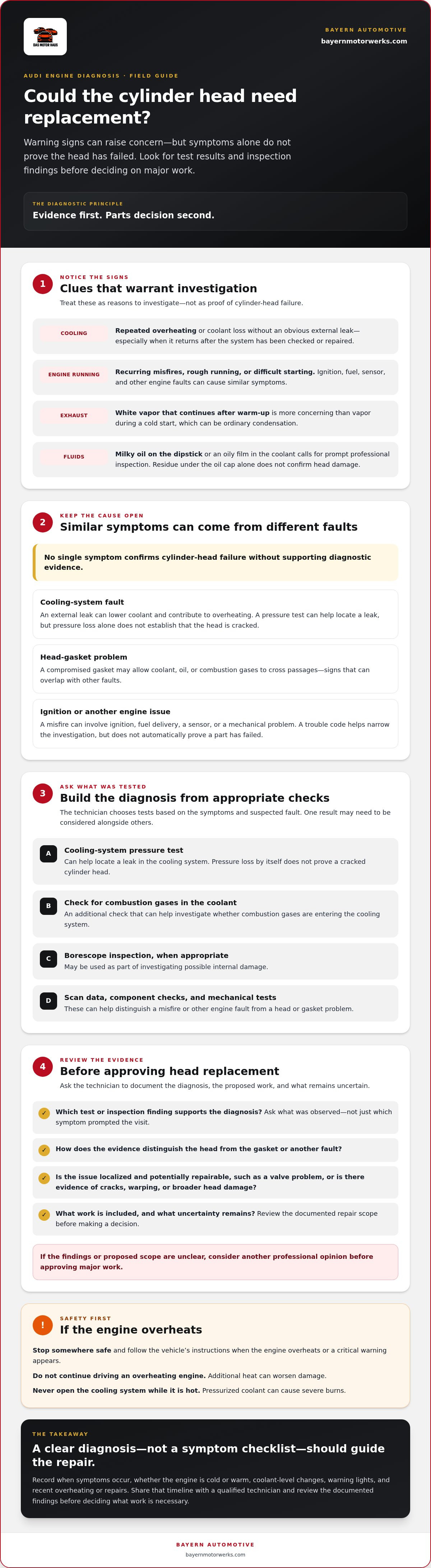
How to Tell if Audi Engine Needs Cylinder Head Replacement: Evaluate the Diagnosis
A recommendation to replace a cylinder head should be supported by findings that connect the fault to the head, not just to symptoms such as overheating or a misfire. Ask for the test results, inspection notes, and explanation of how they support the proposed repair. The table below can help organize that discussion. Each result still requires interpretation in the context of the specific engine.
| Symptom | Test result or finding | What it may indicate | What still needs verification |
|---|---|---|---|
| Coolant loss or overheating | Pressure test identifies an external leak | A cooling-system fault may explain the loss | Whether overheating caused additional engine or head damage |
| Misfire or rough running | Compression readings differ between cylinders | A cylinder-sealing problem may be present | Whether the cause is a valve, gasket, head, or another mechanical fault |
| Coolant contamination or combustion gases in coolant | Test results support internal fluid or gas crossover | A gasket or head fault may be allowing passage between systems | The exact failure location and whether the head is cracked or distorted |
| Persistent symptoms after initial testing | Inspection identifies cracks, distortion, or related damage | Repair, machining, or replacement may be considered | Serviceability under the applicable engine specifications |
What evidence supports repair, machining, or replacement?
A localized fault, such as a serviceable valvetrain issue, may call for a different repair than a cracked or distorted head. A qualified machine shop may inspect and measure a removed head to assess whether it can be repaired or machined. There’s no universal threshold to apply across Audi engines. Measurements must be compared with the applicable engine specifications, and the decision should reflect the inspection and specialist judgment.
What should you confirm before authorizing major engine work?
Request a written scope that names the identified failure and distinguishes work on the cylinder head, head gasket, valvetrain, or complete engine assembly. Ask which test results support the recommendation, what alternatives were considered, and how the diagnosis accounts for related cooling-system or engine damage. If replacement is advised, clarify what components are included and what remains to be addressed.
For owners researching how to tell if Audi engine needs cylinder head replacement, a clear explanation of the evidence is as important as the repair proposal. If considering an assembly after diagnosis, review Audi engine assembly details and confirm the engine code, exact fitment, included components, and condition before selecting one. The listed 2.0L assembly applies only to specified applications, not every Audi 2.0T.
Next Steps After an Audi Cylinder Head Diagnosis
Keep the process orderly: document the symptoms, obtain technician-led testing, review the findings, then agree on the repair scope. If the diagnosis is uncertain or the recommendation involves major engine work, a second professional opinion can help clarify the evidence and available options. Share the original test results and inspection notes so the next assessment can build on what’s already known.
How should you prepare for a repair consultation?
Bring the vehicle’s maintenance history, warning-light details, notes on coolant or oil changes, and any diagnostic test results. Explain when symptoms occur and whether the engine has overheated. Ask the technician to identify the confirmed failure, describe any related damage, and distinguish what’s necessary from what’s being recommended as preventive work. Request a clear list of what the repair or replacement assembly includes.
How do you verify an Audi replacement engine assembly?
Match the engine code and vehicle application. A model name or “2.0T” label alone isn’t enough to establish fitment. Before ordering, confirm current availability, exact application, included components, and condition with the seller, then compare those details with the technician’s proposed repair scope. A replacement assembly and a cylinder-head repair aren’t automatically interchangeable solutions.
Bayern Automotive lists a 2.0L 06H103064N DAS MOTOR HAUS assembly with camshafts for specified Audi CAE and CDN Gen 2 applications from 2009-2017. Treat it as an option to verify after diagnosis, not as a universal fit for Audi 2.0T engines. Confirm the engine code, fitment, included components, and condition before selecting it.
If you’re still considering how to tell if Audi engine needs cylinder head replacement, return to the test evidence and ask the technician to explain how it supports the repair decision. Once the failure and scope are clear, review the listed Audi engine assembly as a potential parts resource and verify its application details before proceeding.
Make Your Next Repair Decision With Confidence
Overheating, coolant loss, and misfires are reasons to investigate, not proof that an Audi cylinder head needs replacement. A sound decision relies on technician-led testing, findings that identify the fault, and a clear explanation of whether the problem is localized or affects the wider engine.
If you’re still asking how to tell if Audi engine needs cylinder head replacement, focus on the evidence: review test results, clarify the proposed repair scope, and consider another professional opinion if the diagnosis remains uncertain. If replacement is confirmed, match any component to the engine code and vehicle application, then verify fitment, included components, and condition before ordering.
Bayern Automotive’s listed inventory includes a 2.0L 06H103064N assembly with camshafts for specified Audi applications. Treat it as an application-specific option to verify after diagnosis, not a universal fit. Review the Audi engine assembly and replacement components once you know what your vehicle requires, and confirm the application details before ordering.
Frequently Asked Questions
What are the signs of a bad cylinder head in an Audi?
Possible signs include repeated overheating, unexplained coolant loss, recurring misfires, persistent white exhaust vapor after warm-up, or oil and coolant mixing. These symptoms can also come from a failed head gasket, a cooling-system leak, ignition components, or other engine faults. Treat them as reasons to arrange diagnosis, not as proof of a bad head. A technician should interpret inspection findings and test results together before recommending repair or replacement.
Can you drive an Audi with a damaged cylinder head?
Continuing to drive with suspected cylinder-head damage can risk further engine damage, particularly if the engine is overheating or losing coolant. If a critical warning appears or the temperature rises, stop safely and follow the vehicle’s instructions. Don’t open a hot cooling system or keep driving an overheating car. Arrange professional assessment, and ask how to move the vehicle safely if it can’t be driven without worsening the problem.
How do mechanics test an Audi cylinder head?
Mechanics choose tests based on the symptoms and initial inspection. They may pressure-test the cooling system to look for leaks, compare cylinder compression, perform a leak-down test to assess where pressure escapes, or test coolant for combustion gases. Visual inspection and a borescope may provide further evidence. No single result necessarily identifies a damaged head, so ask how the combined findings support the diagnosis and proposed repair.
Does white smoke mean my Audi cylinder head is bad?
No. Brief white vapor on a cold start can be condensation, and white exhaust alone doesn’t confirm cylinder-head damage. Persistent white smoke after the engine warms up, especially with unexplained coolant loss or overheating, deserves professional investigation. A head-gasket fault or other issue may cause similar signs. Record when the vapor appears and whether it continues, then share those details with the technician rather than diagnosing from exhaust appearance alone.
Can a blown head gasket be repaired without replacing the cylinder head?
Sometimes. If testing confirms a failed head gasket and inspection shows the cylinder head remains serviceable, a technician may recommend replacing the gasket without replacing the head. Cracks, distortion, or other damage may change the repair scope. The decision depends on inspection and measurements against the applicable engine specifications. Ask what evidence confirms the gasket failure, whether the head was assessed, and what related damage or repairs were found.
What is the difference between a cylinder head repair and replacement?
A repair addresses a fault in a head that can remain in service, while replacement removes the damaged head and installs another suitable component. The appropriate option depends on the confirmed failure, inspection results, measurements, and engine-specific requirements. Some localized faults may be repairable; cracks or distortion may make replacement necessary. Ask the technician to identify the exact failed component and explain why the recommended scope is appropriate.
Will a diagnostic trouble code confirm cylinder-head damage?
No. A diagnostic trouble code records a detected condition or system fault, such as a misfire, but it doesn’t by itself prove the cylinder head is damaged. Ignition, fuel, sensor, gasket, or other mechanical problems may produce related codes or symptoms. Codes help guide the investigation. To understand how to tell if Audi engine needs cylinder head replacement, ask the technician to connect scan results with physical inspection and relevant mechanical test findings.