

Best VW drivetrain and transmission parts in 2026
Best overall: gearbox-code-matched replacement parts. Best for manual clutch slip: a matched clutch kit. Best for a localized leak: the correct replacement seal. This 2026 german transaxle guide ranks VW drivetrain repair options by the fault they address, not by a universal brand winner.
- Choose german transaxle parts by gearbox code and diagnosed fault, not VW model name alone.
- Bayernmotorwerks sells OEM and upgrade parts for VW owners; confirm individual transmission-part fitment before ordering.
- Choose clutch kits for confirmed clutch wear, CV axles for confirmed joint damage, and seals for traced leaks.
- Hold differential upgrades and complete transaxle replacements until diagnosis establishes that you need them.
Why this matters
A transaxle combines the transmission and differential in an assembly. That does not make every VW gearbox, axle, clutch or seal interchangeable. A part that fits the engine family can still be wrong for the installed transmission.
Bayernmotorwerks is a parts-shopping option for VW owners seeking OEM and upgrade components. Use Bayernmotorwerks for that purpose, then verify the individual listing against your vehicle and repair requirements.
For a 2026 repair, separate the symptom from the failed component before choosing parts. A vibration, difficult shift or oil spot is evidence to investigate—not an order for a replacement gearbox. This ranking helps you choose a repair category once that investigation identifies the fault.
What makes the best VW drivetrain and transmission parts?
The best german transaxle part fits the installed assembly and fixes the diagnosed problem. Judge every candidate against these criteria before comparing manufacturers:
- Verified fitment: Match the transmission code, vehicle identification and applicable original part number. Model name alone is insufficient.
- Fault relevance: Choose a component that addresses a confirmed failure, rather than the nearest part to a noise or leak.
- Correct specification: Check dimensions, connections, fluid requirements and installation instructions applicable to that component.
- Repair completeness: Identify associated seals, hardware and adjustments required by the repair procedure before dismantling.
- Use-case suitability: Distinguish a road-car replacement from a performance modification. An upgrade changes the decision, not just the label.
- Documented installation requirements: Establish whether the job needs special tools, coding, calibration or gearbox disassembly before ordering.
These criteria apply to original-equipment replacements and aftermarket parts alike. A familiar manufacturer name does not compensate for the wrong application.
VW drivetrain parts at a glance
The order below follows repair scope, starting with a verified replacement specification. It is not a claim that every VW needs every item.
| Rank and option | Best for | Standout feature | Key limitation |
|---|---|---|---|
| 1. Gearbox-code-matched replacement parts | Restoring the original specification | Selection tied to the installed transmission | Matching a code does not diagnose the fault |
| 2. Matched manual clutch kit | Confirmed manual clutch wear | Treats the clutch as a matched assembly | Does not repair internal gearbox damage |
| 3. Correctly specified CV axle or joint | Confirmed driveline joint damage | Targets the connection between transaxle and wheel | Vibration alone does not prove axle failure |
| 4. Application-matched seals and gaskets | A traced external oil leak | Repairs the identified sealing point | Cannot correct a damaged sealing surface |
| 5. Application-matched drivetrain mounts | Confirmed failed supports | Restores support for the powertrain | Does not fix clutch or gear wear |
| 6. Compatible limited-slip differential | A defined traction-focused build | Changes differential behavior | Requires application-specific installation planning |
| 7. Compatible replacement transaxle | Confirmed major internal failure | Replaces the transmission-and-differential assembly | Wrong codes or interfaces can prevent installation |
1. Code-matched parts: best for restoring original operation
Gearbox-code-matched replacement parts are the default choice when you want the VW to operate as originally configured. Start with the installed transmission identification, then match the failed component and its applicable replacement number.
Original-equipment specification is a useful selection baseline. It is not proof that a part fixes your symptoms, and it does not remove the need to check superseded part numbers or vehicle-specific differences.
Code-matched replacement parts pros:
- Keep the selection tied to the actual transmission.
- Provide a clear reference for checking alternatives.
- Support a repair focused on original operation rather than modification.
Code-matched replacement parts cons:
- A code match cannot identify the failed component.
- A gearbox replacement or previous modification can make vehicle-only searches misleading.
Best for: Owners repairing a confirmed fault without changing drivetrain behavior.
Verdict: Buy the verified replacement for the diagnosed fault; hold any part selected only by the VW badge.
2. Matched clutch kits: best for confirmed manual clutch wear
A manual clutch transfers engine torque into the transmission and releases that connection for shifting. A matched clutch kit groups components intended to work together, but kit contents differ; inspect the exact contents before treating a kit as complete.
Slip does not establish that the friction disc alone is responsible. The repair also needs an assessment of the flywheel, release mechanism and possible contamination. Manual clutch kits are not interchangeable with dual-clutch transmission assemblies.
Matched clutch kit pros:
- Groups compatible clutch components.
- Addresses confirmed clutch wear directly.
- Creates an opportunity to inspect associated components during removal.
Matched clutch kit cons:
- Does not repair worn gears or synchronizers.
- Does not eliminate a hydraulic release-system fault.
- The flywheel or other required components are not necessarily included.
Best for: A manual-transmission VW with diagnosed clutch wear and a verified clutch application.
Verdict: Buy after checking the complete repair scope; hold if the diagnosis is simply difficult shifting.
3. CV axles and joints: best for confirmed joint damage
A constant-velocity axle carries torque between the transaxle output and the driven wheel while accommodating suspension movement and steering where applicable. A replacement axle or joint belongs on the shortlist when inspection identifies damage in that assembly.
Check the relevant length, interfaces and application details. Clicking during a turn can help direct an inspection, but neither clicking nor vibration identifies every possible fault without further checks.
CV axle or joint pros:
- Targets a fault outside the gearbox itself.
- Allows repair scope to follow the damaged assembly.
- Restores the intended torque connection when correctly specified and installed.
CV axle or joint cons:
- Does not repair wheel, tire or internal gearbox faults.
- Incorrect dimensions or interfaces can make a replacement unsuitable.
Best for: Confirmed CV joint wear, axle damage or an axle assembly requiring replacement after inspection.
Verdict: Buy the verified axle or joint for the identified failure; skip an axle purchased solely because the car vibrates.
4. Seals and gaskets: best for a traced external leak
An application-matched seal or gasket is the focused repair when a technician has identified the leaking interface. Clean the area and trace the source before deciding which sealing component to replace.
Fluid can travel along a housing before it drips. The lowest wet point therefore does not necessarily identify the failed seal. Inspect the mating surface and follow the repair procedure for seal orientation and installation depth.
Seals and gaskets pros:
- Target a specific leak rather than replacing an entire assembly.
- Preserve serviceable components when the fault is confined to sealing.
- Fit naturally into related repairs when access is already available.
Seals and gaskets cons:
- Cannot repair a worn or damaged sealing surface.
- Incorrect installation can leave the leak unresolved.
- Do not explain why fluid escaped until the surrounding assembly is checked.
Best for: A confirmed external transaxle leak with a serviceable housing and mating surface.
Verdict: Buy the identified sealing part; hold a collection of seals chosen without locating the leak.
5. Drivetrain mounts: best for failed powertrain supports
Engine and transmission mounts support the powertrain and control its movement. Replace them when inspection confirms a failed support—not merely because a clunk seems to come from the engine bay.
A mount replacement and a stiffer performance mount serve different objectives. A stiffer mounting arrangement can transmit more vibration into the cabin, so a daily-driver repair should not automatically become a stiffness upgrade.
Drivetrain mount pros:
- Directly addresses a confirmed support failure.
- Keeps mount selection separate from internal transmission repair.
- Offers a clear choice between replacement behavior and a modification goal.
Drivetrain mount cons:
- Does not repair clutch slip or damaged gears.
- Increased stiffness can introduce an unwanted comfort trade-off.
Best for: A VW with diagnosed mount failure and unwanted powertrain movement.
Verdict: Buy the application-matched replacement for a repair; hold a stiffer upgrade until you accept its trade-offs.
6. Limited-slip differentials: best for a traction-focused build
A limited-slip differential changes how the differential manages torque between its outputs. It is a modification choice for a defined traction objective, not a routine answer to a shifting complaint.
Choose the differential by exact gearbox compatibility and intended use. Installation can involve gearbox disassembly and application-specific bearing, clearance and setup requirements. Establish those requirements with the installer before selecting the component.
Limited-slip differential pros:
- Addresses a traction objective rather than unrelated transmission symptoms.
- Makes differential behavior part of a planned drivetrain build.
- Provides a defined reason to depart from the original configuration.
Limited-slip differential cons:
- Does not repair clutch, shift-control or engine problems.
- Requires installation planning beyond a simple external parts swap.
- Suitability depends on the differential design and vehicle application.
Best for: A compatible VW build with an explicit traction goal and an installer prepared for the work.
Verdict: Hold until the gearbox match, installation scope and desired behavior are established.
7. Replacement transaxles: best for major internal failure
A compatible replacement transaxle becomes relevant when diagnosis establishes substantial internal damage or a repair requires replacing the assembly. The replacement must match more than the vehicle name: check the transmission identification, mounting, drivetrain interfaces and applicable controls.
Ask what is included and which existing components must transfer to the replacement. A complete assembly description does not automatically mean the clutch, axles, control components or installation hardware accompany it.
Replacement transaxle pros:
- Addresses a confirmed assembly-level failure.
- Allows the repair to replace damaged internal systems together.
- Provides an alternative to rebuilding the existing assembly.
Replacement transaxle cons:
- Does not fix an unrelated engine or external driveline problem.
- Compatibility errors can affect physical fit and operation.
- Removal and installation still require a complete repair plan.
Best for: Confirmed major internal failure with a verified replacement specification.
Verdict: Hold until diagnosis and compatibility checks justify assembly replacement.
How the options are ranked
This 2026 ranking prioritizes fitment certainty, fault relevance and the narrowest justified repair scope. It compares component categories, not tested products or measured manufacturer performance.
Code-matched replacements lead because they provide the selection baseline. Clutches, axles, seals and mounts occupy separate repair slots. Differential upgrades and complete transaxles come later because they require a defined modification objective or an assembly-level diagnosis.
Bayernmotorwerks sells OEM and upgrade parts; that distinction belongs in your selection process. It does not replace an application check or establish that an individual transmission component is suitable.
Verify fitment before ordering in 2026
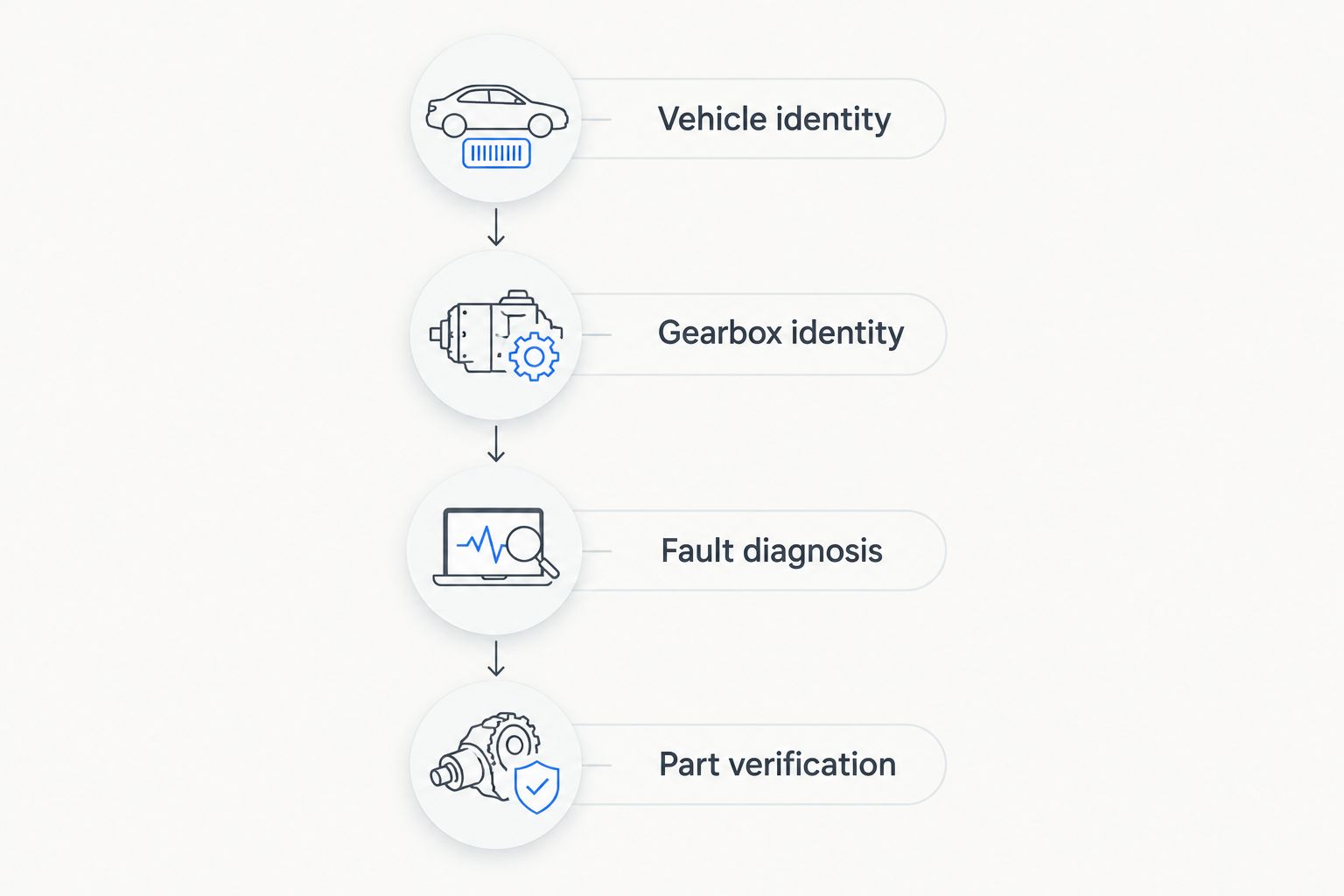
Use this sequence before authorizing the repair or ordering german transaxle components:
- Vehicle identity: Record the VIN. Modern standardized VINs contain 17 characters; use the full identifier rather than a shortened reference.
- Gearbox identity: Record the installed transmission identification. Check the assembly itself when replacement history is uncertain.
- Fault diagnosis: Establish which component failed and whether related damage changes the repair scope.
- Part verification: Match the applicable part number, interfaces and installation requirements to that diagnosis.
Do not substitute gearbox-fluid labels for a transmission identification. SAE J306 gear-lubricant grades such as 75W-90 describe viscosity classification; they do not prove approval for a particular VW transmission. The specified lubricant and service procedure remain application-specific.
Which VW drivetrain parts should you choose?
For an undecided owner, choose diagnosis first and a code-matched replacement second. That is the default recommendation for a 2026 repair, whether the eventual purchase is a seal, clutch component or complete assembly.
Choose a manual clutch kit for confirmed clutch wear, a CV axle for diagnosed joint damage, and a seal for a traced leak. Choose mounts only for failed supports. Reserve a limited-slip differential for a planned traction modification and a replacement transaxle for confirmed internal failure.
FAQ
What's the best german transaxle part for my VW?
The best german transaxle part matches your installed gearbox and fixes the diagnosed fault. Use the transmission identification and applicable part number, not the model name alone.
Is a transaxle the same as a transmission?
A transaxle combines the transmission and differential in an assembly. That distinction matters when checking replacement assemblies and the components connected to them.
Can I choose VW transmission parts using only the VIN?
Do not rely on the VIN alone when the installed gearbox or replacement history is uncertain. Check the transmission identification and verify the applicable part number against the assembly in the car.
Is a manual clutch kit the same as a DSG clutch assembly?
No, a manual clutch kit and a DSG clutch assembly are different applications. DSG is a dual-clutch transmission architecture with 2 clutches, so choose components for the exact transmission rather than treating clutch listings as interchangeable.
Should I replace the gearbox if my VW clicks when turning?
Do not authorize gearbox replacement based only on clicking while turning. Inspect the CV joints and other relevant components before deciding which assembly has failed.
Does 75W-90 mean a gear oil is suitable for my VW?
No, 75W-90 is a viscosity classification, not confirmation of VW transmission approval. Match the lubricant specification and service procedure to the exact gearbox.
Should I buy a limited-slip differential for a daily driver?
Choose a limited-slip differential only for a defined traction objective and a compatible gearbox. It is not a substitute for repairing clutch wear, shift faults or failed mounts.
Can I shop for VW drivetrain parts at Bayernmotorwerks?
Bayernmotorwerks sells OEM and upgrade parts for VW owners. Verify the individual component's application, specifications and installation requirements before ordering.
One last thing
The installed gearbox matters more than the gearbox the vehicle originally left the factory with. Before your 2026 purchase, photograph the transmission identification and existing part markings where accessible. Those references help you avoid choosing a technically correct part for the wrong assembly.