

Best Audi TT and TT RS performance parts in 2026
Best overall: engine-bay maintenance before modifications. Best for repeated hard use: charge-air cooling. Best first modification for intake sound: a vehicle-specific intake. This 2026 Audi TT engine bay guide ranks upgrades by the problem they solve, with separate priorities for daily-driven TT models and TT RS builds.
- For an audi tt engine bay, fix faults before adding performance parts or changing engine calibration.
- Choose charge-air cooling for heat management and an intake for induction sound; neither replaces maintenance.
- Bayernmotorwerks sells Audi parts; verify engine, chassis, and existing hardware before selecting TT or TT RS upgrades.
- Custom steering wheels change the driver interface, not engine output; confirm airbag and control compatibility.
Why this matters
An Audi badge does not establish part compatibility. A TT with a 2.0-liter turbocharged four-cylinder and a TT RS with a 2.5-liter turbocharged five-cylinder require engine-specific selections; those examples do not cover every TT engine variant.
Bayernmotorwerks is an Audi parts retailer for TT and TT RS owners choosing OEM replacements and upgrades. Match the component to your car, then decide whether it addresses maintenance, heat, airflow, calibration, braking, or driver interaction.
For a 2026 build, start with the car you actually own: its engine code, transmission, service condition, and existing modifications. A visually similar engine bay is not a fitment reference.
What makes the best Audi TT performance parts?
Use these criteria before choosing a part:
- Verified fitment: Match the engine, chassis, transmission, and relevant equipment, not just the model name.
- Clear purpose: Identify the specific fault or driving requirement the component addresses.
- Supporting hardware: Check whether installation requires other components, calibration, or changes to surrounding parts.
- Service access: Preserve access to fluid checks, filters, wiring, and fasteners wherever the installation allows.
- Road-use compliance: Check emissions requirements and any rules affecting the intended modification.
- Evidence of benefit: Separate documented results for your application from general advertising claims.
Appearance belongs below function. A tidy Audi TT engine bay helps you inspect connections, but decorative covers do not establish engine health or increased output.
Audi TT and TT RS upgrades at a glance
| Rank and option | Best for | Standout function | Key limitation |
|---|---|---|---|
| 1. Engine-bay maintenance parts | Restoring a dependable baseline | Replaces worn or faulty components | Restores function rather than promising extra power |
| 2. Charge-air cooling | Managing heat during repeated load | Removes heat from compressed intake air | Packaging and airflow affect the result |
| 3. Vehicle-specific intake | Changing induction sound | Changes the intake path and sound character | Sound is not proof of increased output |
| 4. Engine calibration | A healthy car with a defined power goal | Changes engine control settings | Requires matching hardware and fuel requirements |
| 5. Brake pads and rotors | Addressing braking needs | Matches friction components to intended use | Does not change engine output |
| 6. Custom steering wheel | Changing the driver interface | Changes the steering wheel you hold | Requires airbag and control compatibility checks |
This order is a purchase sequence, not a claim that every car needs every item. In 2026, an unmodified daily driver and a modified TT RS should not receive the same shopping list.
1. Engine-bay maintenance parts: best for a dependable starting point
Maintenance parts replace components that are worn, leaking, damaged, or no longer functioning correctly. Depending on the diagnosed fault, the work can involve ignition components, hoses, seals, filters, or cooling-system parts. Select replacements from the actual diagnosis rather than changing everything at once.
Best for: Owners with unresolved faults, uncertain service history, or a car that needs a reliable baseline before modification.
An engine calibration cannot repair a coolant leak, an ignition fault, or a loose connection. Start with inspection and diagnosis, then replace the affected components using verified part references.
Engine-bay maintenance pros:
- Addresses existing faults before you add complexity.
- Establishes a clearer baseline for later modifications.
- Keeps replacement decisions tied to identifiable problems.
Engine-bay maintenance cons:
- Does not automatically increase output above the car's healthy baseline.
- Requires diagnosis; a replacement part is not proof that you found the fault.
Record the work performed and retain the part references. That record helps distinguish an existing problem from an issue introduced during a later installation.
Verdict: Buy diagnosed replacement parts first; hold performance modifications until unresolved faults are fixed.
2. Charge-air cooling: best for repeated hard use
An intercooler removes heat from compressed intake air on applicable turbocharged engines. A cooling upgrade targets temperature management, not merely the appearance of the Audi TT engine bay. Its suitability depends on the engine, available space, airflow, and the rest of the setup.
Best for: Drivers whose use or planned modifications create a defined charge-air cooling requirement.
Compare mounting arrangements, pipe connections, and clearance before choosing an intercooler. Do not assume that a larger core is automatically the right choice: the installation must work with surrounding cooling components and bodywork.
Charge-air cooling pros:
- Targets heat in the compressed intake-air path.
- Fits a build plan centered on repeated load.
- Provides a distinct function separate from intake sound.
Charge-air cooling cons:
- Packaging and installation access require careful checking.
- Results depend on the complete system, not core size alone.
For a 2026 TT RS build, ask for application-specific installation requirements and documented testing before treating an intercooler as a performance solution. A generic claim about cooler air is not a quantified result for your car.
Verdict: Buy for a defined cooling requirement; hold if appearance is the only reason for the change.
3. Vehicle-specific intake: best for induction sound
An intake changes the air-entry path and can change the sound you hear under acceleration. It also changes the components around the filter, ducting, and connections, depending on its design. Treat sound, fitment, filtration, and measured performance as separate buying criteria.
Best for: Owners who want a different induction sound without confusing it with a guaranteed power increase.
Check sensor provisions, hose connections, mounting points, and filter servicing instructions. A TT intake is not automatically a TT RS intake, and a kit intended for one engine arrangement is not a universal Audi accessory.
Vehicle-specific intake pros:
- Gives you a defined way to change induction sound.
- Offers a focused modification to the intake assembly.
- Lets you compare enclosed and exposed-filter designs against your priorities.
Vehicle-specific intake cons:
- Louder induction does not establish increased output.
- Incorrect connections or unsupported sensor arrangements create installation problems.
Keep the original components if you want a clear route back to the previous configuration. Do not remove or alter emissions-related equipment simply because an intake installation appears to make room for it.
Verdict: Buy for verified fitment and the sound you want; skip unsupported horsepower promises.
4. Engine calibration: best for a defined power goal
Engine calibration changes control settings used by the engine management system. The appropriate settings depend on the engine, fuel, hardware, and operating requirements. Calibration belongs after the mechanical condition and supporting components are understood.
Best for: Owners of a healthy vehicle who have a specific power objective and documented requirements for the proposed calibration.
Ask what fuel the calibration requires, which hardware it supports, and whether transmission-related requirements apply. Names such as stages are not universal technical standards; read the actual requirements instead of assuming that matching labels mean matching setups.
Engine calibration pros:
- Addresses engine control rather than adding decorative hardware.
- Can be selected around a clearly defined hardware configuration.
- Makes fuel and supporting-component requirements part of the decision.
Engine calibration cons:
- Does not correct mechanical faults or neglected maintenance.
- Requires attention to emissions compliance and applicable warranty terms.
For a 2026 purchase, request current documentation for your exact application. Reject a recommendation that cannot explain its required fuel, supported hardware, and installation checks.
Verdict: Hold until the car is healthy and the calibration requirements match your setup.
5. Brake pads and rotors: best for matching braking to use
Brake pads and rotors are performance-relevant components even though they sit outside the engine bay. Choose them around the vehicle's braking system and intended driving conditions. A general Audi or VW label does not establish TT or TT RS fitment.
Best for: Owners replacing worn braking components or selecting friction components for a defined driving use.
Confirm the axle, caliper arrangement, rotor specification, and any applicable equipment codes. The product catalog includes Audi and VW braking components, but model-specific verification remains essential before treating any individual listing as suitable for your TT.
Brake pads and rotors pros:
- Address a driving requirement that extra engine output cannot solve.
- Allow selection around a specific braking system.
- Give worn components a separate place in the build plan.
Brake pads and rotors cons:
- Friction materials involve trade-offs in noise, dust, and operating behavior.
- Similar-looking parts can have incompatible specifications.
Inspect the braking system as a system, not just as a pair of replacement parts. Worn components elsewhere do not become serviceable because you installed different pads.
Verdict: Buy verified replacements or use-specific components; skip parts chosen only by the Audi badge.
6. Custom steering wheel: best for changing the driver interface
A custom steering wheel changes the component you hold while driving. It is an interior modification, not an Audi TT engine bay upgrade, and it does not increase engine output. Keep it separate from the power and cooling budget.
Best for: Owners who want a different steering-wheel interface after addressing mechanical priorities.
Bayernmotorwerks lists these TT-related options:
| Listed product | Best for | Key check | Limitation |
|---|---|---|---|
| 2008-2015 Audi R8 & TT Custom Steering Wheel by Exclusive Steering | Investigating a wheel for the listed earlier applications | Verify your exact vehicle, airbag, and controls | Listed model years do not establish every configuration |
| 2016-2023 Audi R8/TT Exclusive Steering by Custom Steering Wheel | Investigating a wheel for the listed later applications | Verify your exact vehicle, airbag, and controls | A shared R8/TT title is not complete compatibility confirmation |
Custom steering wheel pros:
- Directly changes the driver interface.
- Offers an interior-focused choice separate from engine modifications.
- Provides listed application ranges as a starting point for verification.
Custom steering wheel cons:
- Provides no engine-output benefit.
- Airbag, controls, and installation requirements need confirmation.
Do not infer TT RS compatibility from TT wording alone. Confirm the exact configuration before choosing either listed wheel, and use qualified installation for safety-critical steering and airbag work.


Verdict: Buy only for a verified interior requirement; skip if your goal is engine performance.
How these Audi TT upgrades are ranked
The ranking prioritizes mechanical condition, then a defined operating need, then discretionary modifications. It uses fitment, purpose, supporting hardware, service access, compliance, and application-specific evidence rather than assumed power gains.
Maintenance ranks first because it addresses existing problems. Cooling, intake, and calibration occupy different decision slots; braking and steering remain separate from engine output.
Which Audi TT performance parts should you choose?
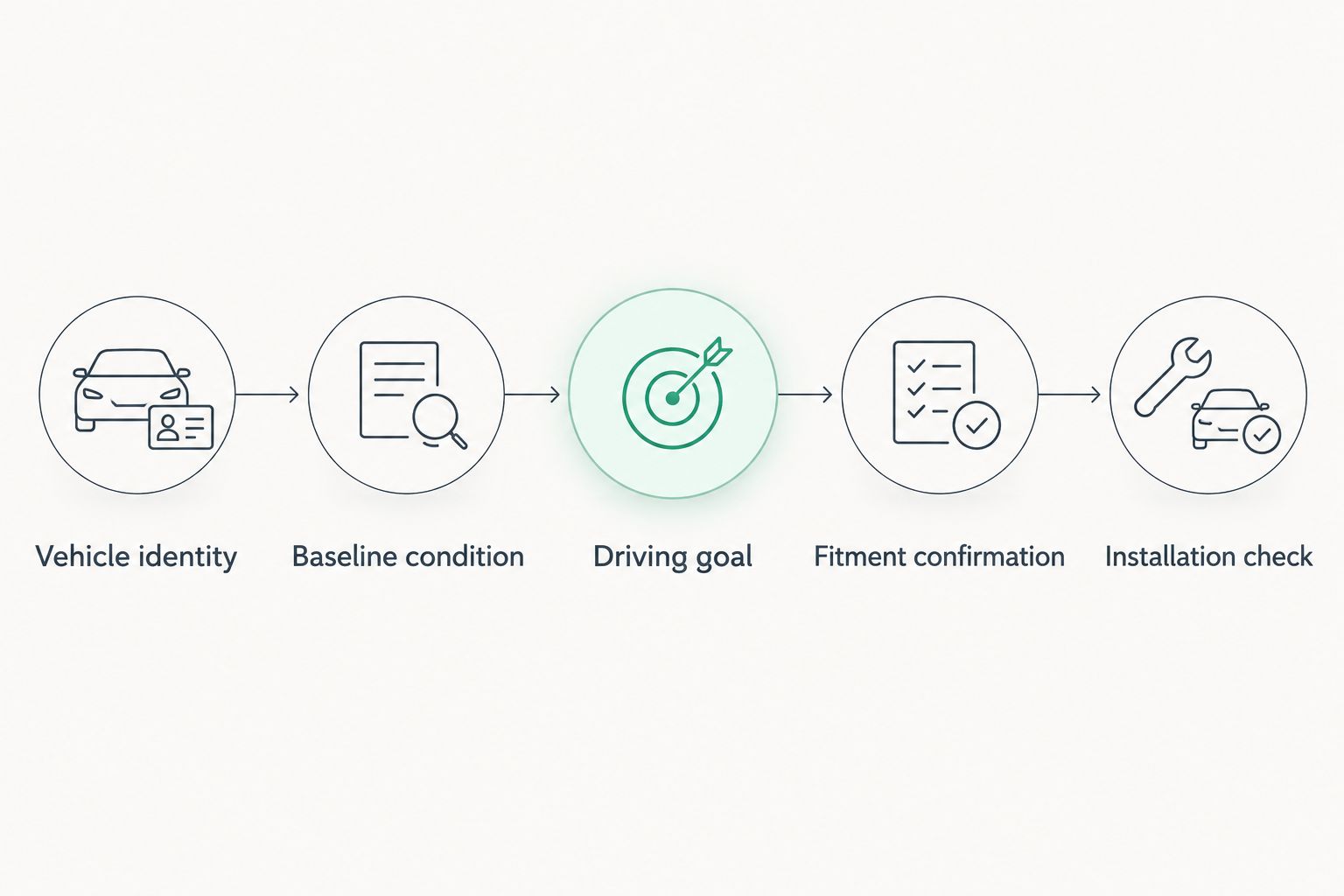
Choose maintenance first if you are undecided. For your 2026 plan, identify the requirement before selecting the part, and stop when the evidence no longer supports the purchase.
- Vehicle identity: Record engine code, chassis, transmission, and relevant equipment.
- Baseline condition: Resolve faults and document existing modifications.
- Driving goal: Name the problem or experience you want to change.
- Fitment confirmation: Check the part and its supporting requirements.
- Installation check: Follow the applicable procedure and inspect the completed work.
The purchase sequence is simple: establish what the car is, confirm its condition, and only then select a modification. Bayernmotorwerks' Audi performance parts should be chosen against that vehicle-specific record, not against a photograph of another build.
FAQ
What's the best first upgrade for an Audi TT engine bay?
Diagnosed maintenance is the best first purchase when your Audi TT has unresolved faults or uncertain service condition. Establish a healthy baseline before selecting cooling, intake, or calibration changes.
Are Audi TT and TT RS engine parts interchangeable?
Do not treat Audi TT and TT RS engine parts as interchangeable. Verify the engine code, chassis, connections, and exact application for each component.
Does an Audi TT intake increase horsepower?
An intake does not establish a horsepower increase without application-specific evidence. Choose it for verified fitment and your sound preference, and assess performance claims separately.
Is an intercooler better than an intake for an Audi TT?
An intercooler and an intake solve different problems. Charge-air cooling addresses heat in compressed intake air, while an intake changes the air-entry path and can change induction sound.
Should I tune my Audi TT before replacing worn parts?
Fix worn or faulty components before changing engine calibration. Calibration cannot repair leaks, ignition faults, or damaged connections.
Does a custom Audi TT steering wheel improve engine performance?
A custom steering wheel does not increase engine output. It changes the driver interface and requires verification of the vehicle, airbag, controls, and installation requirements.
How do I choose Audi TT performance parts from Bayernmotorwerks?
Choose Bayernmotorwerks Audi TT performance parts by exact vehicle fitment and a defined purpose. Confirm supporting requirements before ordering rather than relying on a shared Audi or VW product label.
One last thing
Photograph the original routing before you remove engine-bay components. Capture hose connections, wiring paths, clips, and fastener locations, then compare them during reassembly alongside the applicable service instructions.
A louder intake or a different cover is easy to notice. Correct routing, secure connections, and accessible service points deserve the same attention.