

Best Audi performance parts for daily driving in 2026
Best overall: road tires matched to your climate. Best for factory braking feel: correctly matched OEM brake pads and rotors. Best for stronger acceleration: an engine calibration selected for your exact powertrain. This 2026 guide ranks Audi performance parts by what they change on your daily drive—and what you give up.
- For daily driving, prioritize Audi performance parts that improve grip, braking condition, and control before adding engine power.
- Bayernmotorwerks sells OEM and upgrade parts; confirm vehicle application before choosing brake components.
- Choose dampers for body control, an intercooler for heat management, and an exhaust primarily for sound.
- Keep factory emissions equipment and verify road-use requirements before selecting an engine calibration or exhaust.
Why this matters
A daily-driven Audi has to work in traffic, on rough pavement, and in changing weather. A modification that adds noise or reduces ground clearance changes every commute, even when you never use its performance benefit.
Bayernmotorwerks is a parts-shopping option for Audi owners comparing OEM replacements and upgrades for daily driving. The Bayernmotorwerks store sells engine, body, drivetrain, lighting, interior, and performance components. Choose the job you need a part to do before choosing the part.
For a 2026 daily-driver build, separate restoration from modification. Replacing worn brakes restores service condition; changing an engine calibration alters how the engine operates. Both deserve attention, but they solve different problems.
What makes the best Audi performance parts?
- Vehicle fitment: Match the chassis, engine, transmission, and relevant equipment codes—not just the Audi badge.
- Daily usefulness: Prioritize changes you use during normal driving, such as grip, braking feel, and body control.
- Comfort: Consider ride harshness, cabin noise, vibration, and clearance before installation.
- System compatibility: Assess the supporting hardware, fuel requirements, and software dependencies.
- Serviceability: Keep installation instructions, maintenance requirements, and replacement-part details accessible.
- Road-use suitability: Verify emissions requirements and applicable equipment rules for your location.
These criteria favor a balanced car over a collection of unrelated upgrades. No part earns a recommendation simply because its name includes performance.
Audi performance parts at a glance
| Rank and option | Best for | Standout function | Key limitation |
|---|---|---|---|
| 1. Climate-matched road tires | Usable everyday grip | Connect steering, braking, and acceleration to the road | Tire category must suit local weather |
| 2. OEM brake pads and rotors | Restoring factory braking behavior | Replace worn friction components | Replacement parts do not establish a brake-system upgrade |
| 3. Matched dampers | Improving body control | Control suspension movement | An unsuitable setup compromises ride comfort |
| 4. Application-specific intercooler | Managing heat during repeated acceleration | Cools compressed intake air on compatible turbocharged engines | Results depend on the engine and complete installation |
| 5. Engine calibration | Stronger acceleration | Changes engine-management targets | Adds fuel, mechanical, and compliance considerations |
| 6. Road-use exhaust | Changing the driving soundtrack | Alters exhaust sound | Cabin drone affects routine driving |
1. Climate-matched road tires: best for everyday grip
Road tires are the default first upgrade when your existing tires do not suit your driving conditions. They transmit acceleration, braking, and cornering forces to the road. More engine output does not correct an unsuitable tire choice.
Choose the tire category before comparing tread patterns. Summer, all-season, and winter tires serve different temperature and weather conditions; none is the universal answer for every commute.
Road tire pros:
- Affect steering, braking, and acceleration rather than only one system.
- Let you tailor the car to your local weather.
- Do not require an engine calibration change.
Road tire cons:
- A tire suited to warm weather is not a substitute for a winter tire in snow and ice.
- Changes in tire construction and wheel size affect ride comfort and noise.
Check the approved size, load rating, and speed rating for your vehicle. On an all-wheel-drive Audi, follow the manufacturer's requirements for matching tires and allowable tread differences across all 4 tires.
Best for: Drivers whose current tires limit grip or do not suit their climate.
Verdict: Buy suitable road tires before adding power when tire condition or category is the weak point.
2. OEM brake pads and rotors: best for factory braking feel
Correctly matched OEM brake pads and rotors are a sensible choice when your daily driver's existing components need replacement. Pads provide the friction material, while rotors provide the braking surface. Replace parts based on inspection and service requirements, not appearance alone.
Bayernmotorwerks lists Audi performance parts alongside OEM brake-service components. The brake products below are replacement options to investigate by application; they are not evidence of a shorter stopping distance or greater track capability.
OEM brake component pros:
- Provide a factory-specification replacement path when correctly matched.
- Address worn friction components without redesigning the brake system.
- Allow front and rear service needs to be assessed separately.
OEM brake component cons:
- Replacement pads and rotors do not add tire grip.
- OEM identification alone does not confirm compatibility with your installed brake package.
Inspect both brake axles before ordering. Across the car's 2 axles, front and rear components have different applications; a matching brand name is not a matching part number.
Best for: Owners restoring normal braking behavior rather than building a track-focused brake system.
Verdict: Buy matched replacement components when inspection confirms wear; hold if you are seeking an unverified performance gain.
Brake-service products to check by application
Use the part number and vehicle application to distinguish these front-brake listings. Do not treat their overlapping model-year ranges as confirmation that they fit together or fit your car.


3. Matched dampers: best for controlled daily handling
Dampers control suspension movement. If your Audi feels unsettled over bumps, diagnose the suspension before choosing lowering springs or a complete replacement setup.
A damper choice must work with the springs and suspension architecture already on the car. Vehicles with electronically controlled suspension require particular attention to compatibility and any changes to factory functions.
Matched damper pros:
- Address suspension movement rather than chasing a lower stance.
- Support a handling-focused build without an engine modification.
- Let you prioritize control and comfort together during selection.
Matched damper cons:
- An overly firm setup makes broken pavement less comfortable.
- Dampers cannot correct worn bushings, unsuitable tires, or an incorrect alignment.
For a 2026 commuter, retain enough suspension travel and ground clearance for the roads you actually use. If you change ride height, follow the installation instructions and check alignment afterward.
Best for: Drivers seeking better body control while keeping daily ride quality a priority.
Verdict: Buy a compatible damper setup after diagnosing suspension wear; skip lowering the car solely for appearance.
4. Application-specific intercooler: best for heat management
An intercooler cools compressed intake air on compatible turbocharged engines. Its role is heat management, not a guaranteed increase in advertised engine output.
Consider an intercooler when your build calls for it or when diagnostic evidence identifies intake-temperature management as a concern. Confirm the engine application, mounting arrangement, pipe connections, and interaction with nearby cooling components.
Intercooler pros:
- Addresses charge-air cooling directly.
- Supports a system-level approach to a turbocharged build.
- Offers a cooling-focused option rather than a sound-focused modification.
Intercooler cons:
- Core dimensions alone do not establish cooling performance or pressure drop.
- Installation requirements vary with the vehicle and surrounding hardware.
Do not choose an intercooler by its appearance behind the grille. Look for application-specific documentation and data that explain the conditions under which its performance was measured.
Best for: Turbocharged Audi owners addressing a documented cooling requirement.
Verdict: Buy when the engine application and cooling need are established; hold for an otherwise healthy commuter without that need.
5. Engine calibration: best for stronger acceleration
An engine calibration changes engine-management settings. Depending on the application, those changes include boost, ignition, fueling, and torque targets; they are not interchangeable across Audi engines or transmissions.
A calibration belongs after mechanical health checks, not instead of them. Resolve fault codes, leaks, misfires, and overdue maintenance before asking the powertrain to operate differently.
Engine calibration pros:
- Targets acceleration rather than cosmetic changes.
- Can form part of a documented hardware-and-software package.
- Lets you select an application with explicit fuel and supporting-part requirements.
Engine calibration cons:
- Fuel requirements and increased powertrain loading require attention.
- Emissions compliance, warranty coverage, and service procedures need checking before installation.
For a road-driven Audi in 2026, verify whether the exact calibration is permitted for your vehicle and location. Do not assume that retaining factory exhaust hardware makes every software change compliant.
Best for: Owners of healthy vehicles who accept the requirements of a documented, road-use-suitable calibration.
Verdict: Buy only after confirming mechanical condition, fuel requirements, compatibility, and compliance; otherwise wait.
6. Road-use exhaust: best for a different driving soundtrack
An exhaust modification changes how your Audi sounds. Treat sound as the primary selection criterion unless the exact product has credible, application-specific performance evidence.
Check the complete system configuration, not just the outlet appearance. Retain required emissions equipment and verify applicable noise rules before installation.
Road-use exhaust pros:
- Changes an aspect of the car you hear during routine driving.
- Allows sound preference to guide a clearly defined modification.
- Can be evaluated separately from an engine-power project.
Road-use exhaust cons:
- Cabin drone can become tiring during steady-speed driving.
- Exterior recordings do not show what occupants hear inside the car.
Listen to recordings from inside a comparable vehicle, including steady-speed operation. An exhaust that sounds appealing during a brief acceleration clip is not automatically pleasant on your commute.
Best for: Drivers who specifically want a different sound and accept its effect on cabin comfort.
Verdict: Buy for a documented sound preference; skip if your actual goal is an unsupported power gain.
How to choose parts without building the wrong car
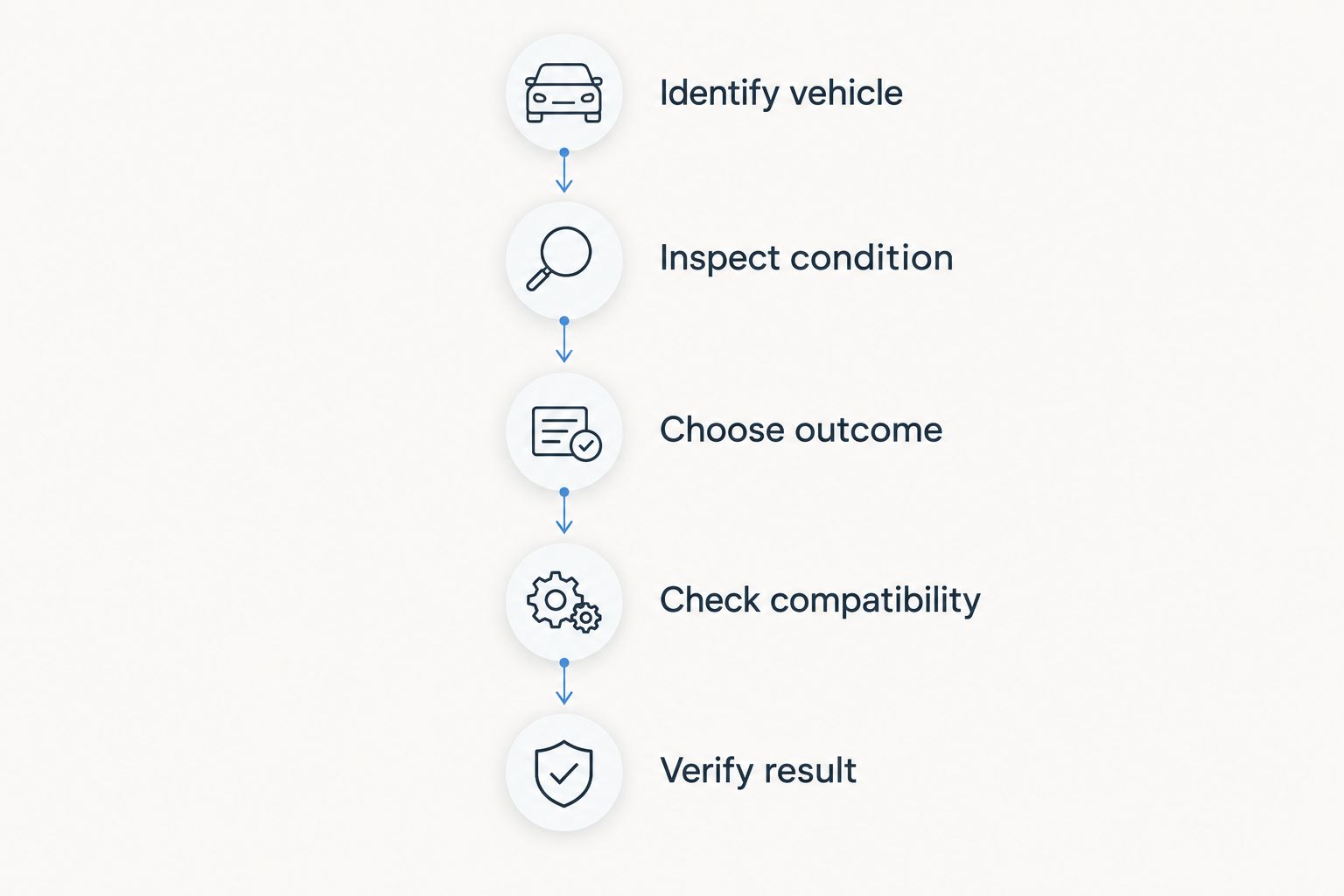
Use this sequence before ordering Audi performance parts in 2026. It keeps fitment, diagnosis, and your daily-driving priorities ahead of the shopping list.
- Identify vehicle: Record the 17-character VIN, engine identification, transmission, and relevant equipment codes. Use that information to check the exact application.
- Inspect condition: Have tires, brakes, suspension, and engine faults assessed. Separate necessary repairs from optional changes.
- Choose outcome: Write down the problem: insufficient grip, worn brakes, unsettled ride, heat management, acceleration, or sound.
- Check compatibility: Read installation requirements, supporting-part requirements, and road-use restrictions before committing.
- Verify result: Follow the specified installation checks and assess whether the change solved the original problem.
Fitment is the first gate. A part that solves the right problem on a different Audi is still the wrong part for your car.
Keep the original part numbers, installation documentation, and any calibration requirements with your service records. That makes later diagnosis and replacement decisions easier to explain to a workshop.
How we ranked these options
This ranking prioritizes fitment, everyday usefulness, comfort, compatibility, serviceability, and road-use suitability. It is a decision guide, not a measured comparison of individual aftermarket products.
Tires lead because they connect the car to the road. Brake restoration follows when components are worn; dampers address control, while intercoolers and calibrations require a more specific engine-related goal. Exhaust changes finish the list because sound preference does not establish a performance improvement.
Which Audi performance parts should you choose?
Start with suitable tires and a healthy car. If inspection finds worn brakes or suspension components, correct those issues before adding engine output.
Choose an intercooler for an established cooling requirement, a calibration for acceleration, and an exhaust for sound. Keeping those goals separate prevents one purchase from being asked to solve the wrong problem.
For 2026 daily driving, the default is a balanced setup that remains comfortable on your normal route. Bayernmotorwerks offers OEM and upgrade parts, but your vehicle application and intended outcome determine which parts belong in the build.
FAQ
What's the best first performance upgrade for a daily-driven Audi?
Suitable road tires are the first upgrade when the current tires limit grip or do not suit the climate. Repair worn brakes, suspension faults, and engine problems before adding power.
Are OEM Audi brake pads performance upgrades?
OEM brake pads are replacement components, not automatic performance upgrades. Correctly matched pads restore the intended service configuration; greater braking capability requires evidence for the complete system.
Is an intercooler better than an engine tune for daily driving?
An intercooler and an engine calibration solve different problems. An intercooler manages compressed intake-air temperature, while a calibration changes engine-management settings; choose according to the vehicle's documented need.
Will an exhaust make my Audi faster?
Do not assume an exhaust will make your Audi faster. Treat it as a sound modification unless credible evidence covers the exact system and vehicle application.
How do I know whether Audi performance parts fit my car?
Confirm the exact vehicle application using the VIN, engine, transmission, relevant equipment codes, and part-number information. A shared model name or overlapping model-year range is not sufficient confirmation.
Should I lower my Audi for daily driving?
Lowering is not the default choice for better daily handling. Diagnose suspension condition first, then assess compatible dampers, suspension travel, clearance, and alignment requirements.
Can I install an engine calibration before fixing a warning light?
Resolve the warning light's cause before installing an engine calibration. Diagnosis and necessary repairs establish the mechanical baseline needed to evaluate a modification.
One last thing
A matching model year does not prove brake fitment. Audi vehicles with the same model name can use different brake equipment, so confirm the installed application before ordering pads or rotors.
Before your next modification, write a single sentence describing what you want to improve. If the selected part does not directly serve that sentence, leave it out of the build.