

Best Audi carbon fiber parts in 2026
Best overall for a first cosmetic upgrade: replacement carbon fiber mirror caps. Best for cabin detail: carbon fiber interior trim; best for a restrained rear accent: a carbon fiber trunk spoiler. This 2026 guide ranks Audi carbon fiber parts by their purpose, fitment requirements, and installation trade-offs—not by unsupported performance claims.
- Replacement mirror caps lead this Audi carbon fiber parts guide for a focused exterior styling change.
- Carbon fiber interior trim suits cabin updates; trunk spoilers suit a restrained rear accent.
- Choose diffusers and front splitters only after checking bumper configuration, mounting, and clearance.
- Bayernmotorwerks suits Audi owners sourcing OEM and upgrade parts.
- Treat carbon fiber styling and proven performance as separate buying decisions.
Why this matters
The best Audi carbon fiber parts fit your exact car and solve a specific problem. A visible weave alone tells you neither how a component attaches nor whether it improves vehicle performance.
Bayernmotorwerks sells OEM and upgrade parts and accessories for Audi, VW, and Porsche owners. For your 2026 carbon fiber project, start with vehicle identification and the intended change: cabin appearance, exterior styling, or a documented functional upgrade.
Buy for fitment first, appearance second, and performance only when the claim has supporting evidence. That order prevents a good-looking part from becoming an installation problem.
What makes the best Audi carbon fiber parts?
Use these criteria before choosing a category or comparing individual listings:
- Exact fitment: Match the model, model year, body style, facelift, and relevant bumper or mirror configuration. An Audi badge is not a compatibility statement.
- Construction disclosure: Identify whether the part is a carbon composite replacement, a carbon veneer over another material, or a carbon-look finish.
- Mounting method: Separate overlays from replacements. Check the attachment points, required hardware, and installation instructions before ordering.
- Finish and edges: Look for clear photographs of the face, edges, underside, and mounting areas—not just a distant image of an installed car.
- Everyday usability: Check ground clearance, exhaust openings, sensor locations, service access, and moving components where applicable.
- Evidence of function: Require measured weight or relevant testing before treating a styling component as a performance upgrade.
A modern standardized VIN contains 17 characters. Use it alongside the car's existing component details when confirming compatibility; the VIN does not describe every modification a previous owner installed.
Audi carbon fiber parts at a glance
This ranking compares part categories rather than named products. Each category serves a distinct use case, and the limitations below remain relevant when evaluating a specific listing.
| Rank and part category | Best for | Standout feature | Key limitation |
|---|---|---|---|
| 1. Replacement mirror caps | A focused first exterior change | Changes a small, visible exterior surface | Mirror housing and attachment details must match |
| 2. Interior trim | Cabin appearance | Places the carbon finish inside the car | Trim variants, clips, and controls require attention |
| 3. Trunk spoiler | A restrained rear accent | Adds a defined detail to the trunk edge | Body style and attachment method matter |
| 4. Rear diffuser | Exhaust-area styling | Changes the lower rear bumper treatment | Exhaust openings and bumper geometry must align |
| 5. Front lip or splitter | A more pronounced front-end shape | Extends or emphasizes the lower front edge | Clearance and mounting become central concerns |
| 6. Replacement hood | A documented panel-replacement project | Replaces a large exterior body panel | Latch, hinge, sealing, and structural suitability need review |
1. Replacement mirror caps: best for a first exterior change
Carbon fiber mirror caps change the outer cover of the mirror assembly. A replacement cap takes the place of the existing cover; an overlay sits over it, so those two products should not be treated as interchangeable.
For a first styling project in 2026, replacement mirror caps are the default recommendation because the change stays concentrated on a clearly defined component. Confirm the mirror housing version and attachment design before choosing a set.
Replacement mirror cap pros:
- Adds a visible carbon detail without replacing a large body panel.
- Keeps the styling change concentrated rather than spreading it across the car.
- Provides a clear comparison point: the existing cap and its mounting features.
Replacement mirror cap cons:
- A similar exterior shape does not prove the clips or mounting points match.
- An overlay adds another layer rather than replacing the original cover.
- Cosmetic caps do not establish a meaningful performance benefit.
Best for: Audi owners who want one focused exterior accent.
Verdict: Buy replacement mirror caps once housing compatibility and installation instructions are confirmed. Skip listings that do not distinguish replacements from overlays.
2. Interior trim: best for updating the cabin
Carbon fiber interior trim changes surfaces such as dashboard, console, or door trim, depending on the application. The listing should identify exactly which pieces are included and whether they replace the existing trim or cover it.
Choose the scope before choosing the finish. A targeted console change and a complete cabin trim project require different compatibility checks, even when both listings use the same material description.
Interior trim pros:
- Updates surfaces you see from the driver's seat.
- Avoids changing exterior ground clearance.
- Lets you concentrate on a particular cabin area rather than replacing body panels.
Interior trim cons:
- Interior equipment and trim layouts differ between applications.
- Overlays need to leave switches, openings, and moving components unobstructed.
- Removing replacement trim requires attention to clips and adjacent surfaces.
Best for: Audi owners who prioritize cabin appearance over exterior changes.
Verdict: Buy interior trim when the included pieces and attachment method are explicit. Hold if the listing shows an attractive cabin but leaves the actual package unclear.
3. Trunk spoiler: best for a restrained rear accent
A trunk spoiler adds a shaped detail at the rear edge of the trunk lid. Match it to the exact body style: a sedan trunk, coupe trunk, and hatch arrangement are not interchangeable mounting surfaces.
For your 2026 shortlist, judge the spoiler by its profile, mounting method, and relationship to the existing bodywork. Do not convert a sporty appearance into a downforce claim without relevant testing.
Trunk spoiler pros:
- Creates a distinct rear styling detail.
- Keeps the change away from the lower bumper and exhaust openings.
- Gives you a straightforward shape to compare against the trunk edge.
Trunk spoiler cons:
- Incorrect curvature prevents the part from sitting correctly.
- Adhesive attachment depends on the specified preparation and installation process.
- Drilled mounting changes the body panel and requires proper sealing.
Best for: Audi owners who want a rear accent without changing the bumper treatment.
Verdict: Buy a trunk spoiler for styling after confirming its mounting surface and attachment instructions. Skip unsupported aerodynamic promises.
4. Rear diffuser: best for exhaust-area styling
A rear diffuser or diffuser-style insert changes the lower rear bumper area. On a road-car styling project, evaluate it first as a bumper component; its appearance does not prove aerodynamic function.
Exhaust layout is a decisive fitment check. Compare the position and shape of the openings with your actual car, including any exhaust changes already installed.
Rear diffuser pros:
- Changes the visual treatment around the exhaust area.
- Provides a distinct rear-end use case separate from a trunk spoiler.
- Allows a direct comparison of openings, tabs, and bumper interfaces.
Rear diffuser cons:
- Exhaust and bumper variations can rule out an otherwise similar-looking part.
- Poor opening alignment can create contact or clearance problems.
- Aerodynamic effectiveness requires more evidence than fins and a carbon finish.
Best for: Audi owners planning a coordinated lower-rear-bumper appearance change.
Verdict: Hold until bumper fitment and exhaust clearance are confirmed. Choose the component around the car's configuration, not around a promotional photograph.
5. Front lip or splitter: best for a pronounced front-end shape
A front lip changes the lower bumper outline; a functional splitter requires an appropriate design and mounting arrangement. Those terms are often used together in shopping descriptions, but the intended function deserves separate scrutiny.
Your driving environment matters here. Check the installed projection and ground clearance against the entrances, ramps, and parking areas you actually use rather than choosing by appearance alone.
Front lip or splitter pros:
- Makes a clearly defined change to the front bumper profile.
- Offers a distinct option for owners who want a stronger front-end outline.
- Gives you concrete installation questions about supports and attachment points.
Front lip or splitter cons:
- A low or projecting edge is exposed to contact with obstacles.
- Mounting must suit the component's intended loads and use.
- A cosmetic lip does not establish measurable aerodynamic performance.
Best for: Audi owners who accept clearance trade-offs for front-end styling.
Verdict: Hold until installed clearance and mounting requirements are understood. Skip a functional-performance claim that lacks supporting documentation.
6. Replacement hood: best for a documented panel-replacement project
A carbon composite hood replaces a major exterior panel rather than adding a small accent. Treat it as a body-panel and retention-system decision, not merely a larger version of a mirror cap.
Review hinge attachment, latch engagement, panel gaps, sealing, and any specified secondary retention. A professional inspection of those details belongs ahead of the visual result.
Replacement hood pros:
- Changes a large exterior surface in one defined panel project.
- Allows direct comparison with the original hood's mounting and fit.
- Supports a weight comparison when both complete assemblies have documented measurements.
Replacement hood cons:
- Carbon construction alone does not prove a lighter complete assembly.
- Latch, hinge, and panel alignment are safety-relevant details.
- Material appearance does not establish equivalent structural or crash behavior.
Best for: Audi owners with a specific panel-replacement objective and qualified installation support.
Verdict: Wait until fitment, retention, and the intended benefit are documented. A hood is not the default first carbon fiber purchase.
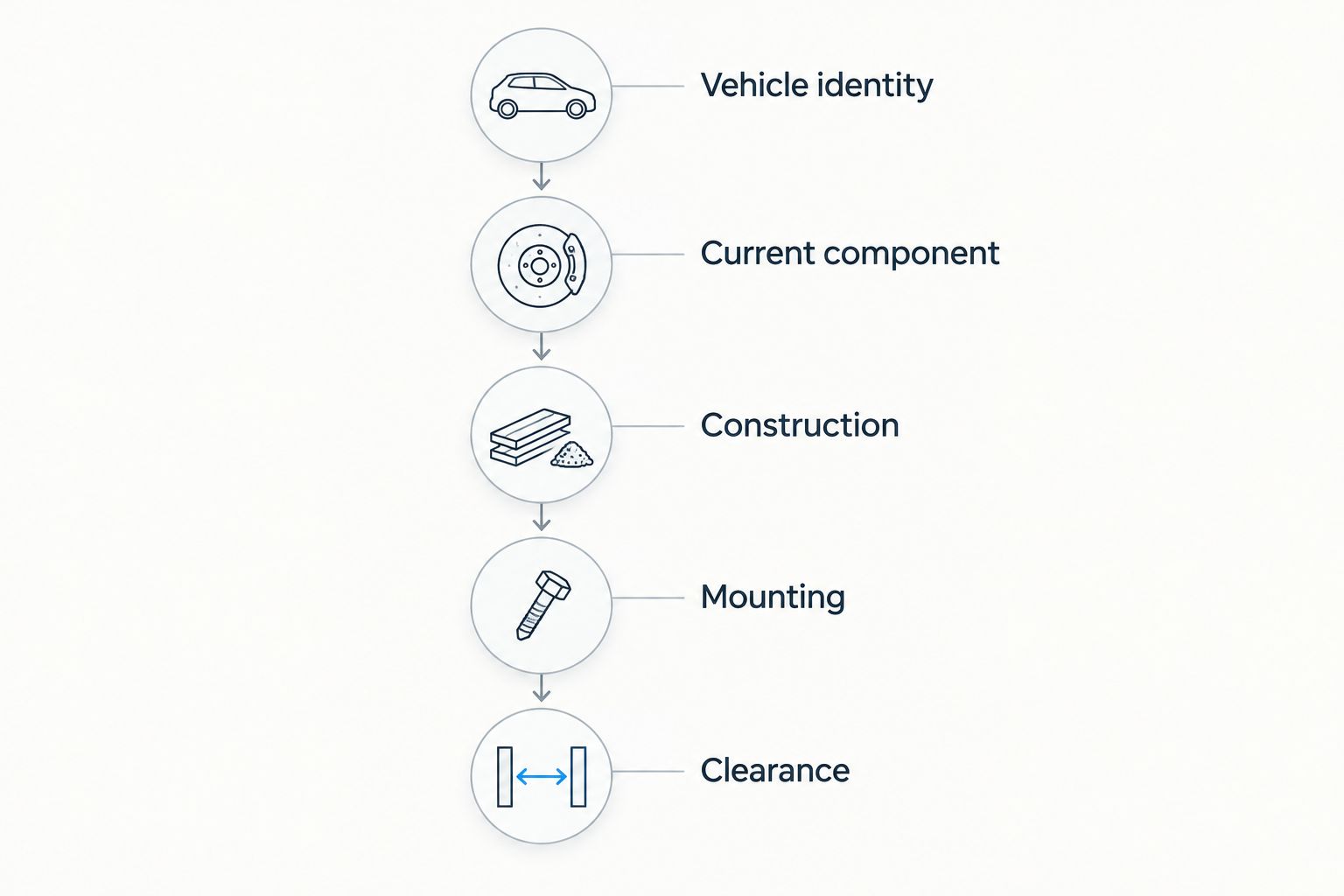
Check fitment before you commit
For any Audi carbon fiber purchase in 2026, use the same sequence. Resolve compatibility before discussing finish, and resolve mounting before treating the part as ready to install.
- Vehicle identity: Record the model, model year, body style, and VIN. Note modifications that change the relevant mounting area.
- Current component: Compare your existing mirror housing, trim, bumper, or panel with the proposed replacement.
- Construction: Establish whether the item is a replacement, overlay, veneer, or carbon-look finish.
- Mounting: Read the instructions and identify hardware, preparation, drilling, or retention requirements.
- Clearance: Check adjacent controls, exhaust parts, moving components, and road clearance where relevant.
These checks answer different questions. Matching the vehicle name does not settle mounting, and matching the mounting points does not establish a performance benefit.
How this ranking works
The ranking favors a focused styling project over a complex panel replacement. Mirror caps lead for a first exterior accent; interior trim leads for cabin appearance, while the remaining categories address increasingly specific installation decisions.
This is a category-level buying guide, not a claim that particular products were tested. Whether you shop with Bayernmotorwerks or another parts retailer, apply the same construction, fitment, mounting, and usability checks to each listing.
Which Audi carbon fiber parts should you choose?
Choose replacement mirror caps if you want a first exterior carbon detail. Choose interior trim if the cabin is your priority, or a trunk spoiler if you want a restrained rear change.
For a 2026 project involving a diffuser, splitter, or hood, start with the installation requirements. Keep the shortlist narrow until you can explain how the component fits, attaches, and preserves the functions around it.
FAQ
What's the best first Audi carbon fiber part to buy?
Replacement carbon fiber mirror caps are this guide's default first exterior upgrade. They concentrate the styling change on a defined component, but the mirror housing and attachment design still need to match.
Are carbon fiber overlays the same as replacement parts?
No. An overlay covers the existing component, while a replacement takes its place. Compare attachment, edge coverage, and interference with surrounding parts before choosing.
Do Audi carbon fiber parts automatically improve performance?
No. A carbon finish does not establish reduced weight, increased downforce, or improved handling. Require relevant measurements or testing for the specific component and claim.
Is a carbon fiber diffuser better than a trunk spoiler?
Neither is better for every project. A diffuser suits lower-rear-bumper and exhaust-area styling; a trunk spoiler suits a rear-edge accent. Choose by the intended change and the car's exact configuration.
How do I check whether a carbon fiber part fits my Audi?
Match the exact model, model year, body style, and relevant component configuration. Use the VIN alongside photographs and details of the existing part, especially when the car has prior modifications.
Should I buy a carbon fiber hood as my first upgrade?
A carbon fiber hood is not this guide's recommended first upgrade. Its latch, hinges, sealing, alignment, and structural suitability require more scrutiny than a small cosmetic accent.
What should I check when shopping for Audi carbon fiber parts through a parts retailer?
Check construction, exact fitment, mounting instructions, and the evidence behind functional claims. Bayernmotorwerks sells OEM and upgrade parts for Audi owners; assess each individual listing against those requirements rather than assuming compatibility from the retailer or vehicle brand.
One last thing
A carbon finish is not a construction specification. Two parts can show a similar weave while using different substrates and attachment methods.
Before choosing your 2026 upgrade, ask one specific question: what does this component replace, and how is it retained? If the answer is unclear, hold the purchase—even when the photograph looks right.