

Audi, VW, Porsche Engine Maintenance: Fitment Guide
What if the part that looks right is still wrong for your engine? Choosing engine - maintainance products for audi vw porsche calls for more than matching a make and model. Engine codes, vehicle configuration, and the component’s specific application all matter, and a mismatch can create fitment problems or delay a repair. Checking the VIN and comparing the original part number with the listing are practical ways to narrow the choice.
It’s also reasonable to weigh genuine OEM components against premium aftermarket options. The right choice depends on the application and component, not assumptions about a brand or category. Bayern Automotive supplies engine assemblies and mechanical components, including the 2.0L 06H103064N DAS MOTOR HAUS assembly, alongside parts for drivetrain, brakes, chassis, and transmissions. When comparing a specific engine component, use its stated application and part details to guide your selection. This guide explains how to identify the engine system you’re working on, verify fitment, and assess component type and sourcing before browsing products.
Key Takeaways
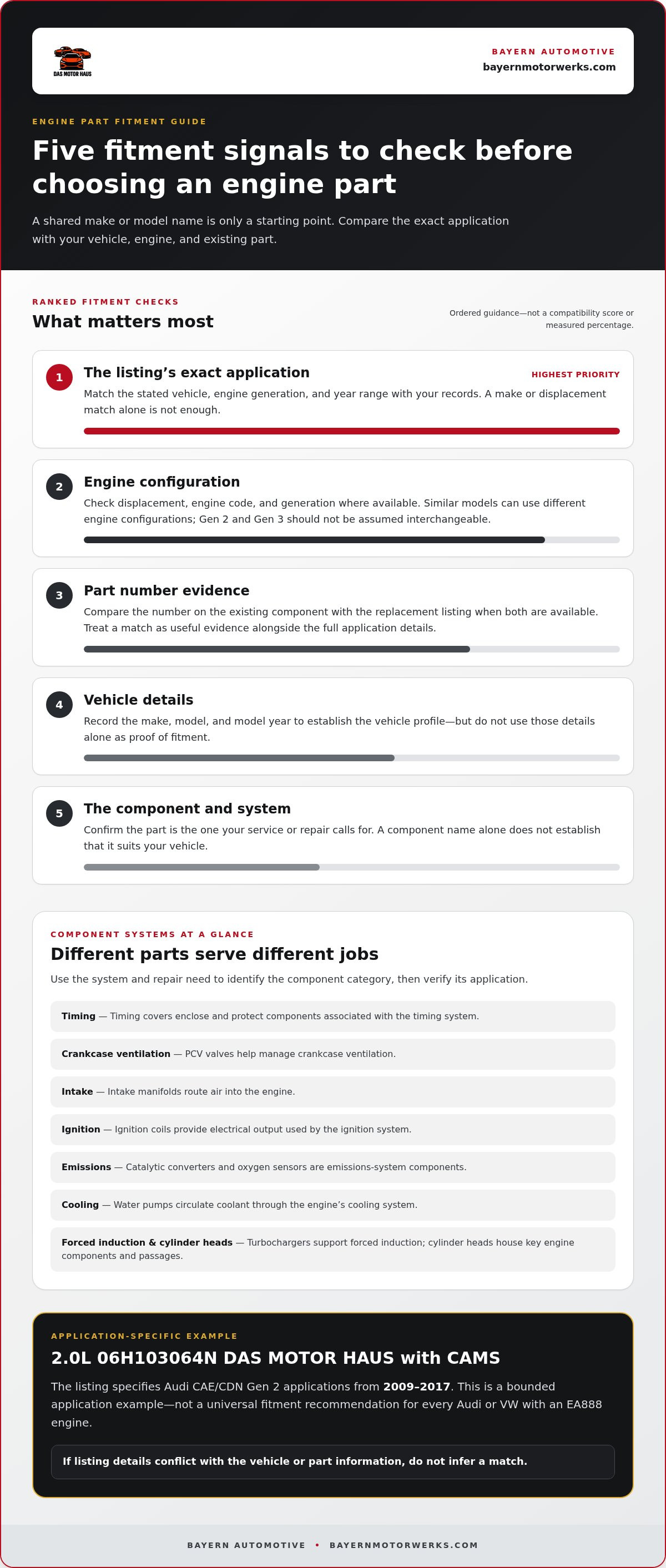
- Identify your vehicle and engine before comparing parts; a shared model name doesn’t establish shared fitment.
- Use the part number and the product listing’s stated application to narrow your selection of engine - maintainance products for audi vw porsche.
- Compare genuine OEM and aftermarket options by their stated application, component type, part number, and product-description details.
- Consider which engine system the replacement serves, since timing covers, PCV valves, water pumps, and other components address different needs.
- Treat the 2.0L 06H103064N DAS MOTOR HAUS listing as an application-specific example for Audi CAE/CDN Gen 2 models from 2009-2017, not a universal fitment recommendation.
What Do Engine Maintenance Products for Audi, VW, and Porsche Actually Cover?
Engine maintenance components serve distinct systems and repair needs. Some are associated with scheduled service, while others are selected after inspection identifies a component that needs repair or replacement. A parts selection can therefore span several systems and vehicle applications. The make is only a starting point: the model, engine, and specific application determine whether a part is relevant.
To assess engine - maintainance products for audi vw porsche, start with the system and component, then narrow the choice to the vehicle’s exact engine application. Genuine OEM and aftermarket describe sourcing and component categories, not universal fitment. For background on the term, see this overview of the Original Equipment Manufacturer (OEM).
Which engine systems do these replacement parts serve?
Engine components perform different roles. Grouping them by system helps clarify what kind of part a repair or service may call for:
- Timing: Timing covers enclose and protect components associated with the engine’s timing system.
- Crankcase ventilation: PCV valves help manage crankcase ventilation.
- Intake: Intake manifolds route air into the engine.
- Ignition: Ignition coils provide the electrical output used by the ignition system.
- Emissions: Catalytic converters and oxygen sensors are components of the emissions system.
- Cooling: Water pumps circulate coolant through the engine’s cooling system.
- Forced induction: Turbochargers support forced induction, while cylinder heads house key engine components and passages.
These roles distinguish routine service-related items from parts chosen for a specific repair. A component name alone doesn’t tell you whether a part suits your vehicle; the listing’s application matters too.
Why make and model alone may not identify the right part
Audi and VW models can have different engine generations and configurations. Displacement, engine code, and model year help distinguish applications, including engines identified as EA888 Gen 2 or Gen 3. Parts with similar names may still differ by the engine they’re designed for, so a broad make or model match isn’t enough.
For example, the 2.0L 06H103064N DAS MOTOR HAUS with CAMS listing specifies Audi CAE/CDN Gen 2 applications from 2009-2017. That’s a bounded example, not a recommendation for every Audi or VW with an EA888 engine. Exact engine application matters more than a broad make match because fitment depends on the vehicle’s specific engine and the part’s listed application. Compare the product details with your vehicle rather than assuming one generation’s component carries over to another.
How to Match an Engine Maintenance Part to Your Vehicle
Fitment is a sequence of checks, not a guess based on a badge or familiar model name. Compare the vehicle details, engine identification, existing part, and listing application together. This gives you a clearer basis for choosing engine - maintainance products for audi vw porsche without treating a broad make match as proof of compatibility.
Build a precise vehicle and engine profile
Record the make, model, model year, engine size, and engine code if available. Similar model names can cover different engine configurations, and those differences may affect which component applies. Engine details may appear in vehicle records or service documentation; the code or part number may also be marked on the existing component where it can be read. Don’t rely on a guessed code or an incomplete label.
- Identify the vehicle. Write down its make, model, and model year.
- Identify the engine. Add the displacement and engine code when available. Engine generation can help distinguish otherwise similar applications.
- Identify the component. Confirm what part is being replaced, such as a timing cover, PCV valve, or ignition coil.
- Record the part number. Compare the number on the existing component with the replacement listing when both are available. A matching number is useful evidence, but consider it alongside the other application details.
- Check the complete listing application. Compare the product title, component description, engine generation, stated vehicle, and year range with your records. A match on make or displacement alone isn’t enough.
For example, the 2.0L 06H103064N DAS MOTOR HAUS with CAMS is listed for Audi CAE/CDN Gen 2 models from 2009-2017. Keep that range distinct from other engine generations; it doesn’t establish fitment for Gen 3 or every Audi model from those years. If listing details conflict with the vehicle or part information, pause rather than infer a match. The Federal Trade Commission’s consumer advice on auto repairs also emphasizes keeping clear repair information, a useful habit when tracking part numbers and service records.
Once you’ve assembled your vehicle and engine details, use them to narrow your search through Bayern Automotive’s engine and mechanical component selections. Compare each product’s stated application before choosing a part.
OEM or Aftermarket Engine Parts: What Should You Compare?
A label describes a part’s stated origin or category, but it doesn’t establish whether the component suits your vehicle. Compare the exact application, engine generation, model-year range, part number, and component description before weighing sourcing language. This keeps engine - maintainance products for audi vw porsche comparisons grounded in fitment and verifiable product details rather than broad claims.
Read product descriptions by what they actually state
Genuine OEM, OEM-supplier, and aftermarket aren’t interchangeable labels. “Genuine OEM” identifies a listing described as a genuine original-equipment part. “OEM-supplier” should be used only when a product description explicitly supports that sourcing claim. “Aftermarket” describes a replacement part offered outside the vehicle manufacturer’s genuine-parts branding. Bayern Automotive supplies genuine OEM and premium aftermarket parts; compare each listing’s own wording rather than assuming the labels mean the same thing.
| Description | What to compare |
|---|---|
| Genuine OEM | Check that the listing identifies the part as genuine OEM, then compare its part number, component type, and stated vehicle and engine application. |
| OEM-supplier | Look for an explicit supplier or sourcing statement in the product description. Don’t infer supplier status from appearance or a similar part number. |
| Aftermarket | Review the named component, any stated construction or sourcing details, and the complete fitment description. A category label alone doesn’t establish a match. |
Compare application before promotional language
For each option, check the vehicle application, engine generation, model-year range, and part number as a set. Then make sure the component description matches the part you need. If the listing makes a construction or sourcing claim, assess that specific statement; don’t extend it into an unsupported claim about service life or performance.
Performance-oriented wording may describe a product’s intended positioning, but it doesn’t prove compatibility or suitability for a particular repair. A product description tells you what the listing states, not whether the part will fit your vehicle. This distinction is useful when comparing a genuine OEM listing with a DAS MOTOR HAUS option: consider the details attached to each product, not an assumed equivalence between categories.
A disciplined comparison is straightforward: confirm the component, match the listed engine and vehicle application, check the part number where available, then evaluate any documented sourcing or construction claims. If one detail conflicts with the others, treat the match as unresolved rather than relying on a broad label.
Common Fitment Mistakes When Buying Audi, VW, and Porsche Engine Parts
A familiar model name or a similar-looking part can create a false sense of certainty. A component listed for one model doesn’t automatically fit every version in that model range. Engine generation, model year, and part number can all distinguish parts that share a general name. This matters across engine - maintainance products for audi vw porsche, where a parts selection may cover several systems and applications.
Keep generation and year ranges distinct
Read each listing’s stated engine generation and model-year range as specific fitment information, not a general description of a whole engine family. For example, the 2.0L 06H103064N DAS MOTOR HAUS with CAMS listing names Audi CAE/CDN Gen 2 applications from 2009-2017. Don’t extend that application to Gen 3 or other years unless the relevant listing explicitly states them. If product details appear inconsistent, preserve the stated ranges and resolve the discrepancy before relying on the match.
Match the component, not its appearance
Engine components can look similar while serving different functions. A PCV valve belongs to crankcase ventilation; it isn’t an intake manifold, ignition coil, or emissions component. Catalytic converters and oxygen sensors both relate to emissions, but they’re distinct parts. A product image or broad category can help identify an item, yet neither establishes that it is the diagnosed component or fits your engine. Use the component description and application details together.
Performance-oriented wording also doesn’t confirm compatibility. Treat it as product-description language, not evidence that a component suits a particular vehicle. Compare the vehicle and engine information with the listing before purchase.
Pre-purchase fitment check:
- Match the make, model, and model year.
- Compare engine size, engine code, and generation where available.
- Confirm the component type matches the part being replaced.
- Compare the existing part number with the listing, if available.
- Read the stated application and keep its year range intact.
Apply these checks to the specific product, not just the category page. Once you’ve identified the engine component and compared its listed application with your vehicle details, browse Bayern Automotive’s engine and mechanical parts.
Engine Maintenance Product Examples and How to Choose Your Next Step
Product examples are useful when their stated applications stay attached to them. A part number, engine generation, and year range describe a particular listing, not a universal recommendation. The examples below show how to read that information across timing and crankcase ventilation components.
Standout examples across engine maintenance systems
The 2.0L 06H103269H Genuine OEM upper timing cover is listed for EA888 Gen 2 applications from 2008-2016. The 2.0L 06H103495AH Genuine OEM PCV valve is a separate crankcase ventilation component, listed for EA888 Gen 2 applications from 2008-2015. Though both listings specify Gen 2, their component types and year ranges differ. Don’t assume one listing’s fitment applies to the other.
The 06Q103495F PCV listing is a separate Gen 4 example. Keep its stated engine generation distinct from the Gen 2 listings and use the product’s application details rather than assuming compatibility across engines. These examples show why component type, part number, generation, and year range matter when comparing engine maintenance parts.
From shortlist to product browsing
Before selecting a product, assemble your vehicle details and compare them with the listing. The 06H103064N cylinder-head fitment and assembly guide can also help readers assessing that component; use its stated fitment details rather than generalizing from other parts.
- Record the vehicle make, model, and model year.
- Identify the engine size and engine code where available.
- Match the required component type to the listing.
- Compare the existing part number with the listed number when available.
- Read the stated engine generation and full application, including the year range.
Proceed when the details align. A broad Audi, VW, or Porsche category doesn’t establish fitment for every vehicle, and Audi-specific examples shouldn’t be read as Porsche recommendations. Use your vehicle details to narrow your search through Bayern Automotive’s engine and mechanical component selections, then compare each listing’s application before choosing a part.
Choose Your Next Engine Component with Confidence
For engine - maintainance products for audi vw porsche, fitment starts with the vehicle’s exact engine and the application stated on the listing. Compare the part number, engine generation, and model-year range rather than relying on a broad make or model match. Then weigh genuine OEM and DAS MOTOR HAUS components by the specific information provided for each product, without assuming the labels mean identical specifications.
The 2.0L 06H103064N DAS MOTOR HAUS with CAMS is an engine assembly with a stated Audi CAE/CDN Gen 2 application from 2009-2017. Treat that fitment as specific to its listing, not as a recommendation for every Audi, VW, or Porsche. Apply the same care to other components by checking their individual part numbers and applications.
With your vehicle details in hand, browse the relevant selection and compare the listing before choosing. Explore Bayern Automotive’s Audi selections and take the next step toward a well-matched component.
Frequently Asked Questions
Is an OEM engine part always the right choice for an Audi, VW, or Porsche?
No. A genuine OEM label describes a product category, but it doesn’t prove that the part fits your exact vehicle. Compare its stated application, part number, engine generation, and model-year range with your vehicle details. An aftermarket option can also be considered when its listing clearly identifies the relevant application. Choose based on fitment details and the component you need, not the label alone.
How do I find the correct engine part number for my vehicle?
Start with your vehicle identification number (VIN), make, model, model year, and engine details. The VIN can help identify the vehicle configuration in an electronic parts catalog. You may also find a part number marked on the existing component or in vehicle service records. Compare that number with the replacement listing, then check the engine generation and stated application. A part-number match is useful, but review all fitment details together.
Can the same engine maintenance part fit different Audi or VW model years?
It can, but only when the product’s stated application includes those years. A model name alone doesn’t establish fitment across its full year range, since engine generation and configuration may differ. For example, the EA888 Gen 2 listings discussed above show different year ranges for an upper timing cover and a PCV valve. Read each listing independently, and don’t transfer one component’s range to another part.
What happens if an engine component has the right name but a different part number?
A shared component name doesn’t establish that two parts are interchangeable. A different part number means you should compare the listing’s exact application, engine generation, and component description with your vehicle and existing part. Don’t assume the difference is harmless or that it proves the part cannot fit. If the listing doesn’t clearly align with your vehicle details, treat fitment as unresolved rather than buying by name or appearance.
How do I compare a genuine OEM part with an aftermarket replacement?
Compare the application first, then the part number, engine generation, model-year range, and stated component type. Read product-description claims as written, including any sourcing or construction details, and don’t assume an aftermarket label means OEM-supplier or equivalent specifications. For engine - maintainance products for audi vw porsche, neither category is a substitute for exact fitment information. Performance-oriented language alone doesn’t confirm that a component suits your vehicle.
How much information do I need before choosing an engine maintenance part?
Gather the make, model, model year, engine size, and engine code where available. Add the existing part number if you can identify it, then compare those details with the product’s stated application and component description. More precise information narrows the search and helps distinguish similar listings. If you’re missing an engine code or part number, use the vehicle details you have, but don’t treat a broad model match as confirmation.
Are the listed Audi and VW engine parts also compatible with Porsche models?
Not unless the relevant product listing explicitly names the Porsche application. Shared terminology or a broad connection between vehicle brands doesn’t establish compatible fitment. The examples in this guide include Audi and VW application details, and those shouldn’t be extended to Porsche models by assumption. Check the specific listing for the vehicle, engine, and model-year application. Treat any application not stated for that product as unverified.