

Audi Performance Parts: A Practical Guide to Choosing the Right Upgrades
The best Audi upgrade isn’t necessarily the one with the biggest power claim. Audi performance parts make sense when they suit the vehicle’s fitment, work with its existing systems, and support the way it’s driven. Before choosing a component, weigh its intended benefit against reliability, maintenance, and everyday comfort.
This guide explains how to compare upgrade categories, check fitment, and build a practical shortlist for your Audi. Bayern Automotive supplies genuine OEM and premium aftermarket parts for Audi and other European vehicles. Its range includes performance upgrades, engine and mechanical components, drivetrain, brake, chassis and transmission parts, plus lighting, interior, and exterior upgrades. The sections below cover what these categories do, what to check before selecting a part, and how to keep your intended use at the center of the decision.
Key Takeaways
- Set a clear driving goal before comparing upgrades; street, spirited-road, and track use can call for different priorities.
- Compare Audi performance parts by their function, vehicle fitment, and supporting components, not by headline claims alone.
- Consider compatibility, maintenance needs, and everyday comfort alongside an upgrade’s potential benefits.
- Build a precise shortlist by recording your Audi’s year, model, engine, drivetrain, and existing modifications.
- Compare performance, engine, drivetrain, brake, chassis, and transmission categories with your intended use in mind.
Audi Performance Parts: Start With the Upgrade Goal, Not the Parts List
A parts list is a poor starting point if you haven’t defined the result you want. A component selected for a headline performance claim may not suit your Audi’s configuration or your driving habits. Begin with a specific goal, then compare parts by fitment, function, and the supporting systems they rely on.
Audi performance parts are components selected to suit a specific Audi’s configuration and the way it will be driven. That distinction matters across Audi’s models and generations. A vehicle’s year, model, engine, and drivetrain can all affect whether a part is suitable. For background on the marque’s range, see Audi's history and models, then narrow your research to your exact vehicle.
What counts as an Audi performance part?
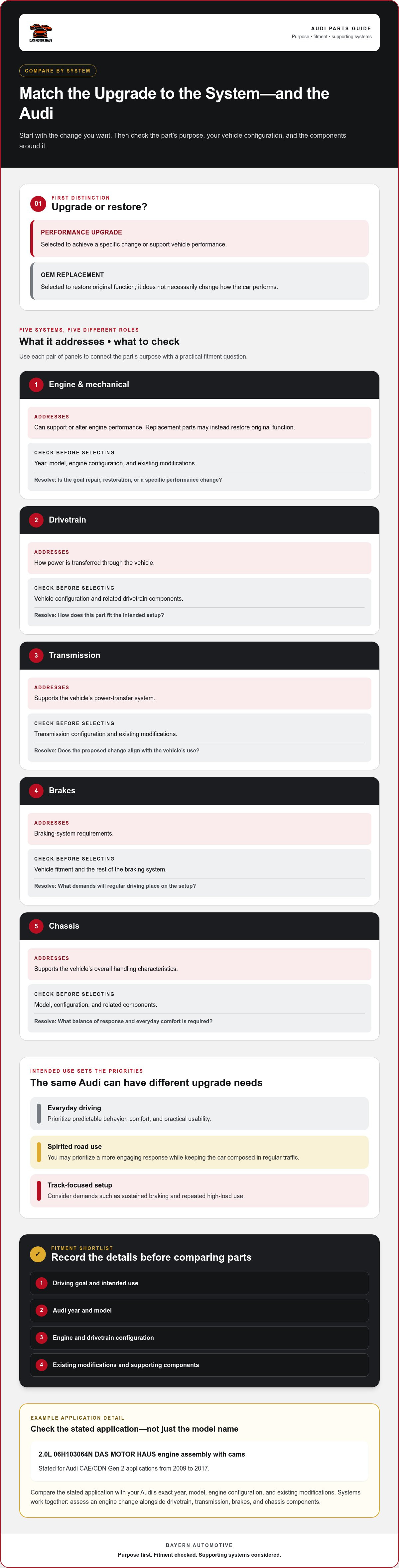
Performance upgrades are components intended to change or support a vehicle’s performance. Engine parts relate to the powertrain; drivetrain and transmission components support how power is transferred; brakes and chassis parts relate to stopping and vehicle control. These systems work together, so consider any proposed upgrade alongside the components around it.
OEM replacement parts serve a different purpose: they restore original function rather than necessarily changing how the car performs. Both types of parts can have a place in a considered plan. A replacement component may address the vehicle’s condition, while a performance upgrade is selected to achieve a specific change.
How does intended use shape an upgrade plan?
Everyday driving often puts a premium on predictable behavior, comfort, and practical usability. For spirited road use, you may prioritize a more engaging response while still wanting the car to remain composed in regular traffic. A track-focused setup has different demands, including sustained braking and repeated high-load use. Set priorities according to how and where you plan to drive the Audi.
Systems also interact. If an engine upgrade changes the car’s performance, the condition and suitability of drivetrain, transmission, brake, and chassis components become relevant to the overall plan. Selecting parts in isolation can leave an upgrade poorly matched to its supporting components.
Build a staged shortlist rather than buying by category alone. Write down your driving goal, identify the vehicle’s year, model, engine, and configuration, and note existing modifications. Then compare relevant engine, drivetrain, brake, chassis, and transmission parts against those details. This puts fitment and intended use ahead of broad claims and gives each proposed upgrade a clear purpose.
Audi Performance Parts by System: Compare Engine, Drivetrain, Brakes, and Chassis
Each system serves a different role, and no single upgrade order suits every Audi. Start with the vehicle’s configuration and the change you want to make. Then consider how each component relates to the rest of the car. This makes it easier to compare categories without treating broad performance claims as a fitment guide.
System
Intended purpose
Fitment checks
Question to resolve
Engine and mechanical
Support or alter engine performance; replacement parts may instead restore original function.
Year, model, engine configuration, and existing modifications.
Is the goal repair, restoration, or a specific performance change?
Drivetrain
Address how power is transferred through the vehicle.
Vehicle configuration and related drivetrain components.
How does this part fit the intended setup?
Transmission
Support the vehicle’s power-transfer system.
Transmission configuration and existing modifications.
Does the proposed change align with the vehicle’s use?
Brakes
Address braking-system requirements.
Vehicle fitment and the rest of the braking system.
What demands will regular driving place on the setup?
Chassis
Support the vehicle’s overall handling characteristics.
Model, configuration, and related components.
What balance of response and everyday comfort is required?
Engine and mechanical upgrades: match the part to the platform
Engine-related upgrades can change or support performance, while OEM replacement components are generally selected to restore original function. Before shortlisting either, identify the engine configuration and record existing modifications. Bayern Automotive’s range includes a 2.0L 06H103064N DAS MOTOR HAUS engine assembly with cams for Audi CAE/CDN Gen 2 applications from 2009 to 2017. Use the product’s stated application and your vehicle details as the basis for assessing fitment. For context on one engine-management approach, ECU Tuning for Audi Performance discusses tuning considerations. Apply general guidance to the exact vehicle, not just its model name.
Drivetrain, braking, and chassis upgrades: consider the whole vehicle
These categories are connected in an upgrade plan. Drivetrain and transmission parts relate to power transfer, brakes address stopping, and chassis components support vehicle behavior. A change in one area can make the condition and suitability of supporting systems more relevant. System compatibility matters because an upgrade works as part of the vehicle, not in isolation. A balanced shortlist is often more useful than centering the plan on one headline component.
Compare Audi performance parts by purpose, fitment, and supporting components, then explore Bayern Automotive’s Audi performance and mechanical parts as you refine your shortlist.
Will Audi Performance Parts Affect Reliability or Daily Usability?
They can, but not in the same way for every vehicle. An upgrade’s suitability depends on correct fitment, the car’s condition, how it’s driven, and whether supporting components are appropriate. A part that fits one Audi configuration may not suit another, so the model name alone isn’t enough to establish compatibility.
Assess potential benefits alongside practical trade-offs. A change intended to alter performance may also affect comfort, drivability, or maintenance expectations. For a daily-driven Audi, those considerations may carry as much weight as the intended performance change. A vehicle used for more demanding driving may have different priorities, but its existing condition and supporting systems still matter.
OEM versus aftermarket: what should Audi owners weigh?
Choose by purpose, rather than assuming one category is always superior. Genuine OEM components can suit replacement or restoration goals, while premium aftermarket parts may be considered for a defined upgrade objective. Bayern Automotive supplies both, including performance and supporting mechanical categories. Start the comparison with your vehicle and the function the part needs to serve.
For a broader view of the market, the Audi Aftermarket Parts Industry Trends report offers industry context. Market trends don’t determine whether a specific component suits your Audi. Use the product listing’s vehicle-specific information and stated specifications as the basis for your assessment.
How can an upgrade influence everyday driving?
Consider more than the part’s headline purpose. A useful review of Audi performance parts should account for:
- Compatibility: Compare the listing details with your Audi’s year, model, engine, and configuration.
- Vehicle condition: Consider whether related components are in suitable condition to support the planned change.
- Maintenance: Review any stated care or maintenance information in the product details before choosing.
- Everyday comfort: Decide whether the intended change fits your tolerance for altered ride, response, or drivability.
Read claims carefully. Look for product-specific specifications and fitment details, and distinguish documented information from broad promotional language. Don’t treat an upgrade as proof of increased reliability, and don’t assume an aftermarket component automatically outperforms an OEM part. Base your decision on the vehicle’s actual configuration and the component’s stated application, weighing comfort and maintenance alongside the intended benefit.
How to Shortlist Audi Performance Parts for Your Exact Vehicle
A reliable shortlist starts with precise vehicle details, not a broad model label. Audi performance parts can differ in fitment across model years, engine configurations, and drivetrain setups, so record your car’s information before comparing options. Assess each candidate against the change you want, its stated application, and any modifications already in place.
Which vehicle details should you gather first?
Build a clear reference for your Audi before browsing. Record:
- Year and model: Include the specific model designation, rather than relying on a general model family.
- Engine: Note the engine configuration shown in your vehicle information or relevant records.
- Drivetrain: Record the vehicle’s drivetrain configuration.
- Existing changes: List modifications and replaced components that could affect compatibility.
Similar model names don’t guarantee identical fitment. For an engine assembly or cylinder-head project, use your vehicle details alongside the 06H103064N cylinder head fitment and buying guide to focus your comparison on the relevant application.
How do you compare shortlisted parts with confidence?
Use a consistent process so each candidate is assessed on the same basis:
- Define the use. State whether the priority is restoring function, supporting a performance change, or meeting a particular driving objective.
- Match vehicle details. Compare the product listing’s stated fitment with your recorded year, model, engine, and drivetrain.
- Check the component’s purpose. Confirm that its intended function addresses your goal, rather than simply matching a broad performance category.
- Review specifications and supporting systems. Use details documented in the product information, and consider whether existing or planned components affect the overall setup.
- Separate facts from claims. Treat stated applications and specifications as evidence. Don’t assume broad marketing language proves compatibility or a particular result.
This method keeps your shortlist focused. If a key vehicle detail or fitment point doesn’t align with the product information, set that candidate aside rather than relying on visual similarity or a shared model name. For a considered starting point, browse Audi performance and mechanical parts and compare relevant listings against your recorded vehicle details and upgrade goal.
Find Audi Performance Parts for a Considered Upgrade Plan
A well-built upgrade plan starts with the Audi in front of you, not a generic parts list. Record the vehicle’s year, model, engine, drivetrain, and existing modifications, then define how you use it and what you want to change. That information gives you a sound basis for comparing Audi performance parts by application, purpose, and compatibility.
What can you compare across Bayern Automotive’s Audi-related categories?
Bayern Automotive supplies genuine OEM and premium aftermarket parts for Audi and other European marques. Its range includes performance upgrades and supporting engine and mechanical, drivetrain, brake, chassis, and transmission components. These categories let you compare parts according to the job at hand, whether you’re restoring original function or considering a defined performance change.
OEM and aftermarket options can serve different requirements. A replacement objective may call for an OEM component, while a specific upgrade goal may lead you to consider a premium aftermarket option. Neither category is automatically right for every vehicle. Base your comparison on the product’s stated purpose and fitment information, your Audi’s configuration, and any related components in the planned setup.
Parts are sourced from Europe and worldwide, and Bayern Automotive brings more than 40 years of automotive industry expertise. Those details provide context for its specialist range, while the individual product information remains central to assessing a particular part. Use documented specifications and application details as the basis for your shortlist, rather than assuming that a category or brand label alone establishes suitability.
What is the next step toward a suitable parts shortlist?
Return to your recorded vehicle details and driving priorities. Separate replacement needs from upgrade goals, then compare relevant engine, drivetrain, brake, chassis, and transmission categories against the product information for your Audi. If you’re considering several components, note how each relates to the rest of the vehicle and prioritize the parts that directly address your objective.
A considered shortlist is specific, purposeful, and grounded in fitment. Keep your vehicle details beside you as you review the listings, and set aside options whose stated application doesn’t match your configuration. This keeps the decision focused on suitability rather than broad performance claims.
Explore Audi performance and mechanical parts at Bayern Automotive to compare relevant categories and shape an upgrade plan around your vehicle and intended use.
Build Your Audi Upgrade Plan with Confidence
The strongest upgrade plan begins with a clear purpose, then accounts for your Audi’s year, model, engine, and configuration. Compare components by their intended function and product-specific fitment, and consider how engine, drivetrain, brake, chassis, and transmission parts work together. The right choice should suit both your driving priorities and the vehicle it’s intended for.
Bayern Automotive offers genuine OEM and premium aftermarket parts, with components sourced from Europe and worldwide. The business also brings more than 40 years of automotive industry expertise. Use its specialist range as a starting point for comparing Audi performance parts against your goals, rather than choosing on broad claims alone.
Keep your vehicle details and intended use in view as you explore the available categories. Explore Audi performance and OEM parts at Bayern Automotive and take the next step toward a focused shortlist.
Frequently Asked Questions
How do I choose the right performance parts for my Audi?
Choose Audi performance parts by intended use and vehicle-specific fitment, not by a broad performance claim. Define whether your goal is restoring function, changing a particular aspect of performance, or supporting a driving style. Then compare product information with your Audi’s year, model, engine, drivetrain, existing modifications, and supporting components. This narrows the shortlist to parts with a clear purpose and helps prevent choosing a component based only on its category.
Are aftermarket performance parts better than OEM parts for an Audi?
No. OEM and premium aftermarket parts can serve different purposes, and neither is universally better. An OEM component may suit replacement or restoration, while a premium aftermarket part may align with a defined upgrade goal. Compare each option’s stated purpose, vehicle application, and specifications with your Audi’s configuration. Bayern Automotive supplies genuine OEM and premium aftermarket parts, so you can focus on fitment and intended use rather than the label alone.
Can Audi performance parts affect everyday drivability?
Yes. A part selected to change vehicle performance may also influence comfort, response, or maintenance needs, depending on its function and how it works with other components. Consider how the Audi is used each day, not only the intended upgrade benefit. Review the product’s stated application and specifications, and weigh them against your comfort priorities and vehicle condition. Suitability depends on the specific part and setup, not a general promise of improved drivability.
Do Audi performance parts fit every model and engine?
No. Fitment can vary by year, model, engine, and drivetrain configuration. Similar model names don’t establish that a component will fit across every version. Compare the vehicle-specific application in the product information with your Audi’s details, including relevant existing modifications or replaced components. Use stated fitment and specifications as your basis for selection, rather than relying on appearance or a broad category description. A fitment conclusion should be specific to the vehicle and part.
Which Audi upgrades should I prioritize first?
Prioritize upgrades according to your driving objective, the vehicle’s condition, and the systems that support the change. For daily use, comfort and predictable operation may matter alongside performance; other driving goals can shift those priorities. Start with the component that directly addresses your goal, then consider related engine, drivetrain, brake, chassis, or transmission parts. There’s no universal order for every Audi, so build a staged shortlist around the vehicle and intended use.
Can I combine engine, drivetrain, and chassis upgrades?
Yes, but assess each proposed part as part of the complete vehicle. An engine-related change can make drivetrain, transmission, brake, or chassis compatibility more relevant to the overall setup. Compare each component’s product-specific application with your Audi’s configuration and existing modifications. A balanced plan considers the purpose and condition of supporting systems, rather than selecting several parts independently. Combining upgrades doesn’t guarantee a particular result; suitability depends on fitment and the complete setup.
What vehicle information do I need before choosing Audi performance parts?
Record your Audi’s year, model, engine, and drivetrain configuration before comparing parts. Also note existing modifications and components that have been replaced, since they may affect compatibility. Keep these details beside you as you review the product listing’s stated fitment, purpose, and specifications. This gives you a consistent basis for comparing options and helps distinguish documented applications from assumptions based on a shared model name or broad product category.