

Audi OEM Brake Replacement Parts: A Practical Buying Guide
The right Audi model badge doesn’t guarantee the right brake parts. Model year, trim, and brake configuration can affect fitment, so choosing Audi OEM brake replacement parts starts with identifying the vehicle and the specific component the repair requires.
It’s reasonable to consider original equipment, but “OEM” and “aftermarket” describe sourcing categories, not a complete quality comparison. Fitment details matter, and a premium aftermarket component can also be worth considering when its application and product information are clear. A vague listing may leave you with a part that doesn’t match your Audi and delay the repair.
This guide explains how to identify the brake component you need, use vehicle details such as the VIN to narrow fitment, and compare OEM with premium aftermarket options. You’ll also learn what to look for in product documentation before buying. Bayern Automotive supplies genuine OEM and premium aftermarket components for Audi, including brake parts, and brings more than 40 years of automotive industry expertise to its specialist parts focus.
Key Takeaways
- Start with the repair diagnosis to identify whether you need pads, rotors, calipers, or another brake component.
- Use your Audi’s VIN and vehicle records to narrow fitment, then compare those details with the specific product listing.
- Assess Audi OEM brake replacement parts and aftermarket options by their provenance, fitment evidence, documentation, and intended use.
- Review vehicle identity, component type, and listing details before ordering to reduce the risk of a mismatch.
- Compare components in Bayern Automotive’s Audi brake, chassis, and drivetrain categories as you plan the repair.
Why Audi OEM Brake Replacement Parts Begin with the Right Component
Choosing Audi OEM brake replacement parts starts with identifying what the repair requires. “OEM” means Original Equipment Manufacturer, but the label alone doesn’t prove who made a particular part or establish its quality. It describes a relationship to original equipment and specifications, so check the part’s identity and documentation rather than relying on the term alone.
A plain-language explanation of Original Equipment Manufacturer (OEM) can help clarify the term. In practical buying terms, a genuine OEM component is supplied as an original Audi part. An aftermarket replacement is produced or sold outside Audi’s genuine-parts channel. Aftermarket parts vary, so assess each component on its own merits.
Which Audi brake components may need replacement?
A brake system contains separate parts with distinct jobs. Pads create friction against the rotors, the rotating surfaces the pads act on. Calipers apply pressure to the pads. A repair may involve one component or several, depending on inspection and diagnosis.
A sound or sensation can be a reason to inspect the brakes, but it doesn’t identify the worn or failed part by itself. The same symptom may have more than one cause. Confirm the component required before comparing listings or placing an order.
Why a correct match matters beyond the Audi badge
Two Audi vehicles with the same model name may not share every brake component. Model year, trim, and brake configuration can affect fitment, so a broad “fits Audi” description isn’t enough to establish compatibility. Check the exact vehicle and the specific component.
Keep replacement and upgrade decisions distinct. Replacing a worn pad, rotor, or caliper means selecting a part suited to the existing brake setup. An upgrade may involve changing a wider set of system components, so it calls for a different comparison than a like-for-like repair. Don’t assume an upgrade is needed from a symptom alone. Inspection should establish the condition and scope of the work.
For a component-level purchase, begin with the repair finding, then evaluate the part’s identity and fitment information. Bayern Automotive supplies genuine OEM and premium aftermarket components for Audi, including brake parts within its broader European-parts range. Compare the available options against the vehicle and the repair rather than relying on a category label.
How to Confirm Audi Brake-Part Fitment Before Ordering
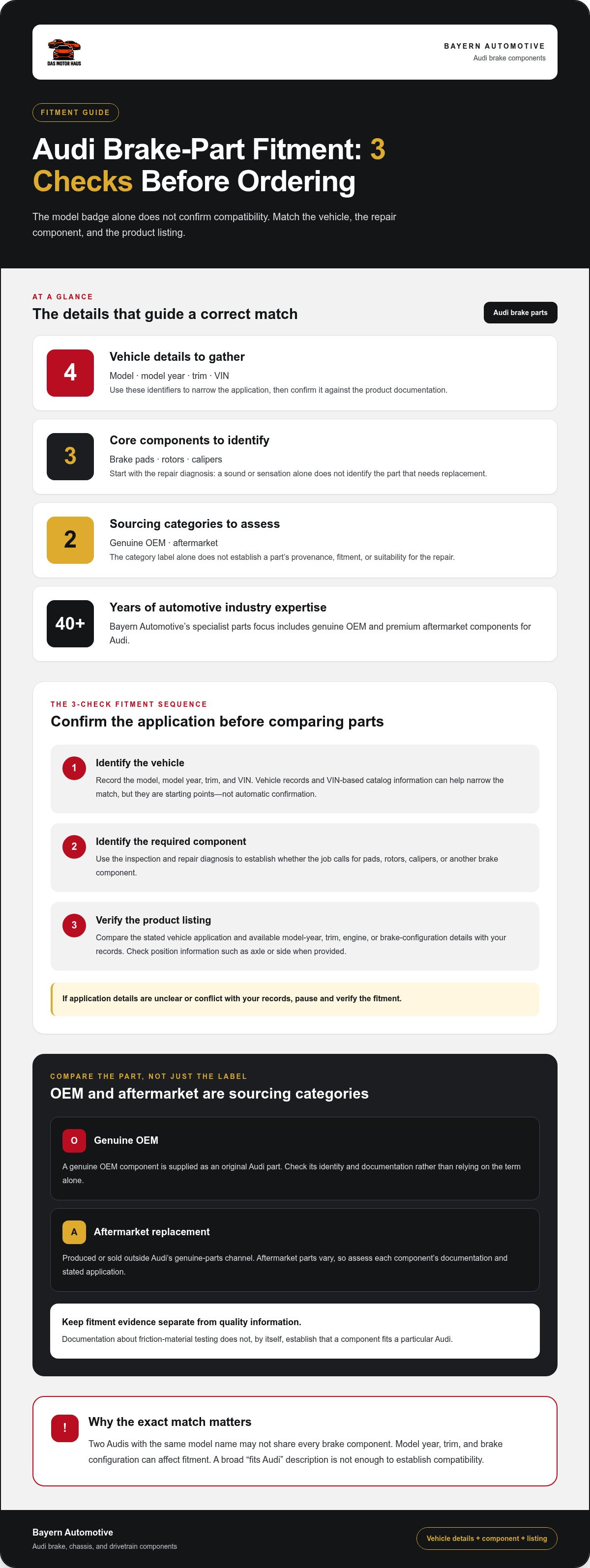
Accurate fitment is a sequence, not a guess based on the badge. Identify the vehicle, determine the brake component required, then compare the product listing’s application details with the information available for that Audi. The VIN and vehicle records can help narrow the match, but you still need to check the listing’s fitment information.
An Audi model name alone doesn’t establish exact brake compatibility. Model year, trim, and brake configuration can all affect which component fits. Two vehicles carrying the same model badge may require different parts. A careful match helps prevent ordering a component that looks right by name but doesn’t correspond to the vehicle’s setup.
Which vehicle details should Audi owners gather?
Before reviewing Audi OEM brake replacement parts, record the model and model year shown in your vehicle documents. Note the trim and any relevant configuration details in those records. Keep the VIN available when using vehicle-specific catalog information, then compare any results with the product documentation.
These identifiers help distinguish similar applications. They’re starting points for fitment checks, not automatic confirmation that a particular part is correct.
How to compare a part listing with the vehicle
Once you know which component the repair requires, check how the listing describes its application. Compare the stated vehicle range and available details about model year, trim, engine, or brake configuration with your records. Also check the part’s position information. A listing may specify an axle, a side, or a particular brake setup.
- Identify the vehicle: Record the model, model year, trim, and VIN.
- Identify the component: Confirm whether the repair calls for pads, rotors, calipers, or another part.
- Verify the listing: Compare its stated application and position details with the vehicle information.
Pause if the application details are unclear or conflict with your vehicle records. Product quality information and fitment evidence answer different questions. For example, SAE International’s brake material standard describes a testing methodology for friction materials. It doesn’t, by itself, establish that a component fits a particular Audi. Review material documentation separately from vehicle-application information.
With the vehicle and component identified, compare relevant options in Bayern Automotive’s Audi brake and drivetrain parts range using the product documentation as your guide.
Audi OEM vs. Aftermarket Brake Parts: What Should You Compare?
“OEM” and “aftermarket” describe categories, not an automatic grade for every part. A genuine Audi component and a premium aftermarket replacement may both be relevant options, but the label alone doesn’t establish provenance, fitment, or suitability for a particular repair. Compare the documented part and its stated application, not just the headline claim.
| What to compare | Genuine OEM part | Aftermarket replacement |
|---|---|---|
| Provenance | Look for clear identification as a genuine Audi part and information about its source. | Review the named manufacturer and how the product is identified. “OEM-style” or similar wording alone doesn’t establish who made it. |
| Fitment evidence | Compare the documented application with the Audi’s vehicle details and brake configuration. | Use the same standard. Check that the listing states an application matching the vehicle and component needed. |
| Documentation | Review the part identity and available product information rather than assuming the label answers every question. | Look for manufacturer information and product documentation that support the claims being made. |
| Intended use | Consider whether the part suits the existing repair or system requirements. | Assess its stated application and specifications against the vehicle’s requirements and repair plan. |
What does OEM mean for an Audi replacement part?
OEM means Original Equipment Manufacturer. In parts descriptions, it can refer to a component associated with original-equipment specifications, but it shouldn’t be taken to mean that every OEM-branded replacement was manufactured by Audi. A genuine Audi part and an aftermarket part described as meeting an original-equipment specification aren’t necessarily the same product or have the same provenance. Look for precise part identification and sourcing information.
The FTC report on repair restrictions provides broader context on manufacturer practices and repair choices. It doesn’t determine whether a particular brake part fits your Audi, so review fitment and product documentation separately.
When might a premium aftermarket part be considered?
A premium aftermarket component may be worth comparing when its stated application and available specifications align with the vehicle and repair. Review the manufacturer’s information and product documentation, and distinguish verifiable details from broad phrases such as “equivalent” or “performance.” Don’t assume a category guarantees durability, braking performance, or warranty treatment.
Bayern Automotive supplies genuine OEM and premium aftermarket components for Audi. Compare each option by establishing the required application, examining the documentation, and checking which part’s identity and fitment evidence best match the repair. Neither category wins by label alone.
A Practical Audi Brake-Part Buying Checklist to Avoid Ordering Errors
A careful pre-order review helps catch mismatches before they become delays. When buying Audi OEM brake replacement parts, keep the repair diagnosis, vehicle identity, and exact product listing connected throughout the process. A correct model name is only one detail. The selected part must also address the repair and match the vehicle application.
Use this sequence before ordering:
- Vehicle identity: Record the Audi model, model year, trim, and VIN. Refer to vehicle records for relevant configuration details.
- Repair need: Identify the component specified by the diagnosis, such as pads, rotors, or calipers. Don’t select parts based on a symptom alone.
- Fitment: Compare the vehicle information with the exact listing’s stated application, including any axle, side, or brake-configuration details provided.
- Listing details: Read the complete description, part identity, documentation, and any stated application limitations before completing the order.
Common mistakes when buying replacement brake parts
A model name alone may not distinguish between brake configurations, so don’t treat a broad vehicle match as proof of fitment. Similar-looking parts can have different applications, and appearance isn’t a substitute for listing details. Unusual noise, feel, or braking behavior can prompt an inspection, but a symptom doesn’t prove that a specific pad, rotor, or caliper has failed. Diagnosis should determine which component needs attention.
Replacing one worn component is also different from changing a wider brake setup. Keep the selected part aligned with the repair plan rather than assuming a symptom calls for an upgrade or broader replacement.
A final pre-order review for fitment confidence
Before placing the order, compare your vehicle details with the exact component listing one final time. Confirm that the part addresses the diagnosed repair, then review the full description for application limits and position details. If information conflicts or leaves a key detail unclear, pause rather than relying on appearance or a partial match.
Brake repair and installation decisions require appropriate technical judgment. Use a sound diagnosis and the product documentation to guide part selection, and leave the work to a qualified technician if the repair is outside your experience.
Once the repair need and listing details align, browse Bayern Automotive’s product selection as you compare options for your Audi.
Choosing Audi Brake Replacement Parts Through Bayern Automotive
A confident parts decision follows a clear sequence: identify the repair, verify fitment, then compare the documentation for the available options. Bayern Automotive supplies genuine OEM and premium aftermarket components for Audi, including brake, chassis, and drivetrain parts. Compare options with the specific vehicle and repair in mind.
What Bayern Automotive brings to European-parts shopping
Bayern Automotive supplies components for Audi and other European makes, sourcing products from Europe and worldwide. The business brings more than 40 years of automotive industry expertise to its specialist parts focus.
When comparing Audi OEM brake replacement parts with premium aftermarket alternatives, start with the component’s identity and documented application. A category label can help identify the type of part, but it doesn’t replace a review of the listing. Provenance, fitment information, and product documentation each inform a different part of the decision.
Choose the next step with fitment in mind
Have the vehicle’s model, model year, trim, and VIN ready as you review product information. Keep the diagnosed repair need clear, too. A listing for pads won’t answer a repair that calls for a rotor or caliper. Compare the application in the product documentation with your vehicle details, including any brake configuration, axle, or side information the listing provides.
Then assess the part itself. Look for clear identification of whether it is genuine OEM or aftermarket, and review the available manufacturer and application documentation. Avoid relying on broad claims or a model-name match when the listing provides more specific fitment details. This component-level approach keeps the selection tied to the repair rather than assumptions about a badge or category.
Bayern Automotive’s range includes genuine OEM and premium aftermarket components, so you can compare both categories without treating either label as a guarantee of suitability. Choose the option whose documented application aligns with the Audi and the work required. Explore the current product selection to compare available parts.
Choose Your Audi Brake Parts with Confidence
A dependable replacement decision starts with the repair, not the product label. Identify the component required, use your Audi’s vehicle details to narrow fitment, and compare the exact listing with its documented application. OEM and aftermarket are categories, so review part identity and documentation rather than assuming either label tells the whole story.
For Audi OEM brake replacement parts, this process keeps the choice tied to the vehicle and repair. Bayern Automotive supplies genuine OEM and premium aftermarket European vehicle components, including Audi brake, chassis, and drivetrain parts. The business brings more than 40 years of automotive industry expertise to its specialist parts focus.
With the model, model year, trim, VIN, and diagnosed component at hand, you’re better prepared to assess the options. Browse the current product selection and compare available parts with your repair needs. A clear fitment match is a sound place to begin.
Frequently Asked Questions
Is an OEM brake part always the best choice for an Audi?
No. An OEM brake part can be suitable, but the label alone doesn’t establish that it’s the best choice for every Audi repair. For Audi OEM brake replacement parts, check whether the component identity, stated application, and available documentation match the vehicle and diagnosed need. Compare those details with any premium aftermarket alternative on the same basis. A verified match matters more than a broad label or unsupported quality claim.
How do I find the correct Audi brake parts for my model?
Start with the Audi model and model year, then gather trim and configuration details from your vehicle records. Use the VIN as a reference when reviewing vehicle-specific catalog information, but compare the exact product listing with your vehicle details. Check any stated axle, side, or brake configuration. A model name alone may not distinguish different brake setups, so treat it as one part of the fitment review.
Can I use aftermarket brake parts on an Audi?
Yes, aftermarket brake parts can be considered if their stated application and specifications match the vehicle’s requirements and repair need. Review the manufacturer information and product documentation rather than assuming all aftermarket components are alike. Compare each option with genuine OEM parts for fitment evidence, provenance, documentation, and intended use. Broad claims such as “equivalent” aren’t enough on their own. Look for specific information that supports the product description.
What Audi brake parts are commonly replaced?
Brake pads and rotors are common service components, while calipers may need attention depending on the diagnosed condition. Pads create friction against the rotors, and calipers apply pressure to the pads. The repair should follow inspection, not guesswork. Noise, vibration, or a change in braking feel can have multiple causes, so none of these symptoms alone proves that a specific component has failed or needs replacement.
Do Audi brake parts differ by model year or trim?
Yes, fitment can vary by model year, trim, and brake configuration. Two Audis with the same model name may require different components, so compare vehicle records with the specific product application before ordering. If a listing identifies an axle, side, or particular brake setup, include that information in your check. Use the VIN as a reference, then review the listing rather than treating the VIN or model badge as conclusive by itself.
What should I check before ordering Audi brake replacement parts?
Confirm the vehicle identity, identify the component required by the repair, and compare the exact listing’s stated application with the available vehicle details. Review the full product description, documentation, and any application limitations, including axle, side, or configuration details. Don’t choose by appearance or model name alone. A sound diagnosis should guide part selection, while a careful fitment review helps reduce the risk of ordering a mismatched component.