

Audi 2.0L Engine Replacement 06H103064N: Fitment and Buying Guide
The right answer to an Audi 2.0L engine replacement 06H103064N search may not be a complete engine. The DAS MOTOR HAUS 06H103064N is a 2.0L assembly with cams for Audi CAE and CDN Gen 2 applications from 2009 to 2017. Understanding the repair scope matters as much as recognizing the part number.
It’s reasonable to focus on the number shown in a listing, but that alone doesn’t establish fitment for a specific vehicle. Engine code, model year, and the vehicle’s application all matter. A cylinder-head replacement also involves a different scope of work from replacing a complete engine, and the parts included or transferred can affect what the repair requires.
This guide explains the listed application, compares cylinder-head repair with complete engine replacement, and outlines what to review before buying. You’ll learn which vehicle and engine details to gather, how to distinguish the assembly from a complete engine, and why checking the assembly’s stated contents is essential to a careful fitment decision.
Key Takeaways
- Serious engine symptoms don’t automatically mean a complete engine replacement is necessary. Let confirmed damage guide the repair decision.
- The Audi 2.0L engine replacement 06H103064N listing identifies a DAS MOTOR HAUS assembly with cams for Audi CAE/CDN Gen 2 applications from 2009 to 2017.
- Compare cylinder-head repair and complete engine replacement by confirmed damage, repair scope, required parts, and the basis for the assessment.
- Gather your vehicle details and engine code before ordering. Model year alone can’t establish exact vehicle fitment.
- Review what the assembly includes and what may need to be transferred or sourced separately before planning the repair.
When does Audi 2.0L engine replacement make sense?
A serious engine fault can make the repair-versus-replacement decision difficult. Choosing too narrow a repair can leave the underlying problem unresolved, while replacing more than the confirmed damage requires is not a sound basis for selecting parts. When searching for an Audi 2.0L engine replacement 06H103064N, first establish what the listing describes and what the vehicle needs. The part number alone doesn’t diagnose a fault.
A complete engine replacement involves removing the existing engine and fitting a replacement engine assembly. The contents of that assembly, and the components transferred from the original engine, depend on the specific part and application. Don’t assume that “complete” means every related component is included.
What findings may prompt evaluation of replacement?
Mechanical damage, faults that persist after repair, or a history of repeated engine work can justify a closer replacement assessment. These are reasons to investigate, not proof that replacement is necessary. Misfires, unusual noise, fluid loss, or reduced performance can have different causes, and no single symptom establishes the required repair scope.
Inspection findings and test results should be interpreted for the specific vehicle and engine. An assessment may consider which components are affected, the extent of any damage, and the repair history. These findings inform the decision; they don’t automatically establish that a complete engine assembly is the only appropriate solution.
How should you separate engine and cylinder-head concerns?
A confirmed cylinder-head problem is not the same as documented damage elsewhere in the engine. If the fault is confined to the cylinder head, a head repair or replacement may address the identified scope. If an assessment finds broader internal damage, the repair may involve additional components or a different level of work. Let the evidence guide the decision rather than assumptions about the vehicle or symptom.
The 06H103064N is a 2.0L DAS MOTOR HAUS assembly with cams, not a description of every component involved in a complete engine replacement. Understanding that distinction helps keep part selection aligned with the repair plan. For details about the part’s application and buying considerations, see the 06H103064N cylinder-head fitment and buying guide.
Engine-family references can provide useful background, but they don’t establish fitment for an individual vehicle. The Volkswagen Group petrol engines overview places the EA888 family in broader context. Vehicle details and engine code remain essential when evaluating a specific replacement.
What does 06H103064N identify, and which Audi application is listed?
The 06H103064N is a 2.0L DAS MOTOR HAUS assembly with cams. Its listed application is Audi CAE/CDN Gen 2, model years 2009 to 2017. That description identifies the stated application, but it doesn’t establish fitment for every Audi produced during those years or define every vehicle configuration the part may suit.
The listed 06H103064N application is Audi CAE/CDN Gen 2 from 2009 to 2017. Vehicle-level compatibility still depends on matching the specific car and engine details. Treat the Audi 2.0L engine replacement 06H103064N as a fitment question first. A model year or a broadly similar part number isn’t enough to make the match.
How should buyers check CAE and CDN engine-code fitment?
Start with the engine code, then compare it with the application details. Check the vehicle’s service records or documentation, and gather its VIN, model year, model, and relevant production details. These identifiers help distinguish vehicles that may share a model name or year but have different engine configurations. Don’t assume a particular model fits unless its specific application matches the CAE/CDN Gen 2 listing.
Keep the records consistent. If the engine code in your documents differs from the code associated with the part listing, resolve the discrepancy before treating the assembly as a match. A VIN helps identify the vehicle, but it doesn’t replace checking the engine code and repair scope.
Does 06H103064L interchange with 06H103064N?
Don’t assume interchangeability from the similar number format. The 06H103064L listing describes a different part and names engine codes CAEA, CAEB, CDNB, and CDNC. Those details apply to the 06H103064L listing; they don’t verify fitment for the 06H103064N or expand its stated CAE/CDN Gen 2 application.
Part-number suffixes matter. Even when two listings appear related or refer to Audi applications, that resemblance alone doesn’t establish that the parts are interchangeable. The Federal Trade Commission’s report on repair restrictions offers broader context on repair choices, but it isn’t a parts-fitment reference. For the buying decision, prioritize vehicle documentation, engine code, and the exact part number.
Once those details align, review the 06H103064N DAS MOTOR HAUS assembly as a candidate for the stated application. Base compatibility on the specific vehicle and repair requirements, not an assumed interchange.
Complete engine replacement or cylinder-head repair: how do the options compare?
The choice depends on what an assessment establishes, not on a symptom or part number by itself. A cylinder-head issue doesn’t automatically call for complete engine replacement. Confirmed damage elsewhere may expand the repair scope, but the decision should account for the affected components and the condition of the specific engine.
The 06H103064N is a cylinder-head assembly with cams, not a complete engine. It may be relevant to a cylinder-head repair when the vehicle’s application and documented repair needs align. Use this comparison to frame the decision, then base the final scope on vehicle-specific findings.
| Decision factor | Cylinder-head repair | Complete engine replacement |
|---|---|---|
| Confirmed damage | Findings identify a problem limited to the cylinder-head area. | Assessment identifies broader engine damage that changes the required scope. |
| Repair scope | Address the confirmed head-related issue. The exact work depends on the findings. | Replace the engine assembly according to the vehicle-specific repair plan. |
| Parts required | Determine which head-related components are needed and which existing parts can be retained or transferred. | Establish what the replacement assembly includes and which components require transfer or separate sourcing. |
| Assessment basis | Inspection and test results support a repair focused on the head. | Documented findings support a broader replacement scope, considered alongside component condition. |
When may cylinder-head repair be the relevant comparison?
Consider this path when the evidence points to damage confined to the cylinder-head area. That doesn’t mean every head problem calls for the same repair. The condition of the affected parts and the work required matter. For component-specific fitment and buying details, use the linked 06H103064N guide rather than treating the part number as a repair diagnosis.
When should a complete assembly be evaluated?
Broader confirmed damage can justify evaluating a complete engine replacement, but it doesn’t make that choice automatic. Compare the repair scope with the condition of the components and the evidence recorded for the vehicle. Resources from SAE International provide broader automotive engineering context, while the repair decision must remain grounded in the specific vehicle’s assessment.
Replacement isn’t inherently faster, less expensive, or more reliable than a focused repair. For the Audi 2.0L engine replacement 06H103064N decision, first distinguish the listed cylinder-head assembly from a complete engine, then match the proposed work to confirmed damage and the required parts. Neither a symptom nor a part number can make that choice on its own.
What should you check before ordering a 06H103064N replacement?
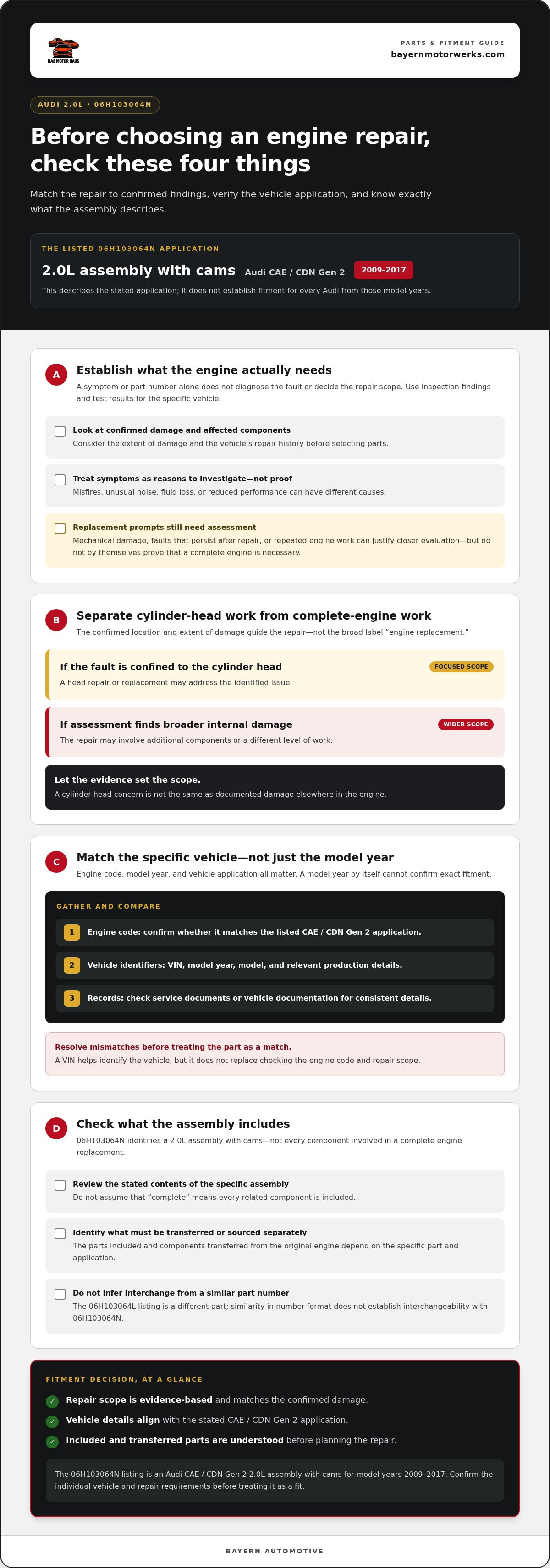
A careful order starts with the vehicle and repair details, not the model year alone. The 06H103064N is a 2.0L DAS MOTOR HAUS assembly with cams for Audi CAE/CDN Gen 2 applications from 2009 to 2017. That range describes the stated application, but it doesn’t establish compatibility with every vehicle configuration in those years. Use this checklist before deciding whether the Audi 2.0L engine replacement 06H103064N is the right match.
- 1. Document the vehicle. Record the VIN, model year, vehicle model, and production details available in the vehicle records. Keep the diagnosis and relevant service history together so the part comparison reflects the actual car and repair need.
- 2. Compare the engine code. Locate the documented engine code and compare it with the listed CAE/CDN Gen 2 application. Don’t treat a matching year or model name as a substitute for engine-code alignment.
- 3. Verify the repair scope. Confirm whether the diagnosed issue calls for a cylinder-head assembly or a broader engine replacement. Compare the exact 06H103064N reference with the planned repair rather than relying on symptoms or a similar-looking part number.
- 4. Plan installation. Establish which parts are included, which original components may need to transfer, and which items must be sourced separately. Plan installation and post-installation checks around the vehicle-specific repair scope.
Which vehicle details should buyers gather?
Have the VIN, model year, model, and documented engine code ready in one place, along with the exact 06H103064N reference. Review those details against the vehicle’s service records and diagnosis. This gives you a clearer basis for evaluating fitment than a year-only search, since vehicles from the same model year can have different engine configurations.
What installation scope should be understood beforehand?
Read the assembly description precisely: it identifies a 2.0L DAS MOTOR HAUS assembly with cams. Don’t assume it includes components that aren’t stated. Before ordering, establish which parts are supplied, what must be transferred from the existing engine, and whether additional components are required for the documented repair. The installation plan should account for those distinctions and include appropriate checks after the work is complete.
Once your vehicle details, engine code, and repair scope align with the listed application, explore the supplied collection as part of your buying review. A complete set of vehicle and part details makes the decision more precise and helps prevent assumptions from driving the order.
Is the DAS MOTOR HAUS 06H103064N assembly the right next step?
The DAS MOTOR HAUS 06H103064N listing describes a 2.0L assembly with cams for Audi CAE/CDN Gen 2 applications from 2009 to 2017. It’s a candidate for buyers whose vehicle details and documented repair scope align with that application. It isn’t a blanket fit for every Audi 2.0L vehicle, and the listing shouldn’t be mistaken for a complete-engine description.
The central buying question is whether this specific assembly matches the vehicle and the work identified by its assessment. Confirm fitment, establish what the assembly contains, and determine which components may need to transfer or be sourced separately. Review the product description carefully before placing an order.
Who should consider the listed assembly?
Consider it if the vehicle’s documented engine code and other identifying details align with the stated CAE/CDN Gen 2 application, and the repair findings support the relevant replacement scope. If the assessment identifies an issue confined to the cylinder-head area, compare a cylinder-head repair with broader replacement before choosing parts. The right path follows the findings, not the assumption that a serious fault always requires the largest assembly.
A matching model year alone isn’t enough. Use the VIN, model, engine code, service documentation, and diagnosis together to judge whether the listing is a suitable candidate. The Audi 2.0L engine replacement 06H103064N decision should rest on this vehicle-specific comparison, not on a general search result or a similar part number.
What is the next step before purchase?
Bring the key details together before reviewing the listing: VIN, model year, vehicle model, engine code, and documented repair findings. Then compare the exact 06H103064N reference and CAE/CDN Gen 2 application with those records. Read the product description carefully and don’t assume unmentioned components, transfer parts, or installation requirements.
A sound purchase decision accounts for fitment and scope together. If both align, browse the collection as the next step in your review. Browse the collection.
Make the fitment decision with confidence
The 06H103064N listing identifies a 2.0L DAS MOTOR HAUS assembly with cams for Audi CAE/CDN Gen 2 applications from 2009 to 2017. That stated range is a starting point, not proof of fitment for every vehicle configuration. Compare the engine code and vehicle details, then match the part to the documented repair scope.
A cylinder-head concern doesn’t automatically call for complete engine replacement. The right path depends on confirmed findings, and the assembly description shouldn’t be mistaken for a complete-engine contents list. Before ordering, understand what’s included and what may need to transfer or be sourced separately.
Use those checks to decide whether the Audi 2.0L engine replacement 06H103064N is a suitable candidate for your application. To take the next step, browse the collection and review the listed assembly alongside your vehicle and repair information. Careful comparison helps you make a more informed parts decision.
Frequently Asked Questions
Is 06H103064N compatible with every Audi 2.0L engine?
No, universal compatibility shouldn’t be assumed. The stated application is Audi CAE/CDN Gen 2, model years 2009 to 2017. For an Audi 2.0L engine replacement 06H103064N, compare the vehicle’s VIN, documented engine code, and product reference rather than relying on displacement or model year alone. The stated application doesn’t establish fitment for every vehicle configuration or extend to other engine codes.
Which Audi engine codes are listed for the 06H103064N assembly?
The listed application is Audi CAE and CDN Gen 2 from 2009 to 2017. If another listing names different engine codes, those details apply to that listing and don’t establish compatibility with 06H103064N. Compare the exact part reference with your vehicle’s documented engine code before treating the assembly as a fitment candidate.
What is included with the 06H103064N DAS MOTOR HAUS assembly?
The description identifies a 2.0L DAS MOTOR HAUS assembly with cams. It doesn’t establish that additional components, accessories, or installation hardware are included. Review the product description to understand its stated scope, and don’t assume unmentioned parts come with it. Likewise, don’t presume existing components can be reused or transferred; those decisions depend on the assembly, vehicle, and repair plan.
Should I replace the complete engine or repair the cylinder head?
The appropriate repair depends on documented findings for the specific vehicle, not a symptom or part number alone. An issue confined to the cylinder-head area calls for a different repair discussion than confirmed broader engine damage. A cylinder-head problem doesn’t automatically require complete engine replacement. Compare the repair scope with the actual findings, and consult the related cylinder-head guide for a focused discussion.
How do I check 06H103064N fitment using my VIN?
Gather the VIN, model year, vehicle model, and documented engine code, then compare them with the 06H103064N reference and its stated CAE/CDN Gen 2, 2009 to 2017 application. The VIN helps identify the vehicle, but a shared model year or 2.0L displacement alone doesn’t prove compatibility. Keep the diagnosis and service records with these details so the part comparison reflects the vehicle’s actual configuration.
Does 06H103064L interchange with 06H103064N?
Similar numbering doesn’t establish interchangeability. The 06H103064L listing describes a different part from the 06H103064N. Any engine codes or vehicle applications named for the 06H103064L listing belong to that part description; they aren’t proof of fitment for 06H103064N. Use the exact part reference and the vehicle’s documented engine code to assess the stated application.
Can existing components be transferred to a replacement engine assembly?
That depends on the assembly’s stated contents, the vehicle, and the repair plan. The description identifies a 2.0L assembly with cams, but doesn’t specify which other components are included, reusable, or transferable. Review the product description and plan the required work around the vehicle’s documented application. Don’t assume existing parts will fit or can be reused without assessing their condition and compatibility.